Why E-Commerce Website Security Matters
Your customers entrust you with confidential information such as:
- Personal information
- Phone numbers
- Emails
- Shipping information
- Payment information
This information falling into the wrong hands can cause your customers to lose faith in your organization, thus leading to a loss in sales and a bad reputation for your company.
Security on your website allows you to:
- Gain customer trust
- Get better rankings on Google
- Protect your customers' information
- Avoid hacking
- Protect yourself from financial losses
- Boost conversions
- Develop your brand
Website security is not an option anymore; it is necessary.
Common Security Threats for E-Commerce Websites
1. Phishing attacks
Hackers utilize fake emails and log-in pages to penetrate customers' credentials as well as payment details. A phishing attack can bring about devastating effects to the customer as well as to finances.
2. SQL Injection
This kind of attack involves the use of malicious SQL code sent through form submissions or URL strings to access confidential information from the database.
3. Cross-Site Scripting
The attackers will include malicious scripts in the web page code that is run by the user’s browser. The malicious scripts may be used for cookie theft, redirecting or modifying web site content.
4. Payment Fraud
Inadequate payment security enables hackers to steal credit card information in online transactions. Payment gateways are used to secure such payments.
5. Distributed Denial-of-Service Attacks
During a DDoS attack, the site becomes inundated with intense traffic that makes it either slow or non-responsive. A prolonged period of being unable to access the site means losses and irate clients.
6. Ransomware Attacks
An illegal software program may infect the e-commerce server using outdated plugins and corrupted files, thus preventing one from accessing business information until payment is made.
7. Weak authentication
The use of weak passwords makes it easy for hackers to break into your online shop. The adoption of strong passwords helps increase security measures.
8. API security issues
Plugins, themes, or other integrations from third-party sites can be a source of hidden vulnerabilities in your website. Updates help eliminate these vulnerabilities.
Best Security Tips for E-Commerce Websites
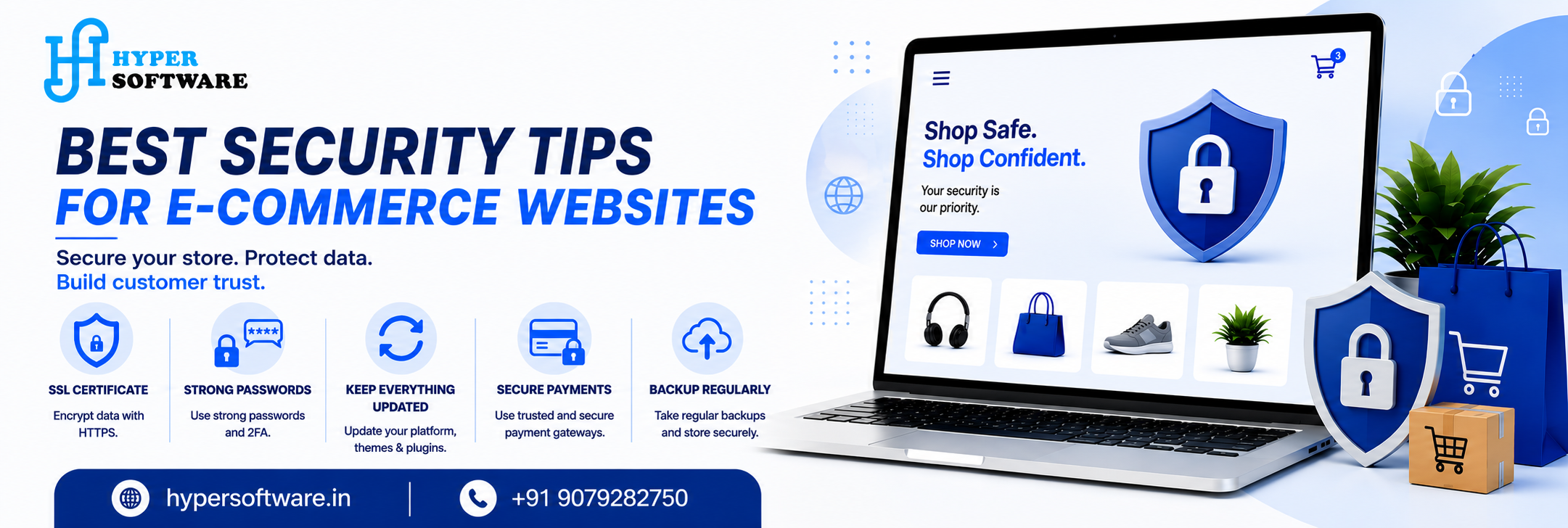
1. HTTPS and SSL Encryption
You should ensure that the website has HTTPS and SSL encryption so that the data that is passed between the clients’ computers and the server is encrypted. The data may include user information and credit card information.
2. Multi-Factor Authentication
Multi-factor authentication should be applied to enhance security of the website. It will make it very hard for anyone to gain access to the account.
3. Update Software and Plugins
It is essential to ensure updates to your CMS, themes, plugins, and server software in order to address any security vulnerabilities. Updated software can protect you from hacking attempts.
4. Install a Secure Payment Gateway
Make sure to use the payment gateway that satisfies the PCI DSS security standards. It will help you to protect customer finances.
5. Regularly Conduct Security Audits
Undertake regular scans for vulnerabilities and penetration tests to detect any security weaknesses that need to be addressed. This will help keep a solid security posture.
6. Develop Password Policies
Use complex passwords for the customer side and administrative purposes while recommending that passwords are changed from time to time.
7. Regular Backing-Up of Website
Regular backing-up of website files and databases should be done in an automatic way. Regular backing-up helps you recover your website in case of any attack from hackers or any other problems.
8. Continuous Monitoring of Website
The activity of your website should be continuously monitored using online security tools that will help you detect any hacking attempt.
Benefits of a Secure E-Commerce Website
1. Establishes Customer’s Trust
An e-commerce website that is secured will build trust within customers about their information being safe. Such trust will encourage them to make repeat purchases.
2. Secures Confidential Information
Security ensures that any confidential information about customers, transactions, and other business related data is kept safe from hackers.
3. Increases Sales and Conversion Rates
A secure environment is necessary to persuade the consumer to buy the products since they feel secure when paying. There is no cart abandonment on a secure website, which increases sales.
4. Improves the Corporate Brand Image
Firms with a high level of security in their websites are professional and are trusted. Website security enhances the reputation of the company.
5. Provides Business Continuity
Good security systems help reduce the chances of interruptions due to malware or cyberattacks. In this way, you can ensure smooth functioning of your business through your website.
Common Security Mistakes Businesses Make
Businesses unwittingly put themselves at risk from cyber threats.
Don’t make these mistakes:
- Using weak passwords
- Neglecting software updates
- Not backing up websites
- Using untrusted plugins
- Sharing admin login details
- Failing to use SSL certificates
- Using old payment methods
- Allowing all staff administrative rights
- Ignores warning about security
- Picking cheap web hosting
Making just one of these mistakes will provide an avenue for hackers to enter.
Expert Tips to Keep Your Online Store Safe
Here are some steps suggested by seasoned programmers:
- Perform a security audit once every month.
- Keep an eye on Google Search Console for security breaches.
- Eliminate plugins that you do not need.
- Automate your security updates when you can.
- Use extensions only from reliable sources.
- Test your site backups periodically.
- Limit the number of login attempts to your site.
- Make sure your server has firewalls turned on.
- Ensure that customer databases are encrypted.
- Monitor the performance of your website.
It is important to treat your website’s security as an investment.
Why Choose Hyper Software for E-Commerce Website Security?
Hyper Software knows that your website is not just a place for an online shop, it is the core of your business.
Our professional team builds secure and effective e-commerce websites that will help you protect your customers and increase your profits.
Creation of safe e-commerce sites
- SSL certificate installation
- Payment gateway installation
- Site security audit
- Malware removal
- Site maintenance
- Performance optimization
- Security of servers
- Backup services
- Migrating sites
- Software development
- Support
We follow all the current web security guidelines and SEO requirements strictly. Reach out to us to build an effective website for your online business.
Frequently Asked Questions (FAQs)
Qus1 Is HTTPS required for an e-commerce website?
Answer: Yes, because HTTPS helps encrypt customer details and builds their trust.
Qus 2 At what interval should an e-commerce website be updated?
Answer: You need to check for updates frequently and install security updates when they are available.
Qus 3 Can small businesses be hacked by people?
Answer: Yes. Small businesses can easily fall prey to hackers as they lack proper security protocols compared to large organizations.
Qus 4 Does security impact SEO?
Answer: Yes. The reason being, secure websites offer a better experience to the users.
Qus 5 What is the main risk to e-commerce security?
Answer: Weak password, old software, plugins, and hosting services can lead to security risks.