
Website launch hone ke baad customer enquiries me noticeable increase hua. SEO aur speed optimization ka result clearly dekhne ko mila. Excellent work.

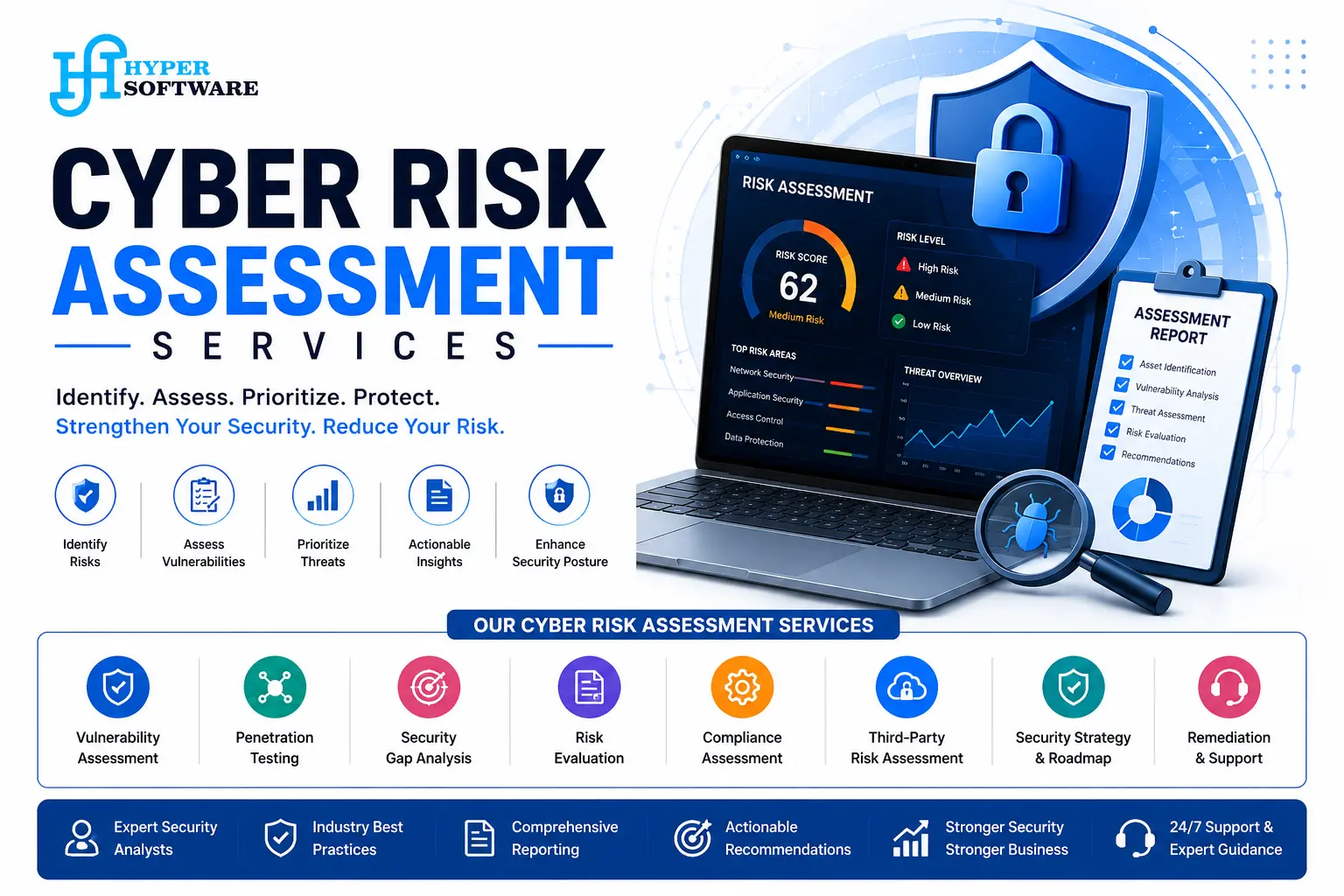
A cyber risk assessment tells you, in plain terms, where your business is exposed to a cyberattack, how bad it would be if that gap got exploited, and what to fix first. It's not a scan that spits out 200 warnings and leaves you guessing. Done properly, it's a prioritized map of your real risk, backed by a framework, and followed by a plan you can actually act on.
At Hyper Software, we've built and secured systems for businesses across industries since 2020. This page walks through what a cyber risk assessment covers, how our process works, what it costs, and what to watch out for if you're comparing providers.
A cyber risk assessment is a structured evaluation of your organization's IT systems, data, applications, and processes to identify vulnerabilities, work out the likelihood that each one gets exploited, and measure the impact if it does. The end result is a risk register: a ranked list of what's wrong, how urgent it is, and what to do about it.
It's easy to confuse this with other security services, so here's the quick distinction:
Most businesses need the risk assessment first. It tells you where to point the sharper tools, so you're not paying for a pentest on a system that was never your biggest exposure to begin with.
Get Free Consultation Within Minutes
Nobody budgets for a cyber risk assessment until something goes wrong, and by then it's a lot more expensive. A few reasons this shouldn't wait:
Not every business needs the same depth. We scope the right type based on your size, industry, and what's driving the request.
We run every assessment through the same five stages. You'll know exactly what's happening and when.
Most baseline assessments for a small-to-mid-sized business take 5–10 working days. Compliance-driven or multi-cloud assessments can run 3–6 weeks depending on scope.
We map assessments to whichever framework fits your obligations and industry, including:
We'll recommend the right one (or combination) once we understand what you're being asked to demonstrate compliance with.
If you're operating in India or serving Indian customers, two things matter more than most generic guides mention:
CERT-In. As the national cybersecurity authority, CERT-In has issued directions requiring organizations to report certain cybersecurity incidents within defined timelines, and has published guidelines for how cybersecurity audits and assessments should be structured, including for CERT-In empanelled auditors.
DPDP Act, 2023. India's data protection law applies to any organization, including foreign companies, that processes personal data of individuals in India. Organizations classified as Significant Data Fiduciaries face extra obligations, including periodic security assessments and, for high-risk processing, Data Protection Impact Assessments. Penalties for non- compliance can be severe, so this isn't a box-ticking exercise.
If your business also falls under a sector regulator, RBI for finance, SEBI for capital markets, IRDAI for insurance, those add sector-specific requirements on top. We scope your assessment to cover whichever combination applies to you, so you're not paying for two separate audits later.
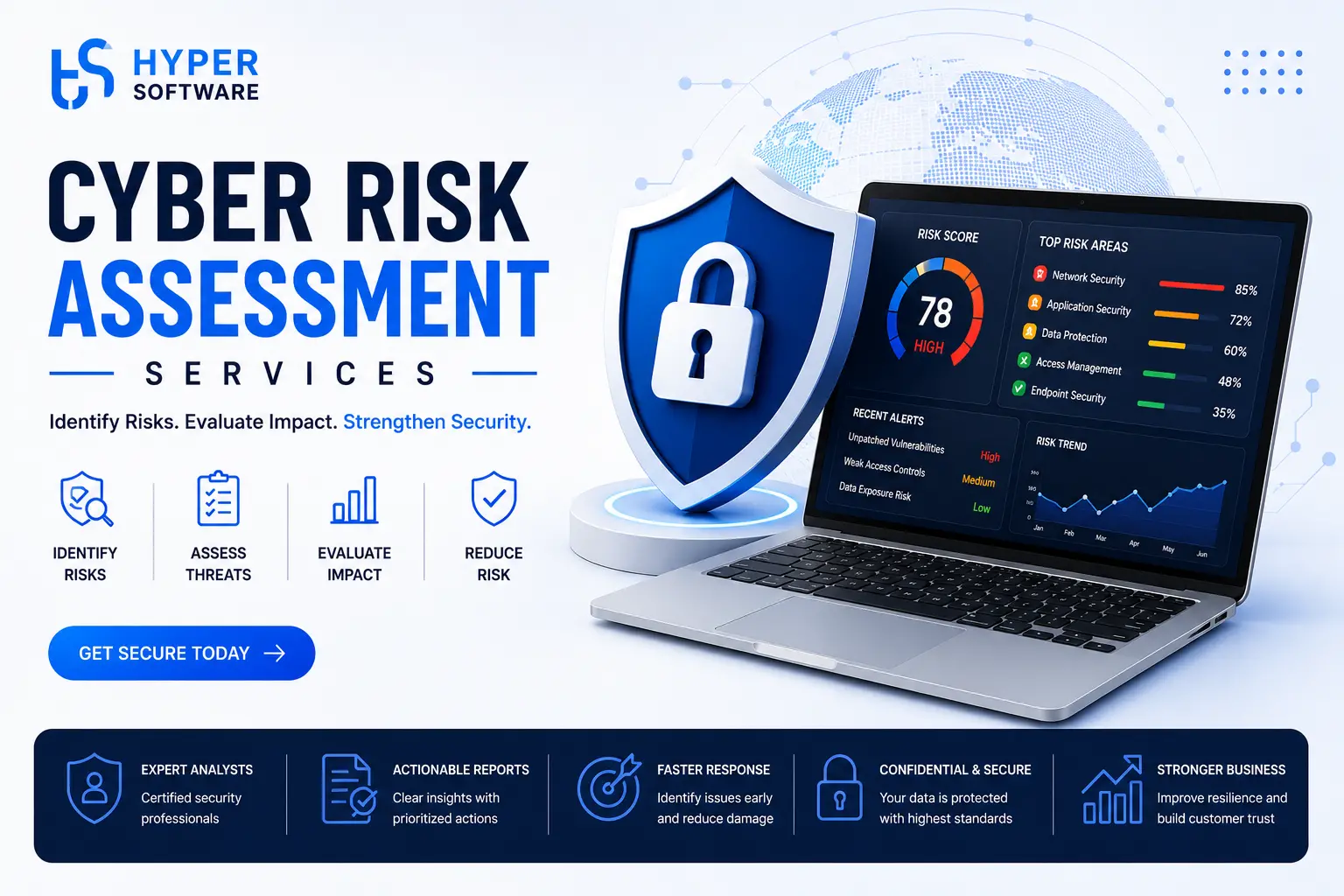
A Jaipur-based e-commerce business came to us after a payment gateway partner flagged their site during a routine vendor security review. They didn't have a dedicated IT security consultation person, just a small dev team focused on features and uptime.
We ran a baseline risk assessment scoped around their web application, hosting environment, and payment flow. The findings weren't dramatic, no active breach, but the risk register told a clear story: an admin panel was reachable from the open internet with no IP restriction, session tokens weren't expiring properly, and a third-party analytics script had far more access to the page than it needed.
None of these would have shown up on a generic malware scan. We prioritized the fixes, the admin panel restriction and session handling went first since both were high-likelihood, high-impact, and had the whole thing resolved within two weeks. Their next vendor review passed without a follow-up call.
That's the real value of an assessment: catching the quiet stuff before it becomes the loud stuff.
You can attempt a basic self-assessment. Whether that's enough depends on what's at stake.
| Criteria | Doing It Yourself | Hiring a Professional Team |
|---|---|---|
| Cost | Free tools, but real time cost from your team | A few thousand dollars upward, scoped to your business size |
| What it catches | Known, obvious gaps if you know what to look for | Configuration issues, business-logic risks, and security gaps that are easy to miss |
| Compliance Value | Rarely satisfies CERT-In, DPDP, or client audit requirements | Produces professional reports that meet most compliance and vendor requirements |
| Objectivity | Internal teams may overlook their own blind spots | Independent experts identify risks and improvement opportunities |
| Best Suited For | Very small businesses with minimal data exposure | Businesses handling customer data, payments, healthcare, finance, or regulated information |
| What Can Go Wrong | Missed vulnerabilities, false sense of security, and no clear remediation plan | Choosing an inexperienced provider instead of a qualified security partner |
If you're a two-person shop with a brochure website and no customer data, a checklist and some care might genuinely be enough. The moment you're handling payments, personal data, or client contracts with security clauses, bring in outside expertise.
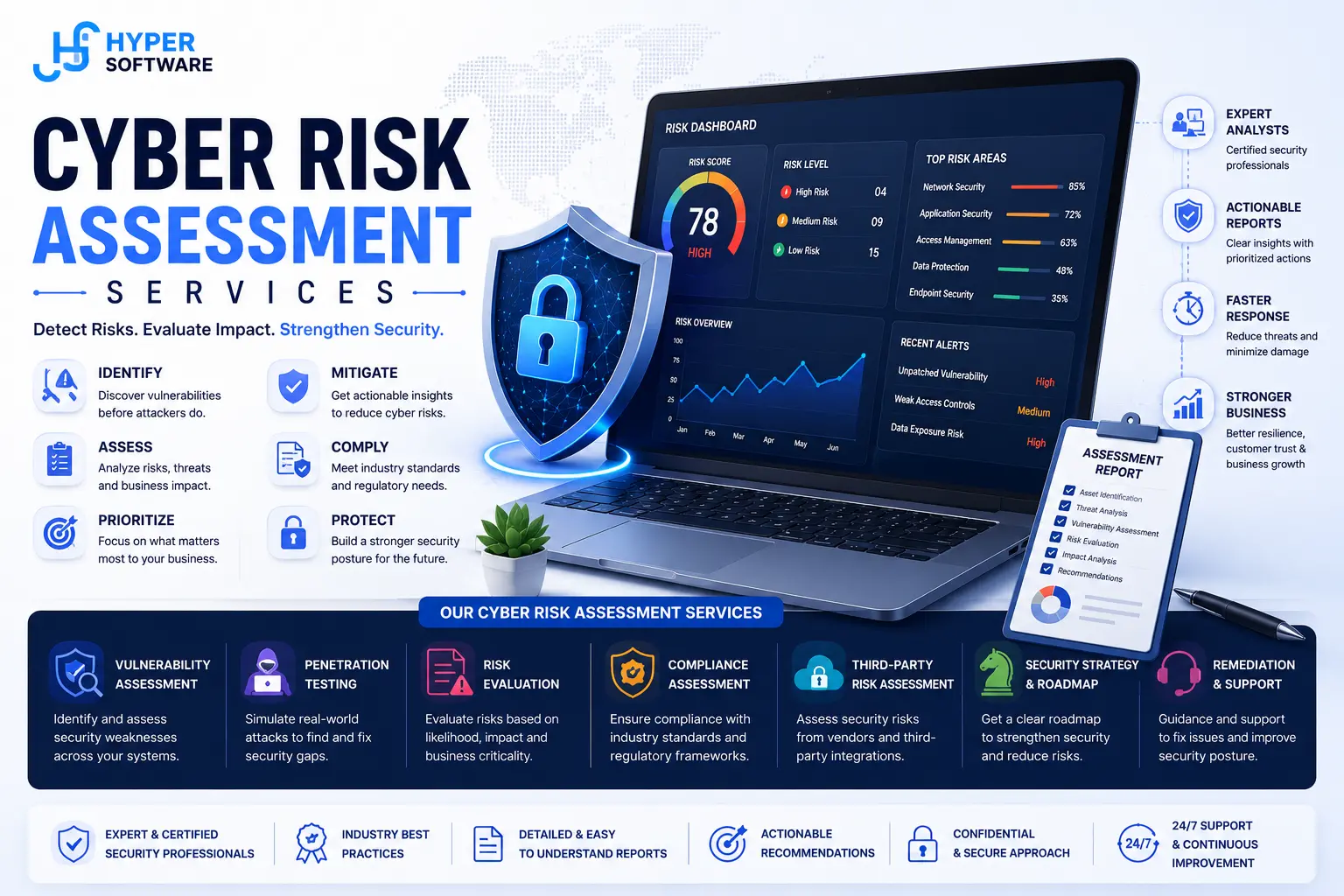
Pricing depends heavily on scope, but here's a realistic range based on current industry benchmarks:
What pushes cost up: the number of systems in scope, whether cloud infrastructure across multiple providers is involved, how mature your current security posture already is (a greenfield environment takes longer to assess than one with existing documentation), and whether the assessment needs to satisfy a specific regulatory framework versus a general baseline.
Exact INR pricing for your business depends on your specific environment. We scope every engagement individually rather than quoting a flat number that doesn't reflect your real exposure, contact us for a free scoping call and a firm quote.
A cyber risk assessment is a structured review of your IT systems, applications, and processes to find security weaknesses, judge how likely each one is to be exploited, and rank them by real business impact. It ends with a prioritized action plan rather than just a list of problems.
A risk assessment maps your entire risk picture across systems, policies, and people. A penetration test actively tries to exploit specific weaknesses to prove they're real. Most businesses run a risk assessment first, then use it to scope a focused pentest if one is needed.
A baseline assessment for a small-to-mid- sized business usually takes 5–10 working days. Compliance-driven or multi-cloud assessments can take 3–6 weeks depending on scope and system complexity.
It depends on your sector and data handling. CERT-In guidelines apply broadly to incident reporting and audit practices, the DPDP Act 2023 applies to anyone processing personal data of Indian residents, and RBI, SEBI, or IRDAI add extra requirements for regulated sectors like finance and insurance.
Costs vary by scope: roughly $2,000– $10,000 for a small business with limited systems, $10,000–$35,000 for a mid-sized business with compliance requirements, and $50,000 or more for large, multi-cloud enterprises. Get a scoping call for an accurate quote based on your actual environment.
At minimum, once a year. It should also be repeated after major changes: a new vendor with system access, a cloud migration, a new product launch, or after any security incident, even a minor one.
For a very small setup with minimal customer data, a basic self-check using free tools and checklists can be a reasonable start. Once you handle payments, personal data, or have contractual security obligations to clients, an outside professional assessment catches far more than an internal team typically will.
A proper report includes a ranked risk register, an executive summary for leadership, a framework-mapped compliance summary, a prioritized remediation roadmap with timelines, and a live walkthrough session, not just a raw list of technical findings.
Common frameworks include the NIST Cybersecurity Framework and SP 800-30, ISO 27001 and ISO 31000, CERT-In guidelines and DPDP Act requirements for India, RBI's cybersecurity framework for regulated finance, and CIS Controls for a simpler, prioritized technical baseline.
Yes. Insurance underwriters increasingly ask detailed security questions during renewal. A recent, documented risk assessment can speed up underwriting and, in some cases, affect your premium by demonstrating active risk management.
Every engagement ends with:
We've run risk assessments for e-commerce platforms, fintech and payment-adjacent businesses, healthcare-adjacent SaaS, professional services firms, and manufacturing companies moving operations onto connected systems. If your business runs on the internet in any meaningful way, from a marketing website to a full transaction platform, the underlying risk questions are the same, only the scope changes.
A vulnerability assessment is a narrower, mostly technical scan for known weaknesses in specific systems. A cyber risk assessment is broader, it includes vulnerability findings but also weighs business impact, policies, vendor risk, and compliance obligations.
Any business that shares data or system access with vendors, payment processors, cloud providers, marketing tools, outsourced developers, should assess that risk. Under the DPDP Act, data fiduciaries are also expected to ensure their processors meet adequate security standards.
A Significant Data Fiduciary is an organization the government designates as higher-risk based on factors like data volume and sensitivity. If your business qualifies, you face added obligations, including periodic security audits and Data Protection Impact Assessments for high-risk processing, which should shape how your risk assessment is scoped.
Yes, effectively. ISO 27001 requires a documented risk assessment as part of building an Information Security Management System. Running one early, aligned to ISO 27001's methodology, saves rework later in the certification process.
You get the report and roadmap, then it's your call how to proceed. Many businesses ask us to support remediation directly, others take the roadmap to their internal team. Either way, a follow-up re-assessment after fixes are implemented confirms the gaps are actually closed.
Have questions or need expert guidance? Our team is ready to help you with the right technology solutions for your business.