Website design se lekar final launch tak pura process bahut smooth raha. Team har update time par deti rahi aur support bhi outstanding mila.

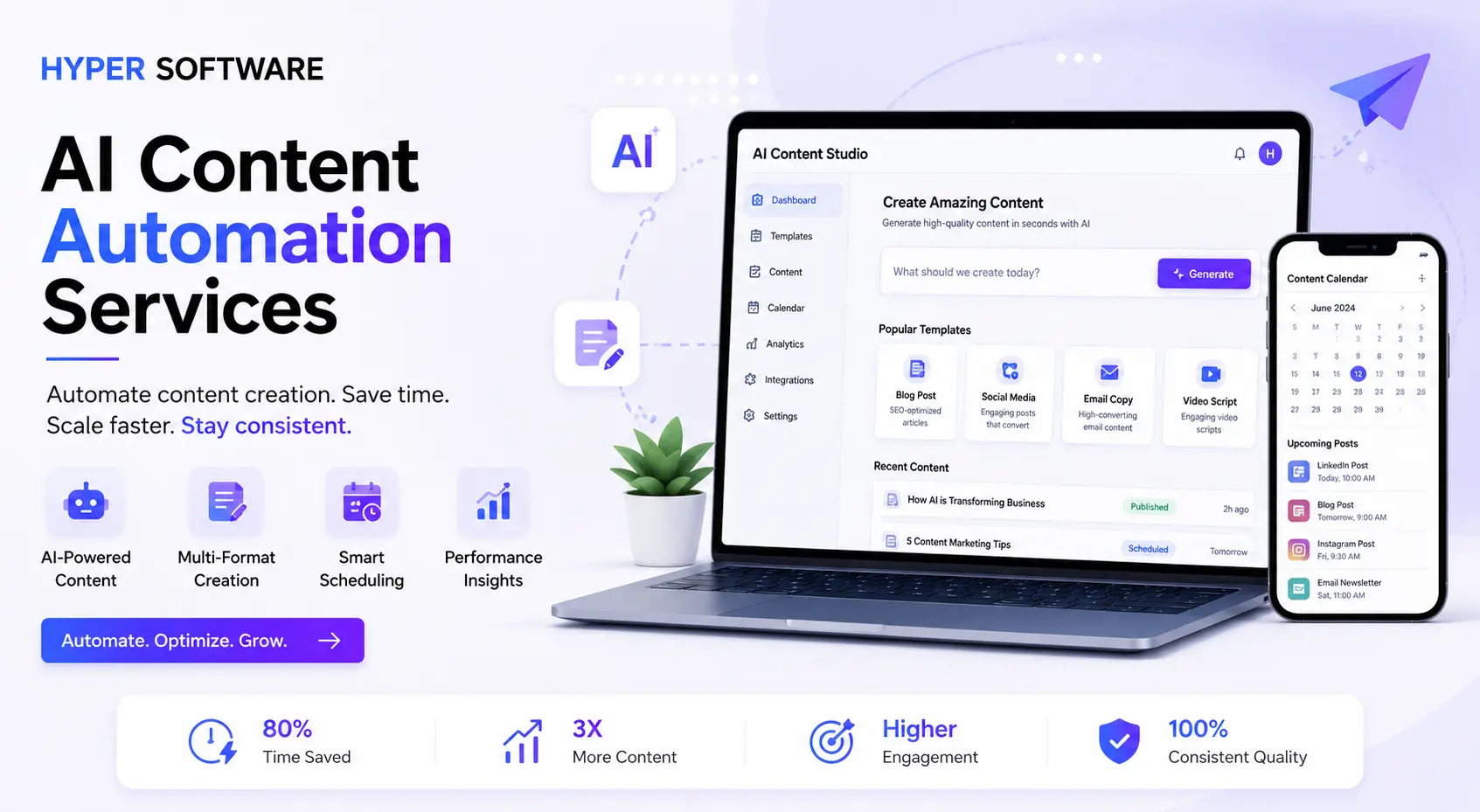
If your team spends more hours formatting and scheduling content than actually thinking about strategy, you don't have a content problem. You have a workflow problem. AI content automation fixes that by combining generative AI integration with structured workflows to plan, write, edit, and publish content in a fraction of the time, without turning your brand voice into generic robot-speak.
Hyper Software builds these systems for businesses that want to publish more, spend less time on repetitive writing tasks, and still sound like themselves. Here's exactly what that looks like, what it costs, and when it's worth it.
AI content automation is the use of artificial intelligence tools, connected through a workflow, to handle the repetitive parts of content production: research, drafting,
formatting, and often scheduling and publishing too. It's not the same thing as "typing a prompt into ChatGPT." A real automation system chains steps together, so a topic goes in one end and a formatted, on-brand, SEO-ready draft comes out the other, with a human checking it before it goes live.
Think of it this way: a single AI writing tool is a hammer. AI content automation is the whole workbench, the jigs, and the process that turns raw wood into a finished piece of furniture, every single time, without you re-inventing the process for each new item.
It typically covers:
What it isn't: a system that lets you skip editing entirely. Content Marketing Institute research found that 41% ofAI-generated content still needed significant revision for brand voice, and another 34% needed minor edits before it was ready to publish. <cite index="13- 1">Content Marketing Institute research reveals an important caveat: 41% ofAI-generated content pieces required significant revision for brand voice alignment, with another 34% needing minor adjustments before publication</cite>. That's not a flaw in the technology. It's simply how a good system is supposed to work: AI drafts, a person makes the final call.
Get Free Consultation Within Minutes
A well-built system usually runs through five stages. Here's roughly how long each one takes once the system is set up (compare that to writing everything by hand, which typically runs 9-13 hours per article from scratch).
Total time: roughly 90 minutes to two hours per piece, once the system is live, compared to a full day of manual work for the same output. The setup itself, meaning the brand voice training, tool integration, and workflow mapping, usually takes anywhere from two to six weeks depending on how many content types you need automated.
Most pages on this topic only list the upside. Here's the full picture.
| Benefits | Drawbacks |
|---|---|
| Cuts production time dramatically, often by more than half | Needs a real editing step, or quality drops fast |
| Keeps output consistent even when your team is busy or short-staffed | Brand voice can drift if the system isn't trained properly |
| Makes it realistic to cover more topics, formats, and channels | Some topics (legal, medical, finance) need extra human review and sourcing |
| Lowers cost per piece of content over time | Upfront setup takes real effort: prompts, brand training, workflow design |
| Frees your team to focus on strategy instead of repetitive drafting | Readers do notice fully unedited AI content, and engagement can drop when they spot it |
That last point matters. Recent research found that 52% of consumers reduce engagement with content they believe is AI-generated, even before they confirm it. <cite index="12- 1">Research shows 52% of consumers reduce engagement with content they believe is AI- generated, even before confirmation. This "AI suspicion penalty" affects click-through rates, time-on-page, and conversion metrics</cite>. This is exactly why the human-edit step in the workflow above isn't optional. It's the difference between content that reads like it came from a real business and content that reads like it came from a machine.
The good news on the search side: Google has been clear that it doesn't penalize content for being AI-assisted. It penalizes content that's unhelpful, thin, or unoriginal, whatever wrote it. Data backs this up too, one 2026 analysis found close to zero correlation between AI content and ranking penalties, while content that blends AI drafting with human editing actually outperformed both pure AI and pure human content on bounce rate and conversions. <cite index="14-1">Google does not penalize AI content. Near-zero correlation (0.011) between AI content and ranking penalties. Google Search Central - AI content guidance penalizes low quality, not AI origin. AI content with human editing outperforms both pure AI and pure human content. 73% bounce rate reduction with human refinement</cite>.
This is the question almost every business asks eventually, and there's no single right answer. It depends on your volume, your team's time, and how much brand risk you're willing to carry.
If you're publishing a handful of posts a month and you enjoy the process, DIY tools are a perfectly reasonable place to start. Once content becomes a real part of how you get customers, and it needs to work across blog, social, and email without your team burning hours on formatting, that's usually the point where a managed system starts paying for itself.

Costs vary a lot depending on volume, number of content types, and how much customization your brand needs, so treat the numbers below as general market ranges, not a fixed quote.
To put the return in perspective: one 2026 analysis found that a 5-person marketing team saved around 28 hours a month after implementing AI content automation, which worked out to roughly a 7x return once tool costs were factored against the value of the time saved. <cite index="13-1">A 5-person marketing team implementing AI automation typically saves 28 hours monthly (5.6 hours per person). At a $75/hour blended rate, that's $2,100 in monthly value against platform costs of $249-$499/month</cite>. That kind of math is exactly why we build a custom plan rather than sell a one-size-fits-all package. Your ideal setup depends on how many content types you need and how your team currently spends its time.
Want an exact number for your business? Call us at +91 9079282750 or visit hypersoftware.in for a free content automation audit. We'll tell you honestly whether automation makes sense for your volume before you spend a rupee.

We don't lock clients into one vendor. Depending on your needs, a system we build might combine:
The exact stack depends on your existing tools. If you already use a CMS or CRM, we build around what you have rather than asking you to switch everything.

We've seen the same handful of mistakes come up again and again with clients who tried to build this themselves before coming to us:
It shouldn't, and the data backs that up. Content with human editing consistently outperforms fully automated content on engagement and trust. The best setups use AI for repetitive drafting and keep people for judgment, fact-checking, and final voice.
Blog posts, social media captions, email sequences, product descriptions, ad copy, and landing page copy are the most common. Highly technical, legal, or medical content needs heavier human review regardless of the workflow.
It can, if the system isn't trained on your actual brand voice and nobody edits the output. A properly built system uses real writing samples from your business and includes an editing step specifically to catch generic phrasing.
Most setups take two to six weeks, depending on how many content types and channels you need covered and how much brand voice training is required.
For very low volume (a few posts a month), DIY tools are often enough. Once you need consistent output across multiple formats and channels, a managed system usually saves more time and money than piecing together tools yourself.
Often, yes. Studies show a meaningful share of readers reduce engagement when they suspect content is AI- generated, which is exactly why human editing and real brand voice matter more than the writing tool itself.
Publishing without a human review step. That's the single most common cause of factual errors, off-brand tone, and generic-sounding content.
Yes, when it's built correctly. A good system pulls keyword and competitor data at the research stage, so the outline and draft are structured around search intent from the start, rather than optimized after the fact.
Yes. We work with clients globally and scope every project around your market, audience, and content needs, not just clients based in India.
After setup, your team typically reviews and lightly edits AI-drafted content on a set schedule, whether that's a few times a week or daily, while the system handles research, drafting, and formatting in the background.
A Jaipur-based B2B services client came to us publishing maybe one blog post a month, whenever someone on their small team found a spare afternoon. Their website traffic had been flat for almost a year. They didn't need a bigger team. They needed a system.
We audited their existing content process first: how ideas got picked, who wrote what, and where things stalled (usually at the editing stage, since nobody wanted to be the one to finish someone else's draft). We built a workflow that pulled weekly topic ideas from real customer questions their sales team was already hearing, generated structured drafts against those briefs, and routed every draft to one person for a 20-minute edit pass before publishing.
Within the first two months, they went from one post a month to three a week, across blog and LinkedIn, without hiring anyone new. Their existing marketing coordinator now spends her time editing and planning instead of starting every piece from a blank page. That's the actual promise ofAI content automation: not zero effort, but effort that goes toward decisions instead of repetition.
Founded in 2020 and based in Jaipur, Rajasthan, Hyper Software has spent years helping businesses move through digital transformation, not just with content, but with the websites, software, and automation that support it. That matters here, because a content automation system that isn't connected to your actual website, CRM, or CMS is just another disconnected tool. We build the workflow and the technical foundation underneath it, since we're the same team that builds websites, custom software, CRM and ERP systems, and business automation for our clients.
We serve businesses globally, not just in India, and we scope every project around your actual content volume and goals rather than selling a fixed package that doesn't fit.
AI content automation is the use of artificial intelligence combined with workflow tools to research, draft, edit, and publish content with much less manual effort. It covers blogs, social posts, emails, and product copy, usually with a human reviewing each piece before it goes live.
No. Using ChatGPT for a single draft is one step. AI content automation connects research, drafting, editing, formatting, and publishing into one repeatable workflow, so you're not starting from scratch every time.
No, not for being AI-generated. Google's own guidance focuses on whether content is helpful and original, not on how it was produced. Data shows almost no correlation between AI content and ranking penalties, but thin or unedited content of any kind still performs poorly.
Basic tools start around $0-$50 a month, mid-tier platforms run roughly $50-$300 a month, and a fully managed system built around your workflow is custom-quoted based on your content volume and channels.
Once a system is set up, most businesses cut per-article production time from around 9-13 hours down to 1.5-2 hours, mostly by automating research, outlining, and first drafts while keeping human editing in place.
Have questions or need expert guidance? Our team is ready to help you with the right technology solutions for your business.