
Website design se lekar final launch tak pura process bahut smooth raha. Team har update time par deti rahi aur support bhi outstanding mila.

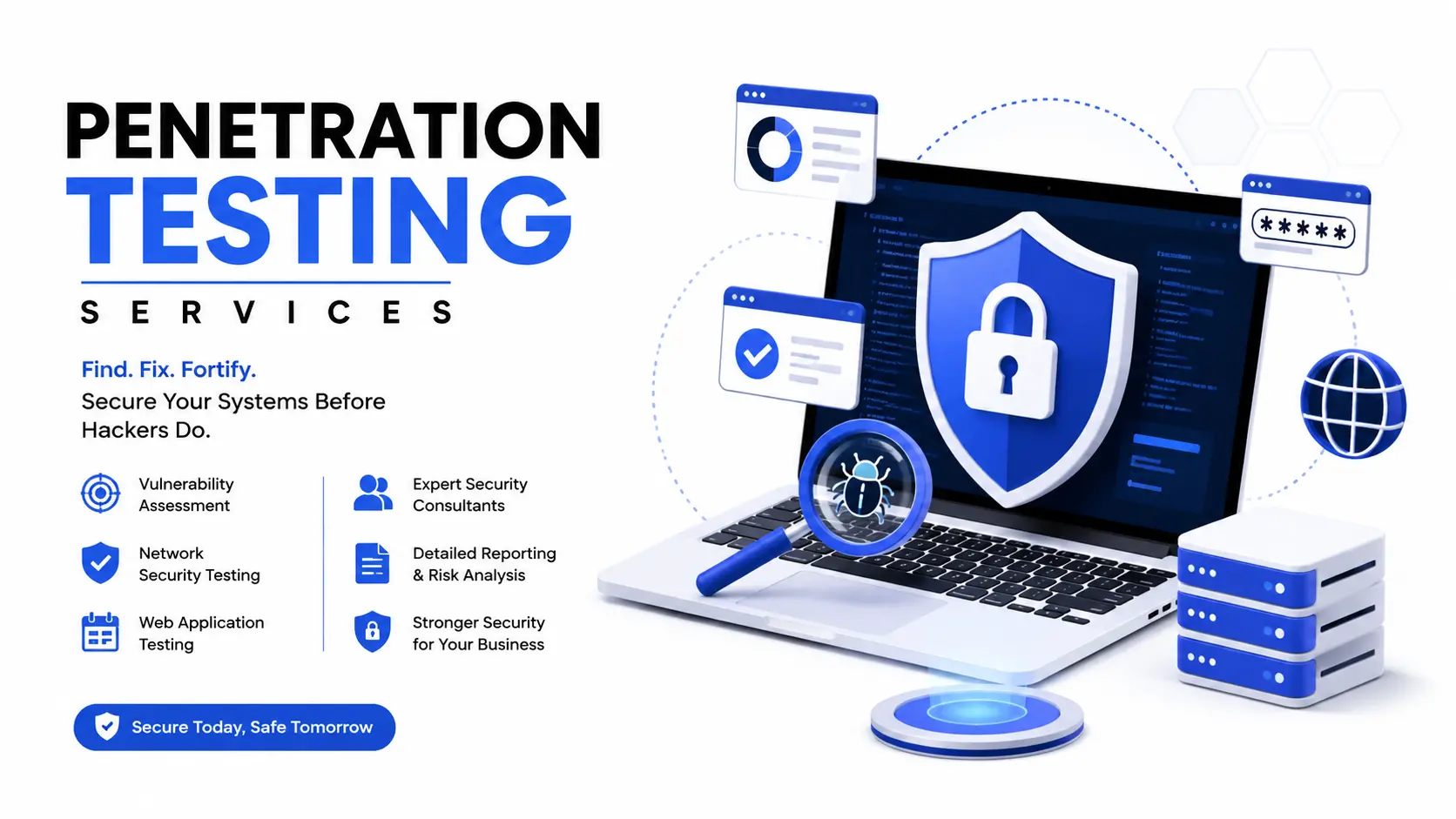
Penetration testing is a controlled, authorized simulated attack on your systems, run by security professionals who try to break in the same way a real hacker would. Unlike an automated scan that just lists possible weak spots, a pen test proves which ones are actually exploitable, how far an attacker could get, and what it would cost your business if they did.
At Hyper Software, we run penetration tests for websites, web applications, networks, cloud infrastructure, APIs, and mobile apps for businesses across India and internationally. You get a clear, prioritized report and a team that explains every finding in plain language, not just a PDF full of jargon. Call +91 9079282750 or visit www.hypersoftware.in to book a scoping call.
Penetration testing (also called pen testing or ethical hacking) is the practice of legally attacking your own systems to find security holes before criminals do. A tester acts like a real attacker: gathering information, probing for weak points, and then actively exploiting anything they find, all within an agreed scope and with your written permission.
It's not guesswork. Testers follow structured methodologies, most commonly the OWASP Testing Guide for web applications, PTES (Penetration Testing Execution Standard) for broader engagements, and NIST SP 800-115 for infrastructure. That structure is what separates a real pen test from someone poking around with a free tool for an afternoon.
The goal isn't to embarrass your team. It's to answer one question honestly: if someone wanted to break into this system today, could they, and how?
Most breaches don't start with some brilliant zero-day exploit. They start with an unpatched plugin, a weak password policy, an exposed admin panel, or a misconfiguredcloud bucket that's been sitting there for months. A pen test finds exactly that kind of thing, before it turns into a headline.
Get Free Consultation Within Minutes
They're about to sign a big client and the client's security consultation team wants proof of testing
before the contract closes.
One thing we tell every client honestly: a pen test is a snapshot in time. It tells you what's true today. That's exactly why it needs to be repeated, not treated as a one-off box to tick.
This is the single most common point of confusion we run into, so let's clear it up properly.
|
VulnerabilityAssessment |
Penetration Testing |
|
|
What it does |
Scans systems and lists possible |
Actively exploits weaknesses to prove |
|
weaknesses |
real risk |
|
|
Method |
Mostly automated tools |
Manual testing by a human expert, tool- |
|
assisted |
||
|
Output |
Long list ofpotential issues |
Prioritized findings with proofof |
|
exploitation |
||
|
False positives |
Common |
Low — findings are verified, not just |
|
flagged |
||
|
Time required |
Hours to a day |
Several days to weeks depending on scope |
|
Best for |
Regular hygiene checks, large asset |
Compliance, high-value systems, real |
|
lists |
risk validation |
|
|
Typical |
Monthly or quarterly |
Annually, or after major changes |
|
frequency |
Here's the honest answer we give clients who ask which one they need: do both. Run vulnerability scans continuously as routine hygiene, and run a full penetration test at least once a year, or any time you make a major change to your systems. Most compliance frameworks explicitly require the second one; a scan alone won't satisfy an auditor.

Types of Penetration TestingWe Perform
Not every business needs every type. We scope this with you based on what you're actuallytrying to protect.
Web Application Penetration Testing
Testing for issues like SQL injection, cross-site scripting (XSS), broken authentication, insecure direct object references, and the rest of the OWASP Top 10. This is usually the first test any business with a customer-facing website security audit or web app should run.
Network Penetration Testing
Split into external (testing what an attacker on the open internet could reach — firewalls, VPNs, public-facing servers) and internal (testing what damage someone could do once inside your network, whether that's a malicious insider or an attacker who's already gotten a foothold).
Cloud Penetration Testing
Reviewing AWS, Azure, or Google Cloud environments for misconfigured storage buckets, over-permissive IAM roles, exposed keys, and weak network security services segmentation. Cloud misconfiguration is one of the most common causes of data exposure we see today.
API Penetration Testing
APIs are often the least-tested part of a system, even though they're frequently the most exposed. We test for broken object-level authorization, excessive data exposure, rate-limiting gaps, and authentication flaws — mapped against the OWASP API Security Top 10.
Mobile Application Penetration Testing
Testing Android and iOS apps for insecure data storage, weak session handling, hardcoded API keys, and insecure communication with backend services.
Social Engineering & Phishing Simulation
Testing your people, not just your systems, with controlled phishing campaigns and pretexting exercises to see how staff respond to a real manipulation attempt.
By approach, any of the above can be run as:
Black box — the tester gets no prior information, exactly like an outside attacker. Most realistic, but can miss deeper issues due to time constraints.
Grey box — the tester gets limited information (say, a standard user login). Good balance of realism and depth; this is what most of our clients choose.
White box — the tester gets full access, including source code and architecture diagrams. Most thorough, best for high-security systems, but takes longer.
We don't run a scanner and call it a day. Here's what an engagement with Hyper Software actually looks like, start to finish.
1. Scoping call. We talk through what you want tested, why, and any compliance deadline driving it. You get a written scope and a fixed quote, not a vague estimate.
2. Rules of engagement. We agree in writing on what's in scope, what's off-limits, testing windows, and emergency contacts. This protects you and us.
3. Reconnaissance. Passive and active information gathering on the target — domains, subdomains, exposed services, technology stack.
4. Scanning and enumeration. Identifying live hosts, open ports, running services, and potential entry points.
5. Exploitation. Manually attempting to exploit the weaknesses found, the same way a real attacker would, but safely and within agreed boundaries.
6. Post-exploitation analysis. If we get in, we check how far that access could go — privilege escalation, lateral movement, data access — without causing actual damage.
7. Reporting. A full write-up with an executive summary for leadership, technical detail for your developers, and a risk rating for every finding.
8. Retest. Once you've patched the issues, we retest the fixed items at no extra charge within the agreed window, and confirm they're actually closed.
That last step matters more than people think. A lot of providers hand you a report and disappear. The retest is where you find out whether the fix actually worked.
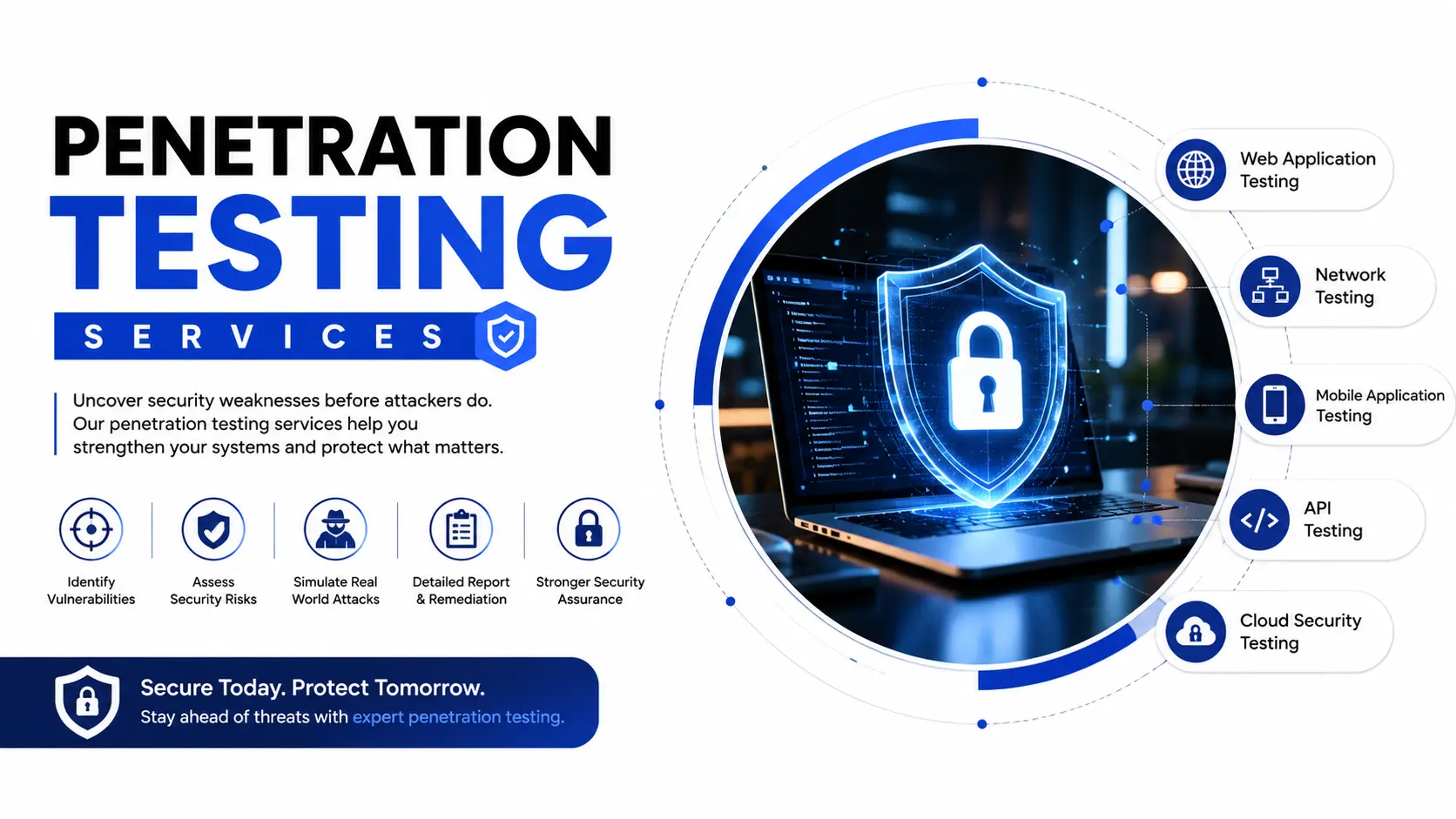
A report is only useful if someone can act on it without a security background. Ours includes:
We get asked this a lot, usually by founders trying to save money early on. Here's the honest breakdown.
|
Doing It Yourself |
Hiring a Penetration Testing Company |
|
|
Cost |
Free tools, but your time and any |
Fixed project cost, scoped upfront |
|
tooling licenses |
||
|
Skill needed |
Deep, current offensive security |
None — the provider brings the expertise |
|
knowledge |
||
|
Coverage |
Limited to what free/automated |
Manual testing catches logic flaws automated |
|
tools catch |
tools miss |
|
|
Compliance value |
Usually not accepted by auditors |
Meets ISO 27001, SOC 2, PCI DSS requirements |
|
Liability |
You carry the risk ifsomething's |
Provider carries professional responsibility, |
|
missed or breaks |
agreed scope protects you |
|
|
Best for |
Personal projects, learning, early |
Any business with customer data, |
|
internal checks |
compliance needs, or revenue on the line |
DIY testing with free tools like OWASP ZAP or Nmap is genuinely useful as a habit for developers. What it can't do is replace manual testing by someone trained to think like an attacker, and it won't satisfy an auditor asking for evidence of a professional penetration test. If real customer data or a compliance deadline is involved, hiring a qualified team isn't overkill. It's the actual requirement.
Pricing depends on scope, and anyone who quotes you a number before understanding your systems is guessing. That said, here's a realistic range so you can budget:
|
Test Type |
Typical Cost Range (India) |
Typical Duration |
|
Single web application |
₹40,000 – ₹2,50,000 |
3–5 working days |
|
Network penetration test (external) |
₹25,000 – ₹2,50,000+ |
3–7 working days |
|
Cloud environment review |
₹75,000 – ₹3,00,000+ |
5–8 working days |
|
API penetration test |
₹50,000 – ₹2,00,000+ |
3–6 working days |
|
Enterprise-scope (multiple assets) |
₹5,00,000+ |
2–4 weeks |
What actually moves the price: how many assets are in scope, whether it's black, grey, or white box, how complex the application logic is, and whether you need a compliance-mapped report (ISO 27001, SOC 2, PCI DSS control mapping adds review time). Add on 1–2 days for the retest once you've patched the findings.
Get an accurate number by calling +91 9079282750 with your actual scope; we'll give you a fixed quote, not a range.
It's a legal, controlled attempt to break into your systems the way a real hacker would, so you can find and fix the weak points before someone with bad intentions does.
A single web application test typically runs ₹40,000 to ₹2,50,000, and network or cloud tests can run higher depending on scope. Get a fixed quote by sharing your actual scope with us.
A vulnerability scan lists possible weaknesses using automated tools. A penetration test manually exploits them to prove they're real and shows how far an attacker could actually get.
Yes, in practice. Neither standard always names it explicitly, but auditors for both routinely require evidence of an annual third-party penetration test to satisfy technical vulnerability management controls.
Black box means the tester has no prior information, grey box gives them limited access like a normal user, and white box gives full access including source code. Grey box is the most common choice for a realistic yet efficient test.
It shouldn't, if scoped correctly. We agree on testing windows and avoid destructive exploits on production systems unless you specifically want that level of testing, and we can test against staging first.
You receive a full report with prioritized findings and remediation steps. Once you've made fixes, we retest the affected areas to confirm they're actually resolved.
Yes. Scope can be limited to the highest-risk asset, like your main web app or login system, to fit a smaller budget rather than testing everything at once.
An executive summary for leadership, detailed technical findings with proof-of-concept, risk ratings for each issue, specific remediation steps, and a retest summary confirming what's fixed.
It can be either. Many clients start with a one-time test, then move to annual or continuous testing as their systems and compliance needs grow.
If a compliance deadline is what brought you here, a few things worth knowing upfront:
We map every finding to the relevant control in your report when compliance is the driver, so you're not left translating a generic vulnerability list into audit language yourself.
A mid-sized fintech client came to us with six weeks before a SOC 2 audit deadline. They'd never had a formal penetration test, and their auditor had flagged it as a hard requirement, not a suggestion.
We scoped a grey-box test across their customer portal and backend APIs, and found eleven issues in the first week, including one critical broken authentication flaw that would have let a logged-in user access other customers' account data just by changing a URL parameter. We flagged that one the same day we found it, rather than waiting for the final report, so their dev team could start fixing it immediately.
Over the next ten days, their developers patched the findings while we kept working through the rest of the scope. We retested every fix, confirmed the critical issue was closed, and delivered a compliance-mapped report tying each finding to the relevant SOC 2 control. They passed their audit with two weeks to spare, and they've come back to us for their annual retest every year since. That's really the point of this whole exercise: not a scary report to file away, but real issues
found and actually closed before they cost you something.
At minimum, once a year. But the real trigger isn't the calendar, it's change. Run a fresh test any time you:
High-risk industries — fintech, healthcare, and any business handling payment data —often run tests twice a year or move to a continuous testing model instead of a single annual engagement.
Hyper Software is based in Jaipur, Rajasthan, but we run penetration testing engagements for clients across India and internationally, all remotely, with the same rigor and reporting standard regardless of location. Whether your infrastructure sits in Mumbai, Dubai, London, or Texas, scoping calls, testing, and reporting happen on your timezone with no compromise on depth.
A penetration test focuses on finding and proving as many exploitable vulnerabilities as possible within a defined scope. Red teaming is broader and stealthier, simulating a real adversary's full attack chain, often without your defensive team knowing in advance.
Yes. We test Android and iOS applications for issues like insecure local data storage, weak session handling, and insecure communication with backend APIs, alongside websites, web apps, networks, cloud, and APIs.
Look for testing that follows recognized methodologies like OWASP, PTES, or NIST SP 800-115, and for a provider that can produce a compliance-mapped report if you need one for ISO 27001, SOC 2, or PCI DSS.
Call +91 9079282750 or visit www.hypersoftware.in to book a scoping call. We'll confirm what needs testing, give you a fixed quote, and schedule the engagement around your timeline.
Have questions or need expert guidance? Our team is ready to help you with the right technology solutions for your business.