Website launch hone ke baad customer enquiries me noticeable increase hua. SEO aur speed optimization ka result clearly dekhne ko mila. Excellent work.

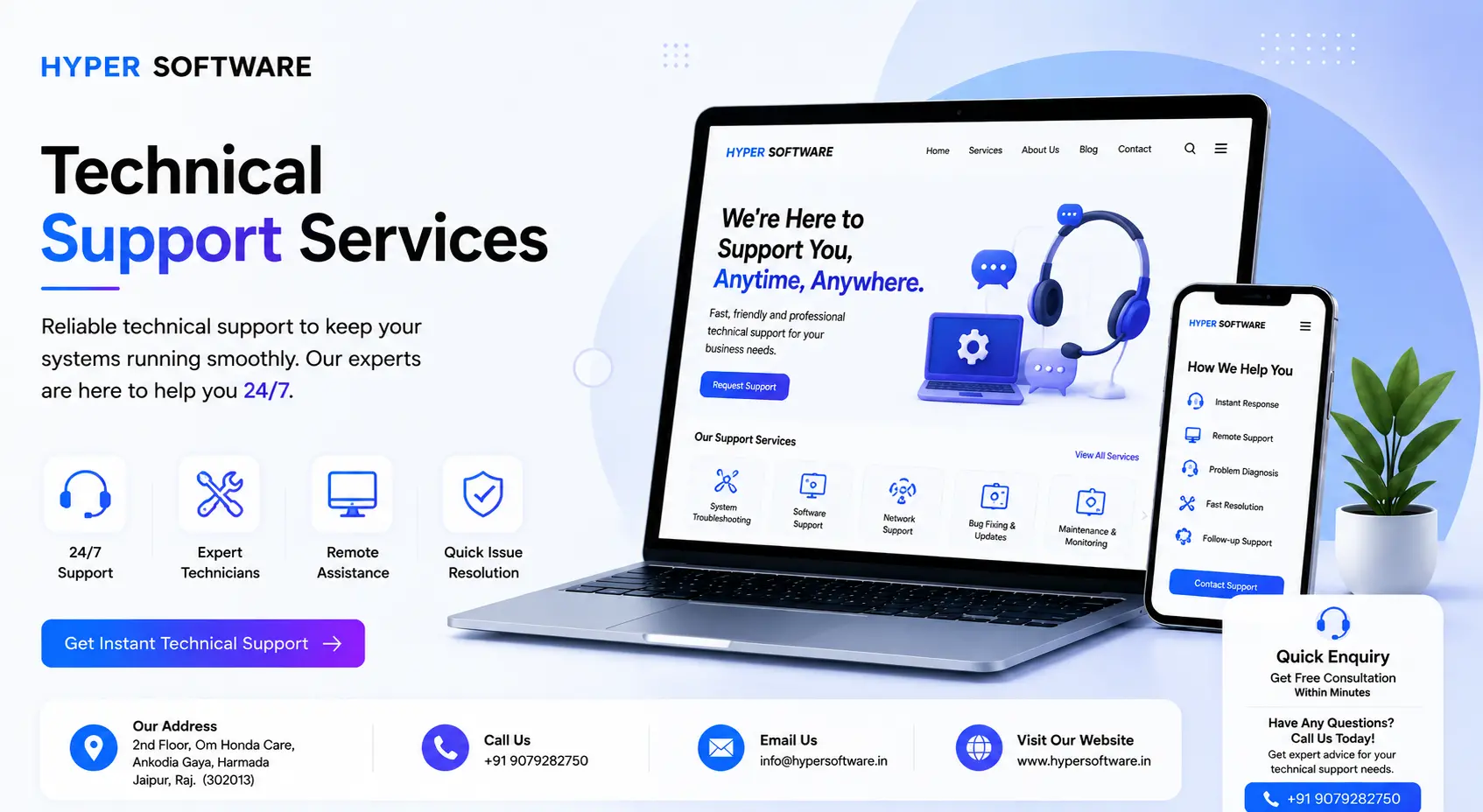
Something breaks. A server goes down, an app won't launch, or your team can't log in — and every minute it stays broken costs you money. Technical support is the service that gets it fixed: trained engineers who diagnose the problem, resolve it remotely or on-site, and get your systems running again. Hyper Software provides technical support for businesses worldwide — software, hardware, network, and cloud issues, handled by a team that's done this for real clients since 2020.
Whether you need a one-time fix or an ongoing support plan, here's everything you need to know before you pick a provider.
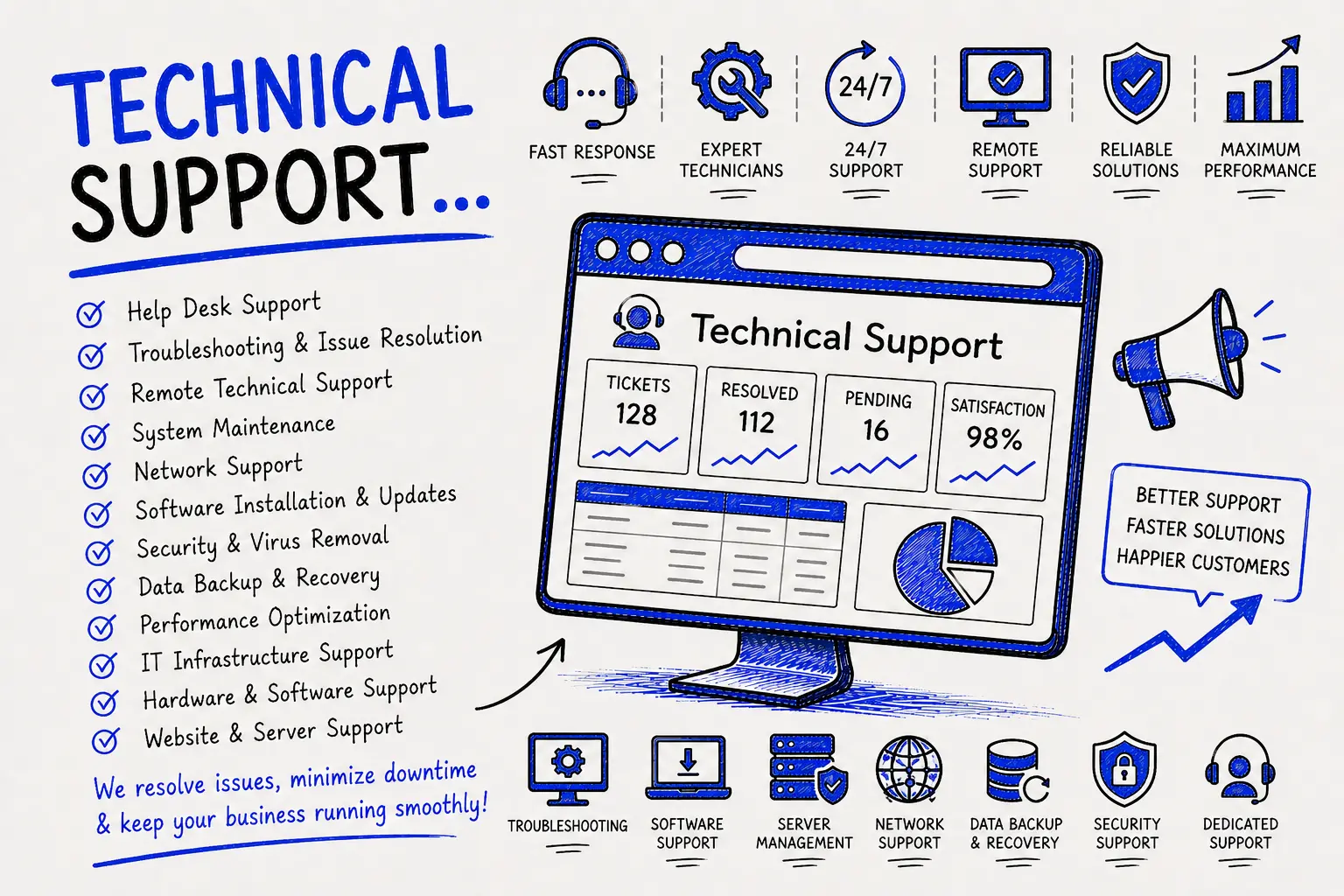
Technical support is the professional service of diagnosing and resolving problems with software, hardware, networks, or IT systems, so a person or business can keep working without interruption. It can be delivered remotely (over phone, chat, or remote desktop access), on-site (a technician visits in person), or through a mix of both.
It's not the same as customer support. Customer support answers questions about a product — billing, features, how something works. Technical support fixes what's actually broken.
Get Free Consultation Within Minutes
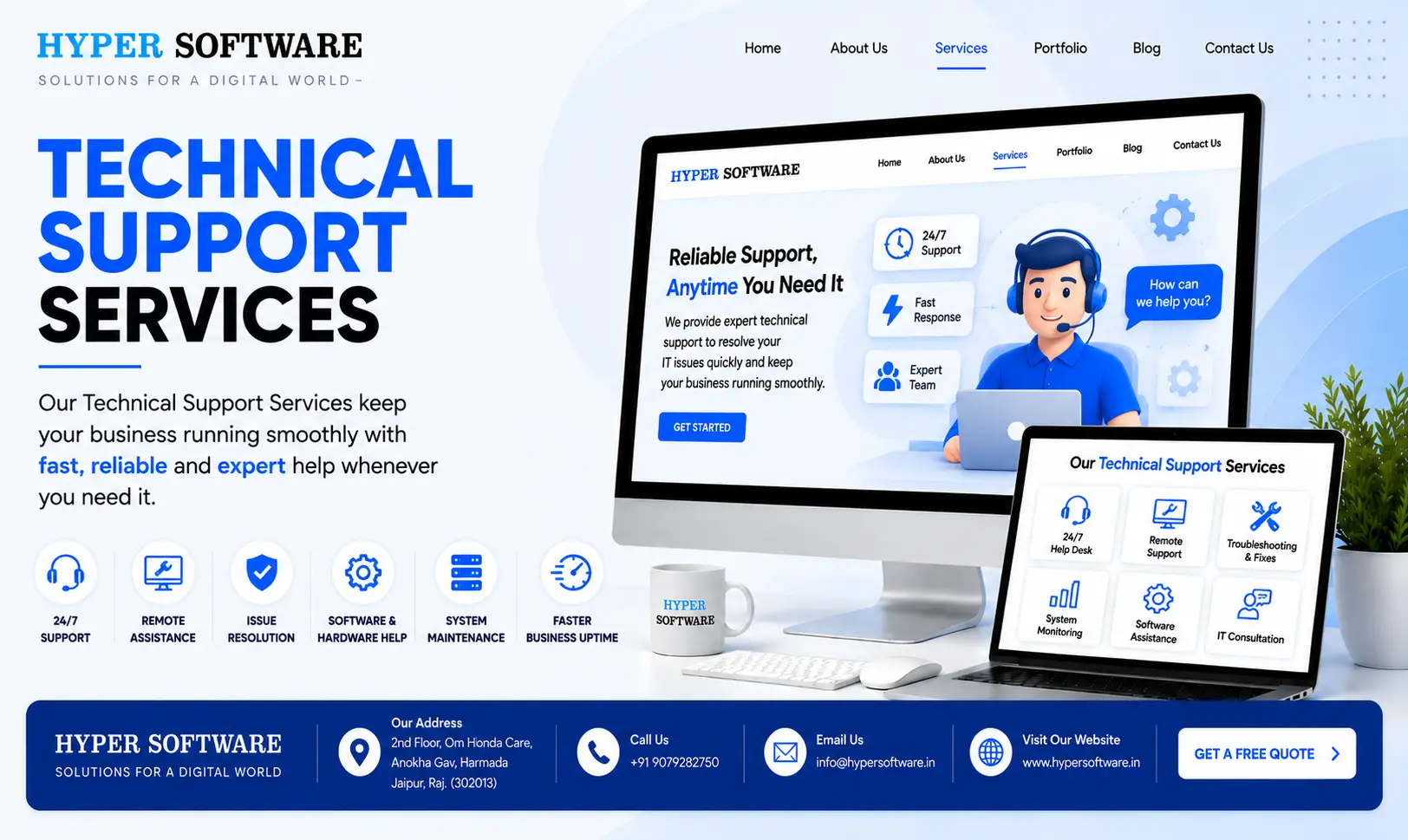
We don't limit "technical support" to one narrow thing. Businesses come to us with all kinds of problems, so our coverage is broad on purpose.
Installation issues, application crashes, licensing errors, update failures, and bugs that block your team from working.
Desktops, laptops, printers, routers, and peripherals that stop responding, overheat, or fail after an update.
Slow or dropped connections, VPN failures, Wi-Fi dead zones, and office network configuration.
AWS, Azure, and Google Cloud troubleshooting, server downtime, backup failures, and storage issues.
Malware and ransomware cleanup, suspicious login investigation, and basic hardening after a breach attempt.
Most issues get fixed remotely within the hour. When hardware needs hands-on repair, our team can be scheduled on-site (availability varies by location).
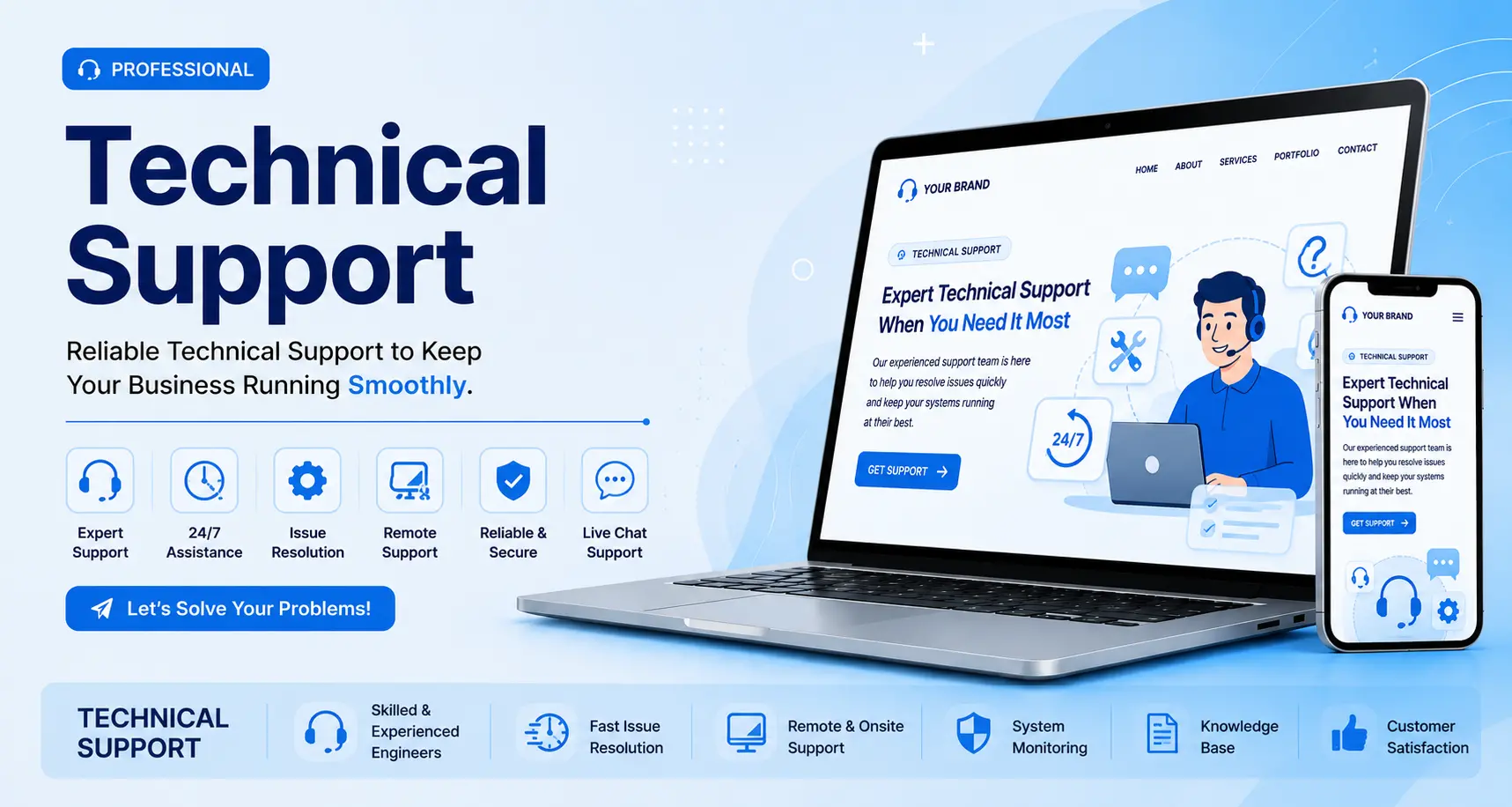
Not every problem needs the same expertise. We route every ticket to the right tier, so you're not paying senior-engineer rates for a password reset — and you're not stuck waiting when the issue is genuinely complex.
| Tier | What It Handles | Typical Examples |
| L1 — Frontline Support | Simple, high-volume issues, resolved fast | Password resets, login problems, basic software setup |
| L2 — Advanced Support | Issues that need deeper diagnosis | Application bugs, network errors, system configuration problems |
| L3 — Expert Support | Complex, technical, often escalated issues | server management failures, security incidents, infrastructure-level bugs |
This tiered model matters because it's the industry-standard way support tickets get resolved fast without bottlenecking senior engineers on routine requests.
People use these terms interchangeably, and it causes real confusion when businesses are trying to figure out what to search for or hire.
| Help Desk | Technical Support | IT Support | |
| Focus | First point of contact, simple fixes | Deeper troubleshooting of specific technical issues | Broader — infrastructure, strategy, ongoing management |
| Typical issue | Password reset, "how do I..." questions | App crashing, network error, device malfunction | Network design, security policy, long term IT planning |
| Skill level needed | Customer service + basic tech | Strong technical/product knowledge | Deep technical expertise across systems |
| Best for | Quick, everyday user problems | A specific broken thing that needs diagnosis | Ongoing management of your whole IT setup |
In practice, a good provider (like Hyper Software) blends all three — you get a fast first response, real technical troubleshooting when it's needed, and access to broader IT support if your business grows into needing it.
A Jaipur-based logistics company came to us after their order-tracking software started crashing every time their team tried to generate daily reports — right in the middle of their busiest shipping season. Their previous vendor had quoted a 5-day turnaround. Our L2 support team logged in remotely within 40 minutes, traced the crash to a corrupted database index caused by a failed update, rebuilt the index, and had reports generating normally again the same afternoon. We also set up automated backups so a future update failure wouldn't cause the same problem twice. That's the difference between a fix and a fix that actually lasts.
1. You raise the issue — call, WhatsApp, email, or the contact form. Tell us what's broken.
2. We triage it — a support engineer identifies the tier (L1, L2, or L3) and gives you a realistic timeline.
3. We resolve remotely first — most issues are fixed through secure remote access, usually the same day.
4. On-site if needed — hardware problems that can't be solved remotely get scheduled for an on-site visit.
5. We confirm and document — you get a summary of what broke, what we did, and how to prevent it happening again.
Retail and eCommerce, logistics and manufacturing, healthcare clinics, educational institutions, real estate firms, professional services (legal, accounting, consulting), and startups across SaaS and tech.
Not every problem needs a professional. Here's an honest breakdown.
| Factor | Doing It Yourself | Hiring a Technical Support Agency |
| Best for | One-off, simple issues (restart, basic settings, known error with a documented fix) | Recurring issues, businesscritical systems, anything you can't afford to get wrong |
| Cost | Free, but costs your own time | Scoped cost — per-incident, per device, or a monthly plan depending on provider |
| Risk | You can make it worse without realizing it — especially with servers, networks, or website security issues | Low risk when the provider is verified and experienced |
| Speed | Depends entirely on your own skill level | Usually faster, since engineers see the same problems repeatedly |
| What can go wrong doing it alone | Data loss from a bad fix, more downtime while you troubleshoot by trial and error, security exposure if you disable protections to "test something" | Minimal, if you vet the provider properly (see checklist below) |
Rule of thumb: if the fix is something you've done before and it's low-risk (clearing a cache, restarting a router), do it yourself. If it touches your server, your customer data, your network security, or it's already cost you more than an hour of downtime, bring in a professional.
Pricing in this industry isn't one-size-fits-all, and any provider promising a fixed number before understanding your setup is guessing. Costs typically fall into a few models:
Exact pricing varies with issue complexity, response-time requirements, and whether support is remote or on-site — check with us directly for a scoped quote rather than relying on a generic number online. Call +91 9079282750 or visit www.hypersoftware.in for a free assessment.
Technical support is professional help that diagnoses and fixes problems with software, hardware, networks, or systems so you can keep working without long interruptions.
Technical support usually focuses on fixing a specific broken thing, while IT support covers the broader, ongoing management of your entire technology setup, including strategy and infrastructure.
It depends on the pricing model — per-incident, per-device monthly plans, or dedicated support — and the complexity of the issue. Ask for a scoped quote rather than trusting a flat number online.
Yes, when it's from a verified provider using secure remote-access tools and you initiated the request. It's not safe when an unsolicited caller asks for access first.
Simple (L1) issues are often resolved within the hour. Complex (L3) issues, like server failures, can take longer depending on the root cause.
Most software, network, and configuration issues can be fixed remotely. Physical hardware failures — a dead hard drive, a broken router — usually need someone on-site.
A help desk is the first point of contact for simple, high-volume requests. Technical support handles issues that need deeper, specific troubleshooting.
Yes — this falls under cybersecurity incident support, which includes removing malware, checking for further compromise, and hardening the system against repeat infection.
It depends on how often issues come up. Frequent or business-critical issues justify an ongoing plan; occasional problems are fine handled per-incident.
Yes, technical support is offered globally, primarily through secure remote access, with on-site availability depending on location.
Use this checklist before you commit:
✅Verifiable address and business history — not just a phone number and a website.
✅Clear pricing model explained before work starts, not a vague "we'll figure it out."
✅References or case studies from real clients.
✅No pressure for upfront gift-card or wire payments — a classic scam red flag in this industry.
✅They explain the problem in plain language, not just jargon.
✅Security practices — how they handle remote access and your data.
Red flag warning: if someone calls you out of the blue claiming your computer has a virus and asks for remote access or gift-card payment, that's not technical support — it's a scam. Legitimate technical support is something you request, not something that calls you first.
A clear description of the problem, when it started, any error messages, and what device or system is affected — this speeds up diagnosis significantly
Yes — a good provider documents recurring issues, sets up backups, and recommends changes so the same problem doesn't keep happening.
They overlap but aren't identical. Technical support reacts to a specific problem; software maintenance is ongoing upkeep — updates, monitoring, and optimization — to prevent problems in the first place
Call +91 9079282750 or visit www.hypersoftware.in to describe your issue and get a response time estimate.
Call Hyper Software at +91 9079282750 or visit www.hypersoftware.in — tell us what's broken, and we'll tell you honestly what it takes to fix it.
Have questions or need expert guidance? Our team is ready to help you with the right technology solutions for your business.