Website design se lekar final launch tak pura process bahut smooth raha. Team har update time par deti rahi aur support bhi outstanding mila.

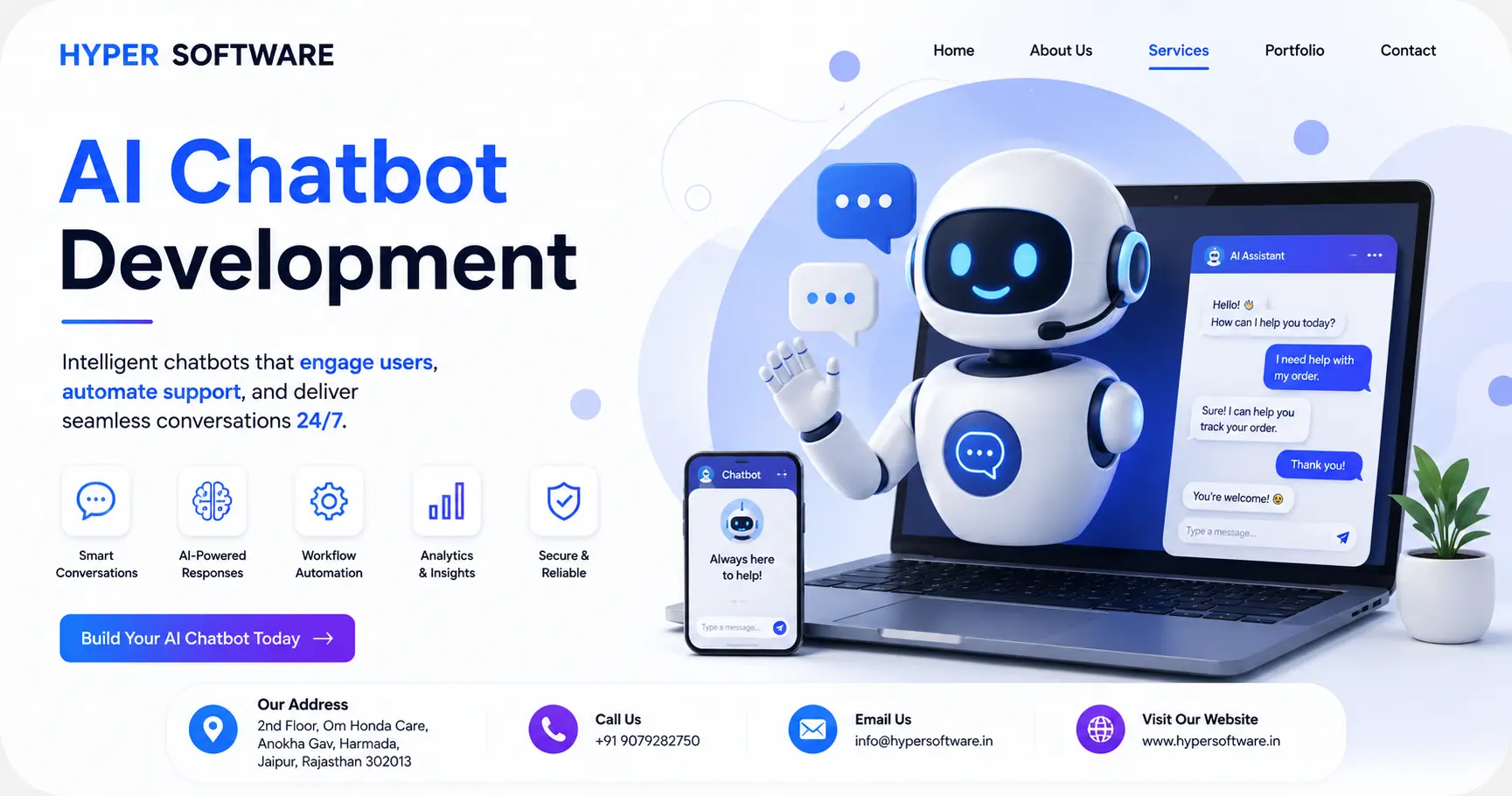
An AI chatbot is software that reads what a customer types (or says), figures out what they actually want, and replies like a person would, without a human typing the answer. Hyper Software builds these chatbots for websites, WhatsApp, and mobile apps, using GPT-4, Claude, and Gemini as the engine behind the conversation. If you're trying to work out what this costs and whether it's worth it for your business, you're in the right place.
We've built chatbots for retail stores, clinics, and B2B software teams. Some needed a simple FAQ bot. Others needed something that could pull live order data from a CRM and answer in Hindi and English in the same conversation. This page walks through both ends of that range, with real numbers, not vague "contact us for pricing" dodges.
AI chatbot development is the process of designing, building, training, and deploying a conversational assistant that uses natural language processing (NLP) to understand user queries and generate accurate replies.
The "AI" part matters. Older chatbots worked off fixed scripts: if a user typed an exact phrase, the bot matched it to a pre-written answer. Anything outside that script, and the bot just failed. Modern AI chatbots don't need an exact match. They understand intent. Someone can ask "where's my order" or "haven't got my package yet, what's going on" and the bot understands both mean the same thing.
Behind the scenes, this usually means one of two approaches:
Most businesses today ask for the second approach, because it handles messy, real-world phrasing far better and needs less manual training data.
Get Free Consultation Within Minutes
Not every business needs the same kind of bot. Here's how the main types differ.
| Type | How It Works | Best For | Rough Cost (India) |
|---|---|---|---|
| Rule-based / menu bot | Fixed decision tree, button clicks | Simple lead capture, appointment booking | ₹30,000 – ₹75,000 |
| NLP chatbot | Trained to detect intent from free text | FAQ automation, order status, support triage | ₹1,00,000 – ₹2,50,000 |
| LLM / generative AI chatbot | GPT-4, Claude, or Gemini with RAG on your data | Complex queries, knowledge base search, sales support | ₹2,50,000 – ₹8,00,000+ |
| Voice AI assistant | Speech-to-text + LLM + text-to-speech | Call center replacement, IVR upgrade | ₹1,00,000+ setup + monthly usage |
A quick rule of thumb: if your business gets the same 20 questions over and over, an NLP bot is enough. If your product catalog, policies, or use cases are genuinely complex, you need an LLM-based bot with RAG.
We don't start with code. We start with your actual customer questions.
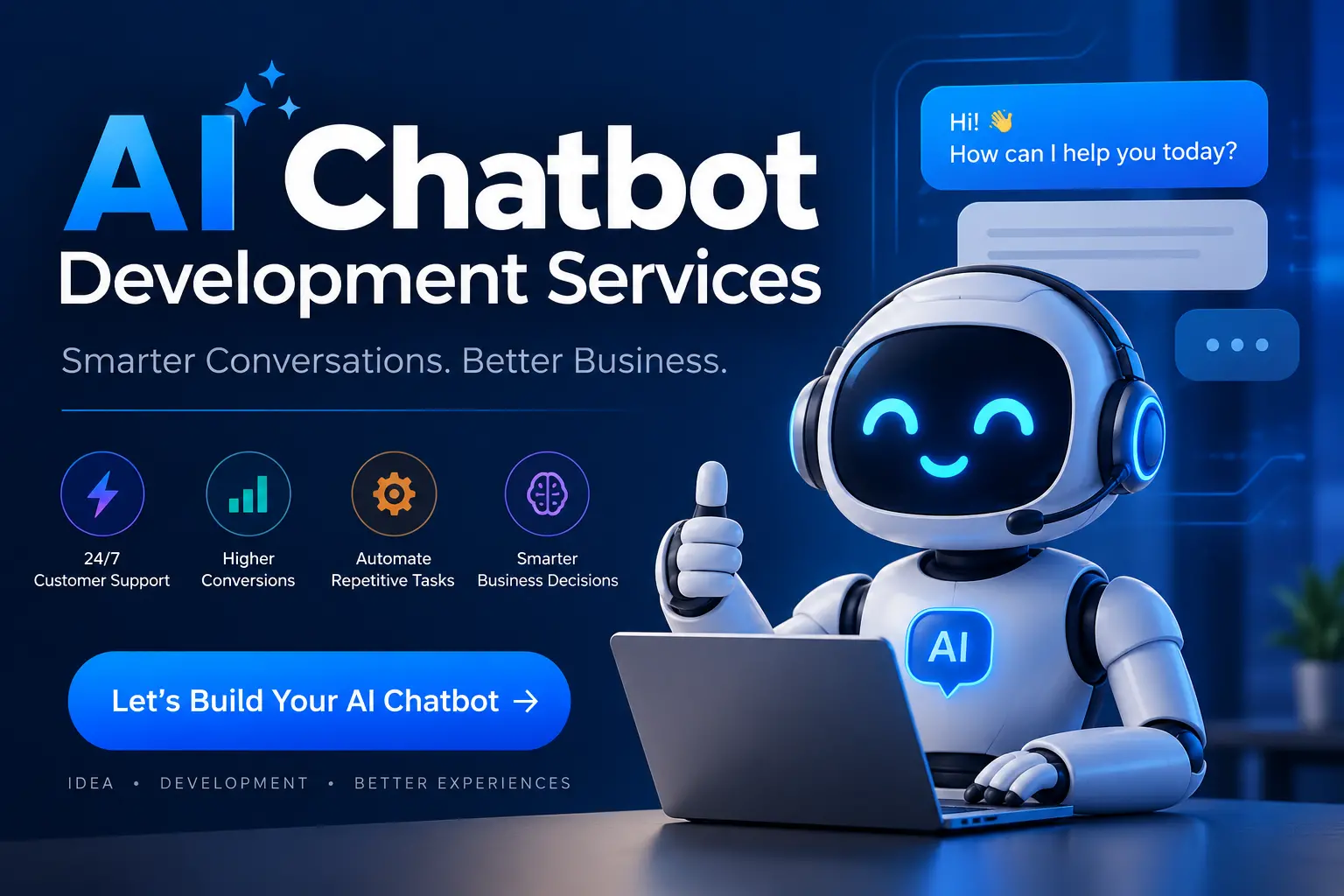
Pricing depends almost entirely on how complex the chatbot's job is, not on which company you hire. Here's a realistic breakdown based on current market rates.
| Chatbot Type | Typical Cost (INR) | Typical Cost (USD) | Timeline |
|---|---|---|---|
| Basic FAQ / rule-based bot | ₹30,000 – ₹75,000 | $400 – $900 | 1–2 weeks |
| NLP chatbot with CRM integration | ₹1,00,000 – ₹4,00,000 | $1,200 – $4,800 | 3–6 weeks |
| LLM-powered chatbot (GPT-4/Claude, single channel) | ₹2,50,000 – ₹6,00,000 | $3,000 – $7,200 | 6–10 weeks |
| Enterprise multi-channel AI chatbot with RAG and compliance | ₹6,00,000 – ₹15,00,000+ | $7,200 – $18,000+ | 10–16 weeks |
Maintenance typically runs 15–20% of the build cost per year, covering retraining, bug fixes, and small feature updates.
E-commerce: A chatbot that tracks orders, recommends products based on browsing history, and recovers abandoned carts by messaging the customer on WhatsApp a few hours later.
Healthcare: Appointment booking, prescription reminders, and answering common patient questions, with strict rules around what the bot can and cannot say about medical advice.
Real estate: Answering property questions instantly, scheduling site visits, and qualifying leads by budget and location before a human agent gets involved.
Education: Handling admission queries, fee structure questions, and course details for hundreds of prospective students at once, especially during admission season when call volume spikes.
Finance and lending: EMI calculators built into the chat, document checklist guidance, and status updates on loan applications, all with audit trails for compliance.
Travel and hospitality: Instant answers on room availability, booking changes, and local recommendations, in the customer's own language.
SaaS and B2B: A support bot trained on your documentation that resolves tier-1 tickets instantly and only escalates the genuinely hard questions to your team.
We match the stack to your project instead of pushing one default combination on every client. A small business FAQ bot doesn't need the same architecture as an enterprise support system handling thousands of conversations a day.
| Factor | DIY Builder (Tidio, Chatbase, ManyChat, etc.) | Hiring Hyper Software |
|---|---|---|
| Setup cost | Free to ~₹5,000/month | ₹30,000+ one-time, plus monthly running cost |
| Time to launch | A few hours | 1–16 weeks, depending on scope |
| Handles complex questions | Weak, mostly template-based | Strong, trained on your actual data |
| CRM/ERP/payment integration | Limited or not available | Fully custom |
| Multilingual (Hindi + English) | Rare, often poor quality | Built to your exact language mix |
| Data ownership | Often locked into the vendor's platform | You own the bot, the data, and the code |
| Best for | Solo founders, very simple FAQ needs | Any business with real support volume or complex data |
When DIY makes sense: you're testing an idea, your budget is under ₹10,000, and your bot only needs to answer 5–10 fixed questions.
When it goes wrong doing it alone: most no-code tools can't connect to your CRM development properly, they cap out on conversation volume fast, and switching platforms later means starting from scratch. We've rebuilt several client bots that started on a free tool and outgrew it within three months.
A Jaipur-based home appliance retailer came to us handling roughly 200 customer queries a day across WhatsApp and phone calls, mostly about warranty status, delivery timelines, and product specs. Two staff members spent most of their day just answering the same handful of questions on repeat.
We started by pulling their product catalog and warranty policy documents into a clean knowledge base, then built an LLM-powered chatbot with RAG, deployed on both their website and WhatsApp Business number. The bot handled order tracking by pulling live status from their existing order system through a custom API ChatGPT integration.
Within the first month, the bot resolved about 70% of incoming queries without any human involvement. Response time on WhatsApp dropped from an average of 40 minutes (when staff were busy) to under 10 seconds. Their two support staff shifted to handling complaints and upsells instead of repeating warranty terms all day. The client's own words after week three: "customers stopped complaining about slow replies, and we didn't have to hire anyone."
There's no universal answer. GPT-4 is strong for general conversation, Claude tends to follow instructions and safety guidelines closely, and Gemini integrates well with Google's ecosystem. The right choice depends on your budget, data needs, and existing tech stack.
For Indian customers, WhatsApp usually gets far higher engagement than website chat. For global B2B businesses, website chat is often the primary channel. Many businesses eventually run both.
It can be, if built correctly. That means encrypted data storage, access controls, and following relevant regulations like India's DPDP Act or GDPR for international customers. Ask any vendor directly how they handle data security before signing.
No, and it shouldn't try to. A well-built chatbot resolves 60–80% of repetitive queries, freeing your team to handle complaints, edge cases, and anything needing real judgment.
A properly built bot recognizes when it's unsure and hands off to a human instead of guessing. This fallback logic is part of conversation design, not an afterthought.
Yes. Expect ongoing retraining based on real customer questions, plus monthlyAPI and hosting costs. Maintenance typically runs 15–20% of the original build cost per year.
For very simple use cases, yes. Free and low-cost builders work fine for a handful of fixed FAQs. Once you need CRM integration, multiple languages, or complex logic, a custom build usually works out better long-term.
E-commerce, healthcare, real estate, education, finance, and travel see the fastest returns, mainly because they deal with high volumes of repetitive customer questions.
Yes, this can be built in, though it typically adds 15–30% to development cost due to the extra training and testing multilingual support requires.
Track resolution rate (how many queries the bot handles without human help), fallback rate (how often it says "I don't know"), and customer satisfaction on chatbot interactions. These numbers should improve steadily over the first few weeks as the bot gets retrained on real conversations.
Hyper Software has been building websites, software, and digital solutions for clients across India and globally since 2020, based out of Jaipur, Rajasthan. Chatbot projects go through the same team that already builds our clients' CRM systems, e-commerce platforms, and mobile apps, so integration work isn't handed off to a third party who doesn't understand your existing setup.
We quote clearly, in both INR and USD, explain what drives your specific price up or down, and don't disappear after launch. If your bot's accuracy needs tuning three months in, that's part of the relationship, not a separate invoice you weren't expecting.
AI chatbot development is the process of building a software assistant that uses natural language processing and AI models like GPT-4 to understand and respond to user questions automatically, instead of relying on a fixed script.
Costs typically range from ₹30,000 for a basic FAQ bot to ₹15,00,000+ for an enterprise-grade AI chatbot with multi- channel deployment and CRM integration. Most small and mid-size businesses land between ₹1,00,000 and ₹4,00,000.
A basic bot can go live in 1–2 weeks. An LLM-powered chatbot with integrations usually takes 6–10 weeks, and enterprise builds can run 10–16 weeks.
A rule-based chatbot matches exact phrases to pre-written answers and fails outside its script. An AI chatbot uses NLP to understand intent, so it can handle differently worded questions that mean the same thing.
Yes. This is called retrieval- augmented generation (RAG). The chatbot searches your documents, FAQs, and product data before answering, so replies stay accurate to your actual business instead of generic information.
Have questions or need expert guidance? Our team is ready to help you with the right technology solutions for your business.