
Hyper Software ne hamare business ko online ek nayi pehchan di. Website professional, fast aur SEO optimized hai. Website Design & Development ke liye best company.

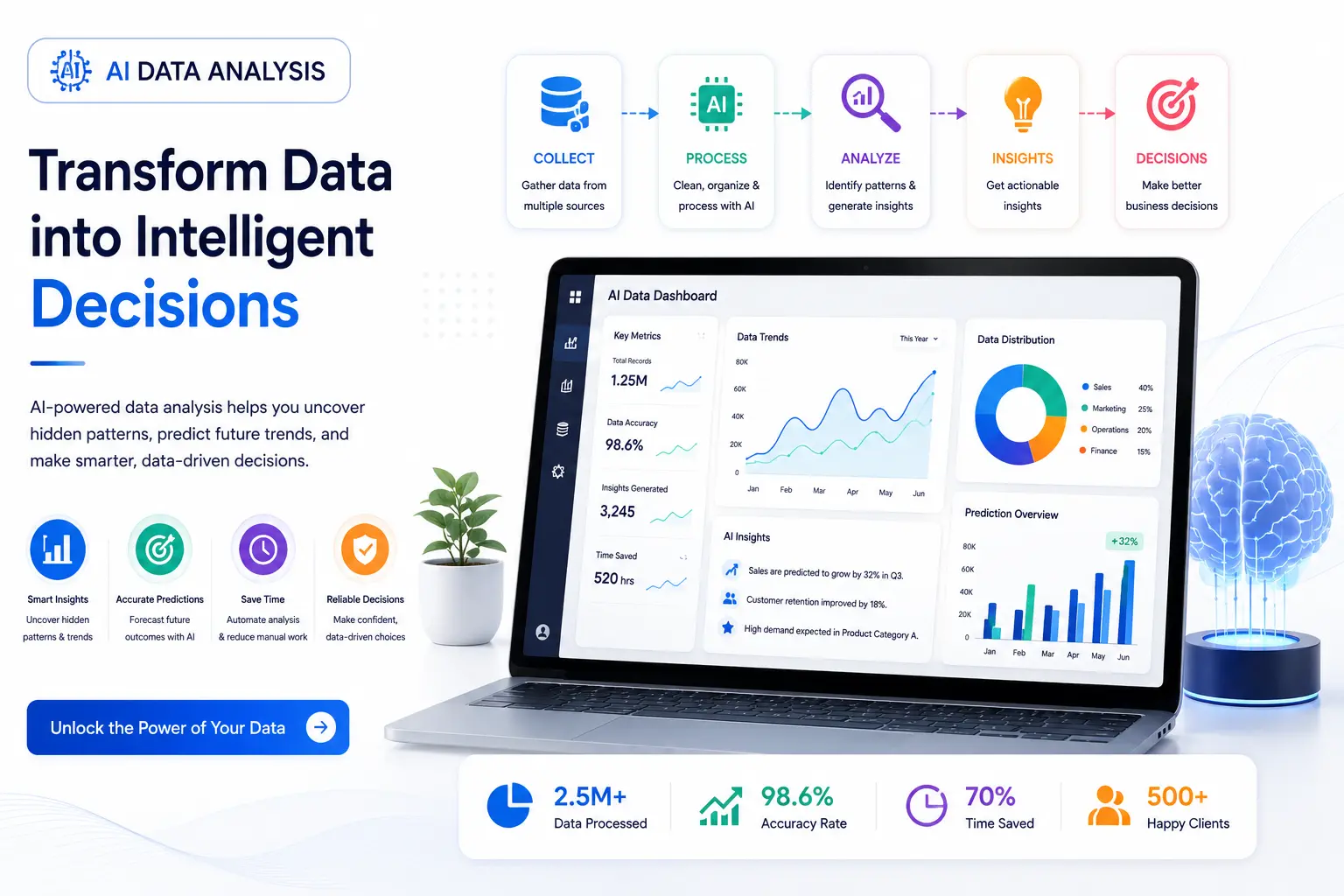
Most businesses aren't short on data. They're short on time to make sense of it. AI data analysis uses machine learning and automation to clean, process, and interpret data far faster than a person scrolling through spreadsheets ever could. Instead of waiting a week for a report, you ask a question and get an answer — often with a prediction attached, not just a summary of what already happened.
Hyper Software builds these systems for businesses worldwide. Here's what AI data analysis actually is, how it works, what it costs, and how to tell if you need it.
AI data analysis is the use of machine learning, natural language processing, and automation to extract patterns and predictions from data, instead of relying only on manual review or fixed spreadsheet formulas. Where a traditional analyst pulls a report and interprets it by hand, an AI system learns from the data itself — flagging anomalies, forecasting what's likely to happen next, and improving its own accuracy as more data comes in.
It's not one single tool. It's a combination of techniques working together:
None of this replaces human judgment. It removes the grunt work so the humans on your team can spend their time deciding, not digging.
Get Free Consultation Within Minutes
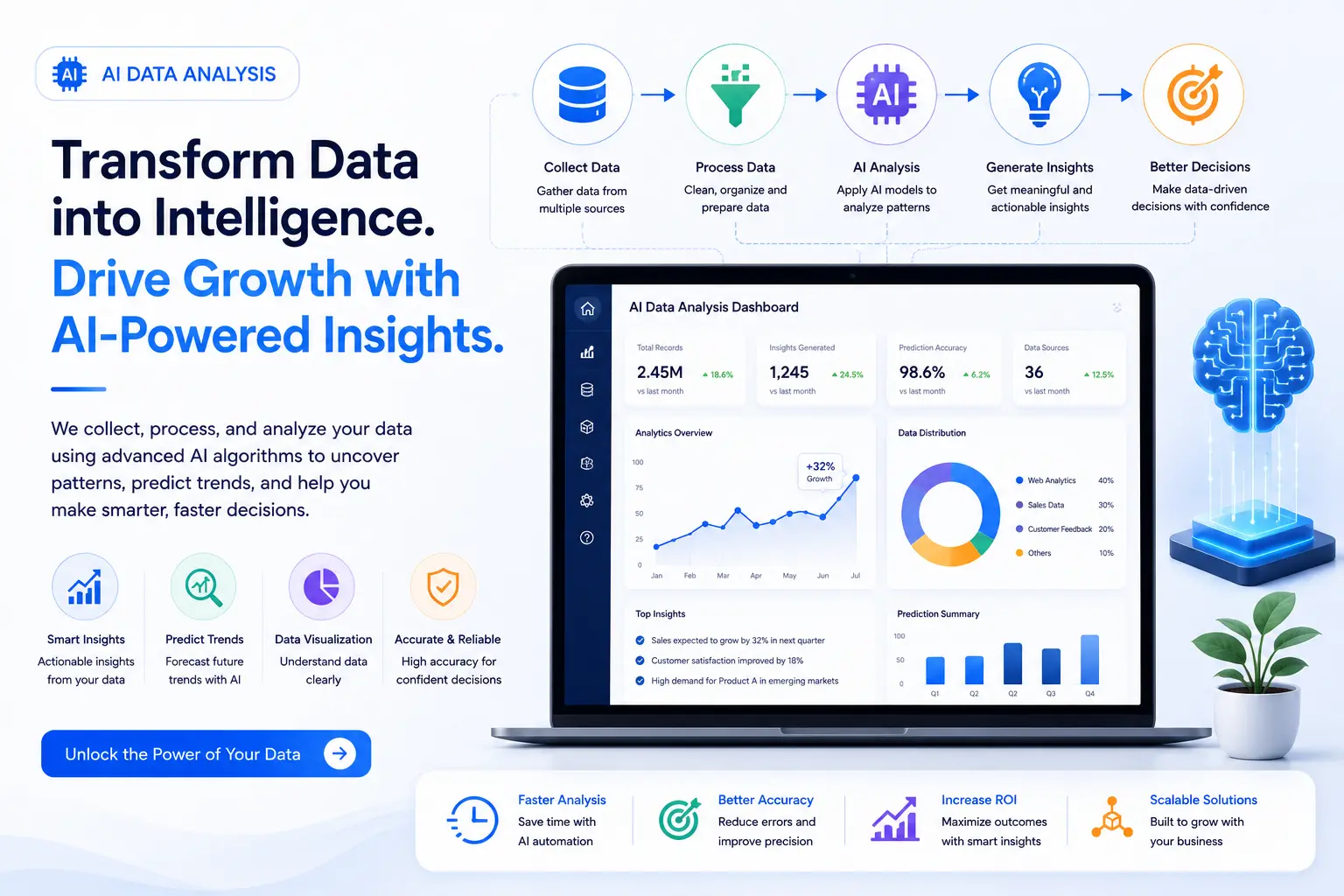
The process looks similar across most business use cases, whether you're forecasting sales or spotting fraud.
Data gets pulled from wherever it lives — your CRM, POS system, website analytics,spreadsheets, or ERP. Most businesses have this data already; it's just scattered.
Messy data breaks AI models. This step removes duplicates, fills gaps, standardizes formats, and flags errors before analysis even starts. Skip this step and every result downstream is unreliable.
Depending on the goal, the system applies the right technique — regression for forecasting, classification for categorizing, clustering for finding customer segments, or NLP for text data.
The system turns raw output into something a person can actually use: a trend line, a risk score, a plain-language summary, or an alert.
Insights land in a dashboard, a scheduled report, or an automated alert — wherever your team already looks. Good AI data analysis doesn't create a new place to check. It feeds the places you already use.
Hyper Software ne hamare business ko online ek nayi pehchan di. Website professional, fast aur SEO optimized hai. Website Design & Development ke liye best company.

People often ask ifAI analysis is just traditional analysis with extra marketing. It isn't. Here's where they actually differ.
| Factor | Traditional Data Analysis | AI Data Analysis |
| Speed | Hours to days for a full report | Minutes for most standard queries |
| Scale |
Struggles past a certain data volume |
Handles large, real-time datasets without slowing down |
| Pattern detection | Limited to what the analyst thinks to look for | Surfaces patterns humans wouldn't think to search for |
| Forecasting |
Mostly backward-looking (what happened) |
Forward-looking (what's likely to happen next) |
| Ongoing accuracy | Static until someone updates the model |
Improves as new data flows in |
| Best for |
Small, well-defined, one-off questions |
Large, recurring, or evolving analysis needs |
Neither one wins in every case. A one-off question on a 200-row spreadsheet doesn't need a machine learning pipeline. A retailer forecasting demand across 40 stores does.
Businesses usually land in one of three camps, and knowing which one you're in saves months of wasted evaluation.
| Tool Category | Examples | Best For |
| Chat-based AI (LLMs) | ChatGPTAdvanced Data Analysis, Claude, Gemini | Quick, one-off analysis on a file you already have |
| BI platforms with AI features | Power BI / Tableau + Copilot, Tableau + Pulse | Teams already running enterprise BI who want AI layered on top |
| AI-native analytics platforms | Databricks, ThoughtSpot, ai- native BI tools | Organizations that want AI built into the analytics from day one, not bolted on |
A quick reality check: ChatGPT and Claude are excellent for exploring a single file or answering a one-off question. They aren't built to connect to your live CRM, refresh automatically, or govern who sees what. For recurring business reporting, most companies need a system, not just a chat window. That's usually the gap a service like ours fills — connecting the AI layer to your actual, live business data instead of a CSV you upload manually every week.
Hyper Software builds AI data analysis systems around what your business already runs on. Typical engagements include:
AI data analysis isn't one-size-fits-all. A few examples of how it plays out by industry:
A mid-sized e-commerce brand came to us with a familiar problem: three team members were spending most of Monday morning manually pulling numbers from Shopify, Google Ads, and a separate inventory spreadsheet into one master file. By the time the report was ready, the numbers were already a few days stale, and nobody trusted them enough to act fast.
We built a system that pulled data automatically from all three sources overnight, cleaned it, and pushed a single dashboard to the team every morning — plus a predictive model flagging which products were likely to run low on stock within two weeks. The manual Monday report disappeared. More importantly, the team caught two stock-out risks in the first month that would have gone unnoticed until it was too late to reorder in time.
That's the actual value ofAI data analysis for most businesses. It's rarely about a dramatic "AI breakthrough." It's about removing the three hours a week someone spends assembling numbers, and catching the problems that used to slip through.
This is the question almost every business asks before spending anything.
What can go wrong doing it alone: Chat-based tools can misread a column, silently drop rows, or generate a chart that looks right but calculates a total incorrectly. Without someone checking the math against the source data, a business can make a real decision off a wrong number and not find out for weeks. DIY tools are fine for exploration. They're risky as the sole basis for a decision that costs money if it's wrong.
There's no single fixed price, and any provider who quotes one without asking about your data first is guessing. Cost depends on a few real factors:
As a general reference point, small and mid-sized businesses in India typically budget in the range of a few lakh rupees per year for a properly built analytics setup, while larger, ongoing enterprise deployments run considerably higher. For global clients, project-based AI development and analytics work commonly falls in the range of a few thousand US dollars for a focused dashboard build, up to five figures for an integrated predictive system. These are general market ranges, not a quote — the only way to get an accurate number is a scoping call, because your actual data and systems decide the real cost.
1. Discovery call — we look at what data you already have and what decisions you're trying to make faster.
2. Data audit — we check data quality and identify what needs cleaning before any modeling starts.
3. System design — we map out which tools and models fit your goal and budget, not the most expensive option by default.
4. Build and test — we build the pipeline, dashboard, or model, and test it against real historical data before going live.
5. Handover and training — your team learns how to read and act on the system, not just stare at it.
6. Ongoing support — models get retrained and dashboards get maintained as your data and business change.
AI data analysis is the use of machine learning, automation, and natural language processing to clean, process, and interpret data faster and more accurately than manual methods.
Traditional analysis is manual and mostly backward-looking. AI data analysis automates the process and adds forecasting, so you see likely future trends, not just past performance.
Common tools include ChatGPT and Claude for quick exploration, Power BI Copilot and Tableau Pulse for BI teams, and custom-built pipelines using Python-based machine learning for larger, ongoing systems.
Cost depends on data volume, number of systems involved, and whether it's a one-time project or ongoing service. Small business dashboards typically start in the low thousands of dollars; full predictive systems cost more. A scoping call gives an accurate number.
It should be, if the provider uses proper access controls, encryption, and doesn't push sensitive data into public AI tools without review. Ask any provider directly how they handle data privacy before signing on.
Yes, though the real advantage ofAI shows up more clearly with larger or recurring datasets. For a single small dataset, a simpler tool may work just as well.
No. A good AI data analysis service builds the system and hands over a usable dashboard or report, so your team doesn't need in-house data scientists to benefit from it.
A basic dashboard build typically takes a few weeks. Predictive models or multi-system integrations take longer, depending on data readiness and complexity.
For one-off questions on a single file, yes. For recurring, automated, or multi-source analysis tied to live business systems, most businesses need a purpose-built system instead.
E-commerce, finance, manufacturing, logistics, and SaaS businesses tend to see the fastest returns, though any business with recurring reporting needs can benefit.
Hyper Software has been building digital systems since 2020, out of Jaipur, for clients across India and abroad. AI data analysis work sits alongside our custom software, CRM/ERP, and automation projects — which means the dashboard we build for you can talk to the CRM or ERP we might already be running for you, instead of existing as a separate, disconnected tool. We scope every project around your actual data before quoting a price, and we hand over systems your team can actually run without us on standby for every question.
Ready to see what your data could tell you? Call +91 9079282750 or visit www.hypersoftware.in for a free data audit call.
Accuracy depends almost entirely on data quality going in. Clean, well-structured data produces reliable predictions. Messy or biased data produces confident-sounding mistakes, no matter how advanced the model is.
Yes. Small businesses often see the fastest payoff, since a single automated report can replace hours of manual work each week without needing a big data team.
No, not as an end user. Tools like ChatGPT and modern BI platforms are built for plain-language questions. Building the underlying system does require technical expertise, which is usually where a service provider comes in.
Traditional BI shows you what happened through dashboards and reports. AI data analysis adds prediction and pattern detection on top of that, forecasting what's likely to happen next instead of only summarizing the past.
Yes, most modern AI data analysis systems are built to connect directly to CRM and ERP platforms, pulling live data instead of relying on manual exports.
Have questions or need expert guidance? Our team is ready to help you with the right technology solutions for your business.