
Hyper Software ne hamare business ko online ek nayi pehchan di. Website professional, fast aur SEO optimized hai. Website Design & Development ke liye best company.

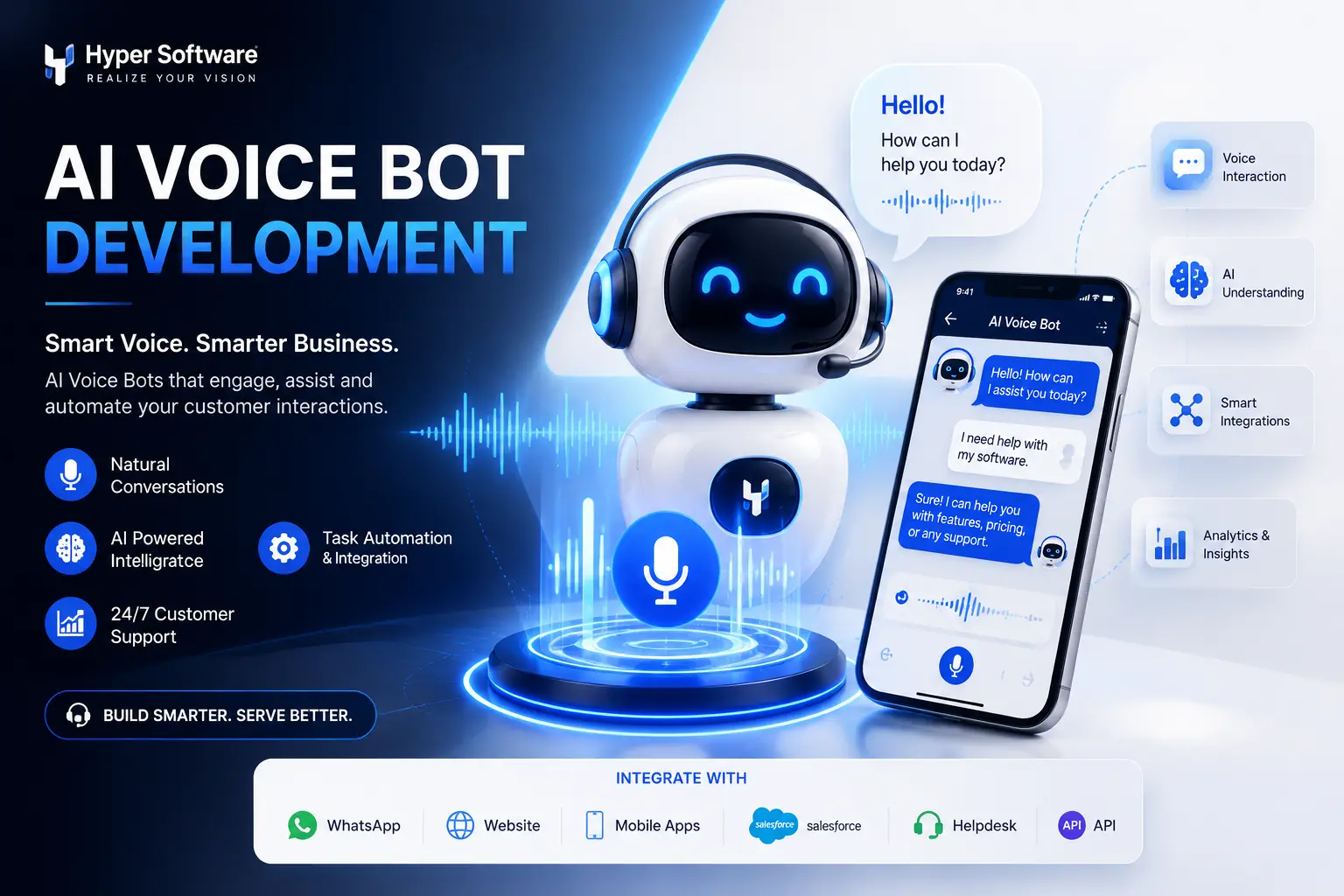
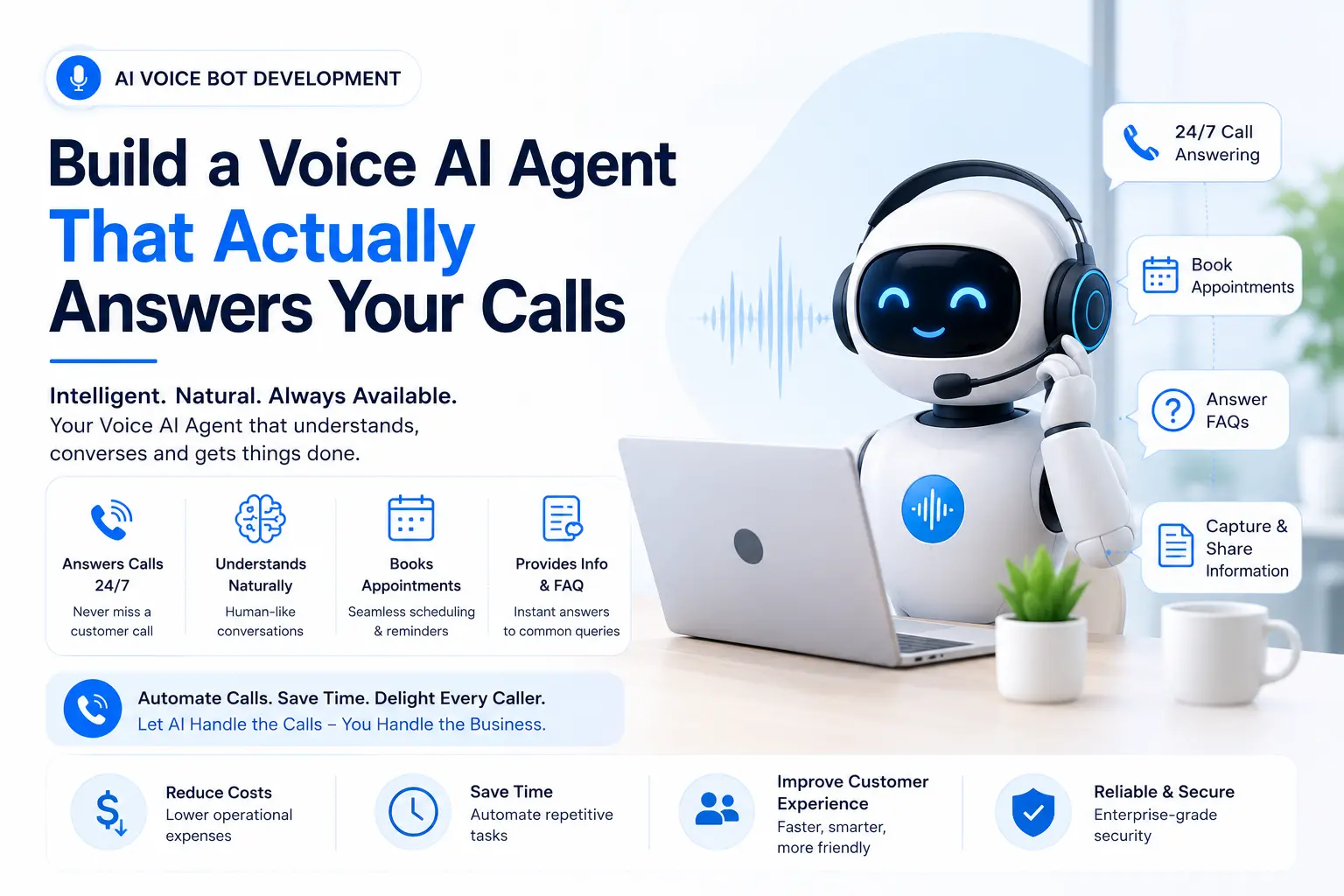
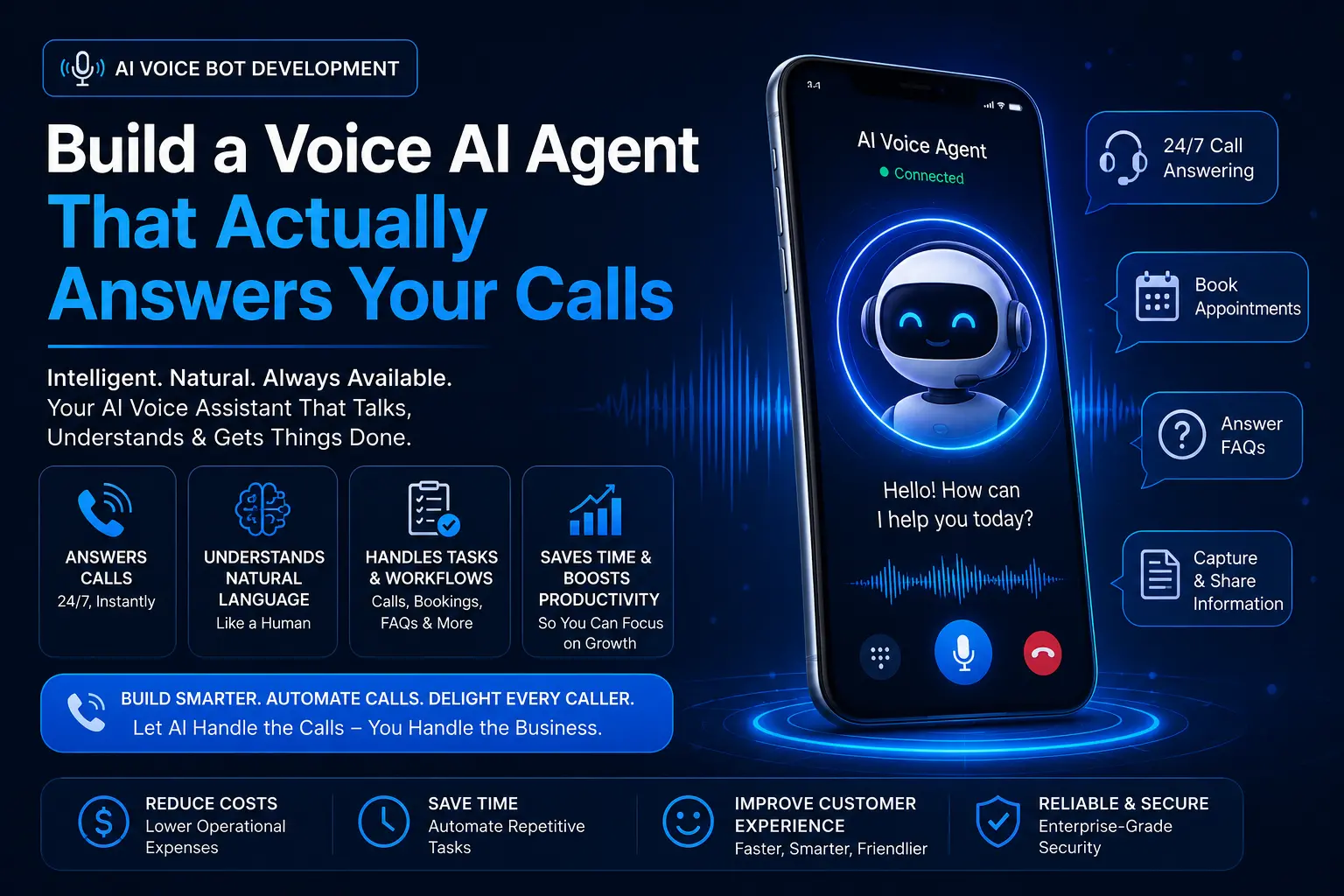
If your business misses calls after hours, puts customers on hold, or answers the same five questions a hundred times a day, that's revenue walking out the door. AI voice bot development solves this by building a software agent that picks up the phone, understands what the caller wants, and responds in a natural voice — instantly, every time, without a coffee break.
At Hyper Software, we build custom AI voice bots for businesses that are tired of losing leads to voicemail. This guide walks through exactly what AI voice bot development involves, what it costs, how long it takes, and what separates a bot that actually works from one that frustrates every caller who dials in.
AI voice bot development is the process of designing, building, and deploying a voice- based software agent that can hold a real conversation over the phone (or through a smart speaker or app) without a human agent involved.
It's not the "press 1 for sales" system you're used to hating. A properAI voice bot does three things in real time:
Think of it as the difference between a phone tree and a genuinely helpful front-desk employee who never sleeps. That's the bar a well-built voice bot needs to clear.
Get Free Consultation Within Minutes
Under the hood, an AI voice bot is built from four core layers working together in fractions of a second:
Speech recognition (ASR). This layer turns the caller's voice into written text. Quality here matters enormously — a bot that mishears "Tuesday" as "today" will frustrate a caller within seconds. Good ASR handles accents, background noise, and interruptions gracefully.
Natural language understanding (NLU). Once the words are on the page, the bot has to figure out intent. "I need to push my appointment" and "can we move my booking" mean the same thing to a human — the NLU layer has to treat them the same way too.
Dialog management. This is the logic that decides what happens next. Does the bot ask a follow-up question? Pull a record from the CRM? Transfer to a human? A weak dialog manager makes bots feel scripted and brittle. A strong one lets the conversation flow naturally, including handling interruptions mid-sentence.
Text-to-speech (TTS). Finally, the reply gets converted back into a spoken voice. Modern TTS engines sound close to human, with natural pacing and tone — a huge jump from the robotic voices people associate with old IVR systems.
Behind all four layers sits the integration work: connecting the bot to your CRM, calendar, ERP, or telephony provider so it isn't just talking, it's actually getting things done — booking the slot, updating the record, sending the confirmation.
The shift isn't hype. It's a handful of very practical problems that voice bots solve better than adding headcount:
None of this means the bot replaces your team entirely. The good implementations use the bot to filter and handle the routine 70%, and route the tricky 30% straight to a human with full context already attached.
Healthcare and clinics. Appointment booking, rescheduling, prescription refill requests, and basic triage questions — freeing front-desk staff from the phone so they can focus on patients actually in the room.
Real estate. Property inquiry handling, virtual tour scheduling, and lead qualification, so agents only spend time on callers who are genuinely ready to move.
Retail and eCommerce. Order status, delivery updates, return requests, and cart-recovery calls — the kind of high-volume, low-complexity queries that eat up a support team's day.
BFSI (banking, insurance, finance). Balance inquiries, EMI reminders, KYC status checks, and fraud alerts, always with a clear handoff to a human agent for anything sensitive.
Hospitality and travel. Booking confirmations, itinerary changes, and multilingual guest support across time zones.
Education platforms. Admission inquiries, course information, and scheduling for counseling calls.
If your business runs on phone calls and half of them are the same three questions on repeat, there's almost certainly a use case here for you.
Hyper Software ne hamare business ko online ek nayi pehchan di. Website professional, fast aur SEO optimized hai. Website Design & Development ke liye best company.

People often lump these together. They're not the same thing, and picking the wrong one wastes budget.
| Feature | Traditional IVR | Chatbot | AI Voice Bot |
|---|---|---|---|
| Channel | Phone (menu-based) | Text (Web/WhatsApp) | Phone / Voice-first |
| Understands free speech | No — fixed menu options | Yes, via NLP | Yes, via ASR + NLU |
| Feels natural | No | Somewhat | Closest to a human call |
| Best for | Simple call routing | Text-first support, FAQs | Phone-heavy businesses, hands-free scenarios |
| Setup complexity | Low | Medium | Medium to high |
| Typical cost (India) | Low | ₹50,000–₹2,00,000+ | ₹60,000–₹8,00,000+ depending on scope |
If your customers mostly message you, a chatbot is enough. If they mostly call you, a voice bot is where the money is being lost or saved.
Not every "AI voicebot company" is built the same. Before you sign anything, check for:
We run every voice bot project through the same seven stages, so nothing gets skipped:
We select tools based on what the project actually needs, not what's trendy. Depending on scope, this can include:
We're upfront about trade-offs — a cheaper stack means lower running costs but sometimes less accuracy on complex accents; we'll tell you which one fits your budget honestly.
This is the question every business actually wants answered, and most agency pages dodge it. Here's a realistic breakdown based on current market rates in India. Treat these as planning ranges, not a quote — your exact cost depends on languages, integrations, and call volume.
| Tier | What's Included | Approximate Cost (India) |
|---|---|---|
| Basic | Single use-case (e.g., appointment booking or FAQs), one language, one integration | ₹40,000 – ₹1,00,000 |
| Standard | Multiple use-cases, CRM integration, basic analytics dashboard, 2 languages | ₹1,00,000 – ₹3,50,000 |
| Enterprise | Full custom build, multi-language, deep CRM/ERP integration, compliance handling, ongoing fine-tuning | ₹4,00,000 – ₹15,00,000+ |
On top of one-time development, expect ongoing costs: telephony/call minutes (roughly ₹2–₹12 per minute depending on the language and complexity), API/LLM usage, and monthly maintenance — usually 15–20% of the build cost per year. These figures vary by vendor and volume, so confirm the exact structure before you sign.
Timelines stretch mainly around one thing: how clean and ready your existing data (FAQs, call scripts, past transcripts) is when the project starts. Messy or missing source material is the single biggest cause of delay we see.
When DIY (no-code voice AI platforms) makes sense: You want to test an idea fast, your use case is narrow (like appointment reminders), and you're comfortable with a generic, less brand-specific voice experience. Setup can take under an hour, and monthly costs can start as low as a few thousand rupees.
Where DIY breaks down: No-code platforms struggle once you need deep CRM/ERP integration, a distinct brand voice, multilingual support with regional accents, or
compliance-grade call handling (like recorded consent and data retention for BFSI). You're also locked into that platform's roadmap and pricing changes.
What can go wrong doing it alone: businesses often launch a DIY bot without testing it against real accents or messy phrasing, discover it fails on 30–40% of actual calls, and end up rebuilding from scratch anyway — spending more in the end than a proper build would have cost.
Yes, most modern voice AI platforms support Hindi and several regional Indian languages, though language support can affect both accuracy and cost — confirm this during scoping.
No. A traditional IVR only understands fixed keypad or menu inputs ("press 1 for sales"). An AI voice bot understands free, natural speech and can hold an actual conversation.
Not entirely, and it shouldn't try to. The best setups use the bot to handle routine, repetitive calls and route complex or sensitive conversations to a human with full context attached.
Healthcare, real estate, retail/eCommerce, BFSI, hospitality, legal services, and education see the strongest results, since these industries deal with high call volumes and repetitive queries.
No. Most voice bot providers integrate with standard telephony/VoIP providers, so you don't need to build your own calling infrastructure from scratch.
Accuracy depends heavily on the ASR engine chosen and how well it's tuned for your caller base. A bot tested only on clean, accent-neutral speech will underperform on real regional calls — this should be tested specifically during development.
A well-designed bot has fallback logic — it asks a clarifying question or transfers the call to a human agent with the conversation context already attached, instead of leaving the caller stuck.
No-code platforms work for simple, narrow use cases and fast testing. A development company is worth it once you need deep CRM/ERP integration, brand- specific voice tone, multilingual accuracy, or compliance-grade handling.
Yes. Bots need periodic retraining based on real call data, since actual conversations reveal phrasing and edge cases that weren't anticipated during design. Budget roughly 15–20% of build cost annually for this.
Reputable development partners build with secure APIs and encrypted data handling, and for regulated industries like BFSI, ensure call recording and data retention comply with relevant regulations. Always confirm data handling practices with your vendor before launch.
A dental clinic chain with four locations came to us losing an estimated 15–20 calls a day after hours and during lunch breaks — mostly patients trying to book or reschedule appointments. Their front desk was already stretched thin during open hours.
We scoped a Standard-tier bot: single language, tied directly into their existing appointment software, handling booking, rescheduling, and basic FAQs about hours and services. We built it around their actual call transcripts, not a generic script, so it recognized how their patients actually phrased requests.
It went live in seven weeks. Within the first month, the clinic recovered roughly 80% of the after-hours calls that had previously gone to voicemail and never got returned. Front-desk staff stopped spending the first twenty minutes of every morning calling back missed patients, and appointment no-shows dropped slightly too, since the bot handled confirmation calls automatically. The clinic's owner told us the bot paid for itself within the second month, purely from recovered bookings.
Hyper Software has been building custom technology for businesses since 2020, out of Jaipur and for clients globally. We're not a template shop — every voice bot we build starts with your actual call data and business systems, not a one-size-fits-all script.
What that means for you:
AI voice bot development is building a software agent that answers phone calls, understands spoken requests using speech recognition and NLU, and replies in a natural voice — automating conversations without a human agent on the line.
In India, a basic single-use-case voice bot typically costs ₹40,000–₹1,00,000, a standard multi-feature bot runs ₹1,00,000–₹3,50,000, and enterprise-grade builds with deep integrations can exceed ₹4,00,000. Exact cost depends on languages, integrations, and call volume.
A basic bot takes about 3–5 weeks, a standard bot with CRM integration takes 6–10 weeks, and a full enterprise build can take 3– 5 months, depending on complexity and how ready your source data is.
A chatbot handles text-based conversations, usually on a website or messaging app. A voice bot handles spoken conversations over the phone, using speech recognition and text-to-speech instead of typed text.
Yes. A properly built voice bot can pull and update records in your CRM or ERP in real time, so it can check order status, book appointments, or update customer details during the call itself.
Have questions or need expert guidance? Our team is ready to help you with the right technology solutions for your business.