
Website design se lekar final launch tak pura process bahut smooth raha. Team har update time par deti rahi aur support bhi outstanding mila.

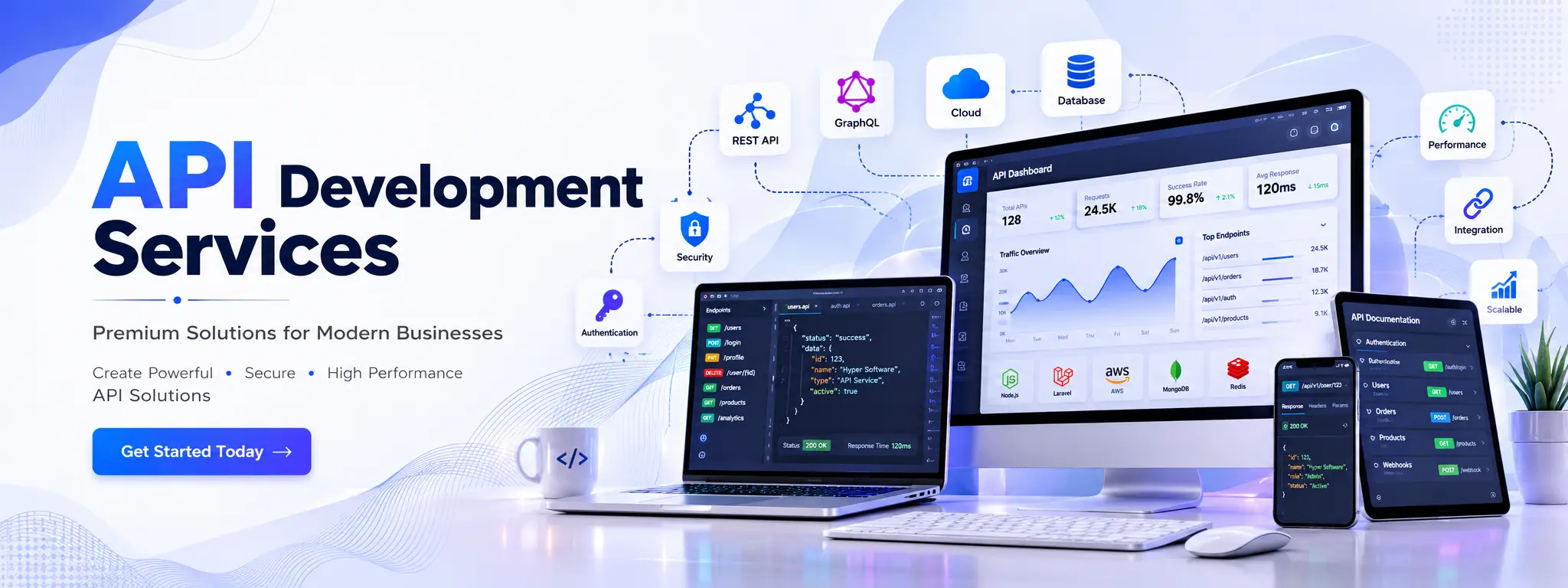
APIs are how your software actually talks to everything else — your payment gateway, your CRM, your mobile app, your partner's systems. Get the API wrong and every one of those connections becomes a support ticket. Get it right, and your business runs on autopilot.
Quick answer: API development is the process of designing, building, testing, and maintaining an interface that lets two software systems exchange data automatically. A typical business API — REST, with standard authentication — takes 2 to 8 weeks to build and costs between $2,000 and $25,000, depending on complexity and security requirements.
Hyper Software has been designing and building custom APIs for clients across the US, UK, Australia, the Middle East, and India since 2020. Whether you need a brand-new REST API for a mobile app, a GraphQL layer for a complex dashboard, or a team to finally document and secure an API someone built five years ago and left unmaintained — this is what we do every week.
An API (Application Programming Interface) is a set of rules that lets one piece of software request data or trigger an action inside another piece of software, without either one needing to know how the other works internally. When your food delivery app shows a live map, it's not drawing that map itself — it's calling Google Maps' API and displaying what comes back.
API development covers the whole lifecycle: deciding what the API needs to do, designing its structure (endpoints, data formats, authentication), writing the code, testing it under real load, documenting it so other developers can actually use it, and then maintaining it as your systems change.
A good API is boring in the best way — predictable, well-documented, and rarely the thing that breaks at 2 a.m.
Get Free Consultation Within Minutes
Most businesses don't wake up one day wanting "an API." They wake up needing one of these:
Two systems that don't talk to each other. Your CRM integration has customer data your accounting software needs, and someone is currently copy-pasting it by hand.
A mobile app backend that needs a backend. No API, no app — mobile apps are essentially a frontend sitting on top of an API.
A product you want other businesses to plug into. Companies like Stripe and Twilio built entire businesses by selling access to theirAPI.
A ERP connections legacy system that's holding everything back. Old software can often stay exactly where it is if you build an API layer on top of it instead of ripping it out.
The business case is simple: manual data transfer between systems costs time and
introduces errors. A well-built API removes both.
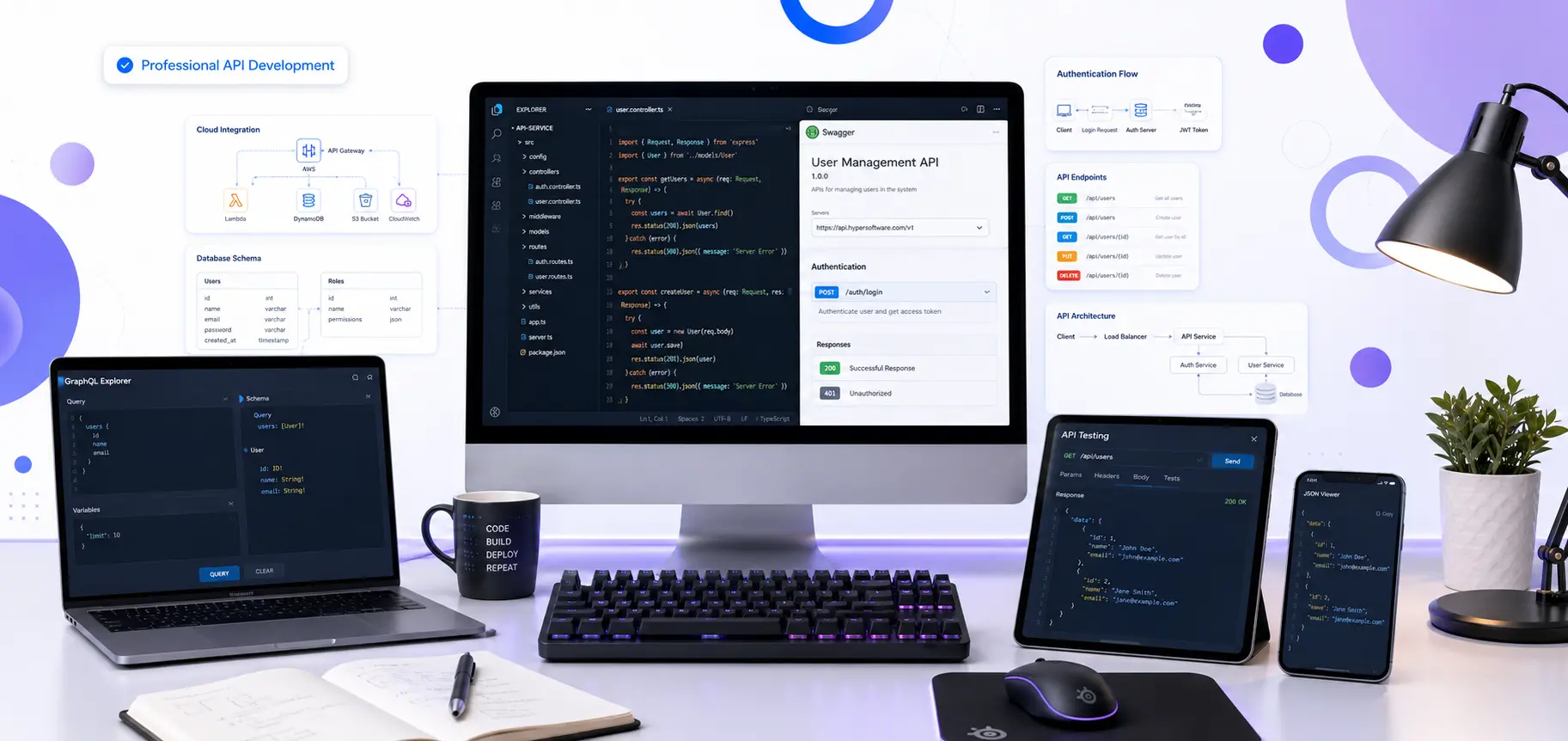
Not everyAPI should be built the same way. Here's how the main options actually compare, in plain terms.
| API Type | Best For | Downside |
|---|---|---|
| REST | Most business apps, mobile backends, public APIs — the default choice for roughly 80% of projects | Can require multiple calls to fetch related data |
| GraphQL | Apps where different screens need different slices of the same data (dashboards, complex mobile apps) | More setup work; harder to cache |
| SOAP | Banking, insurance, and government systems with strict compliance and legacy requirements | Verbose, slower to build, steep learning curve |
| gRPC |
Fast, internal service-to-service communication in a microservices setup |
Not browser-friendly; harder to debug |
| Webhooks | Event-driven notifications ("tell me when this happens") rather than constant polling | Not a full API on its own — usually paired with REST |
Our honest take: if you're not sure which one you need, you probably need REST. It's the safest default — well understood, easy to secure, and cheaper to maintain. We only recommend GraphQL or gRPC when there's a specific problem they solve better.
Custom web application & Development — Built from scratch around your business logic, not a generic template. Includes endpoint design, data modeling, and versioning strategy from day one.
Third-PartyAPIIntegration — Connecting your systems to Stripe, PayPal, Salesforce, HubSpot, Twilio, shipping carriers, social logins, and hundreds of other external services.
RESTAPI Development — Standards-based RESTAPIs using HTTP methods correctly, with clean, predictable endpoints your developers (or your partners' developers) can actually work with.
GraphQL API Development — For products where the frontend needs flexible, efficient data fetching across multiple screens or client types.
Legacy System API Modernization — Wrapping an API layer around older software so it can connect to modern tools without a risky, expensive rebuild.
Microservices API Architecture — Breaking a monolithic system into independent services that communicate through well-defined APIs, for teams that need to scale specific parts of their product independently.
API Security Implementation — OAuth 2.0, JWT tokens, API key management, rate limiting, and encryption, built in from the design phase, not added afterward.
API Testing & QA — Functional, load, and security testing before anything reaches production, using automated test suites so regressions get caught before your users do.
API Documentation — Developer-ready docs using OpenAPI/Swagger standards, so any developer — yours, a partner's, or a future hire — can start using the API without a training session.
API Management & Monitoring — Ongoing uptime monitoring, usage analytics, and version management after launch, because an API is a product, not a one-time deliverable.
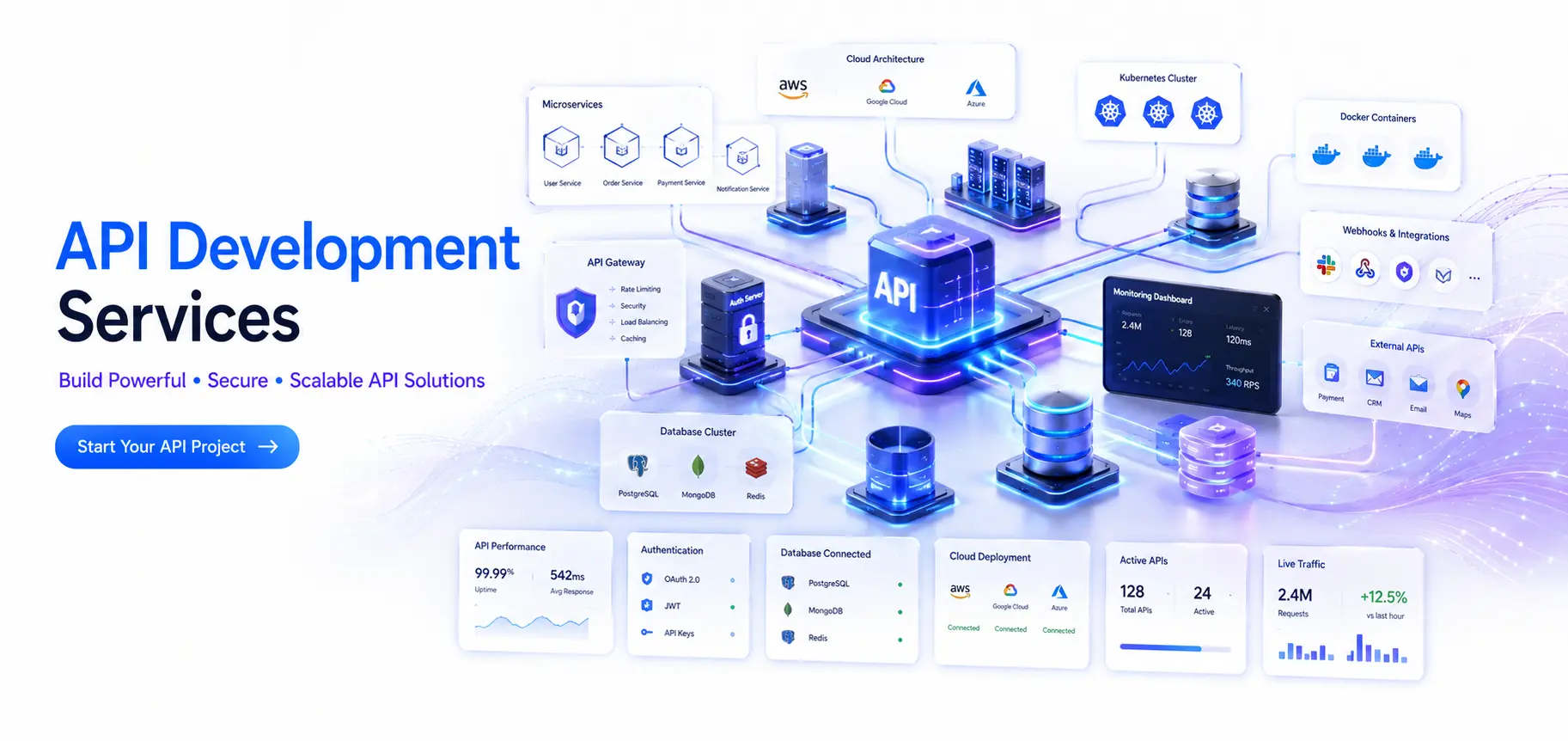
 Our API Development Process
1. Discovery & Requirements — We map out what your API actually needs to do, who will consume it, and what systems it has to connect to. This is where we catch scope problems before they cost you money.
2. API Design — We choose the right architecture, define endpoints, and document the data contract before a line of code is written.
3. Development — Our engineers build the API against the agreed specification, with version control and code review at every stage.
4. Security Implementation — Authentication, authorization, rate limiting, and input validation are built in, not bolted on.
5. Testing — Functional testing, load testing, and security testing, including checks against the OWASP API Security Top 10.
6. Documentation & Handover — Full developer documentation is delivered alongside the code, not as an afterthought.
7. Deployment & Monitoring — We deploy to your environment of choice and set up monitoring so issues get flagged before users notice them.
8. Ongoing Maintenance — APIs evolve as your business does. We offer maintenance plans for updates, scaling, and new integrations.
We've built APIs for eCommerce platforms, healthcare software, fintech products, logistics companies, and SaaS platforms.
If your industry has specific compliance requirements, tell us early — it changes the architecture, not just the paperwork.
We build with Node.js, Python (Django/FastAPI), PHP (Laravel), and .NET on the backend, depending on what fits your existing stack and your team's skills best — not what's trendiest.
For documentation, we use OpenAPI/Swagger. For testing, Postman and automated test suites. For deployment, Software Development AWS/ Azure/and Google Cloud, with Docker-based containerization when it makes scaling easier.
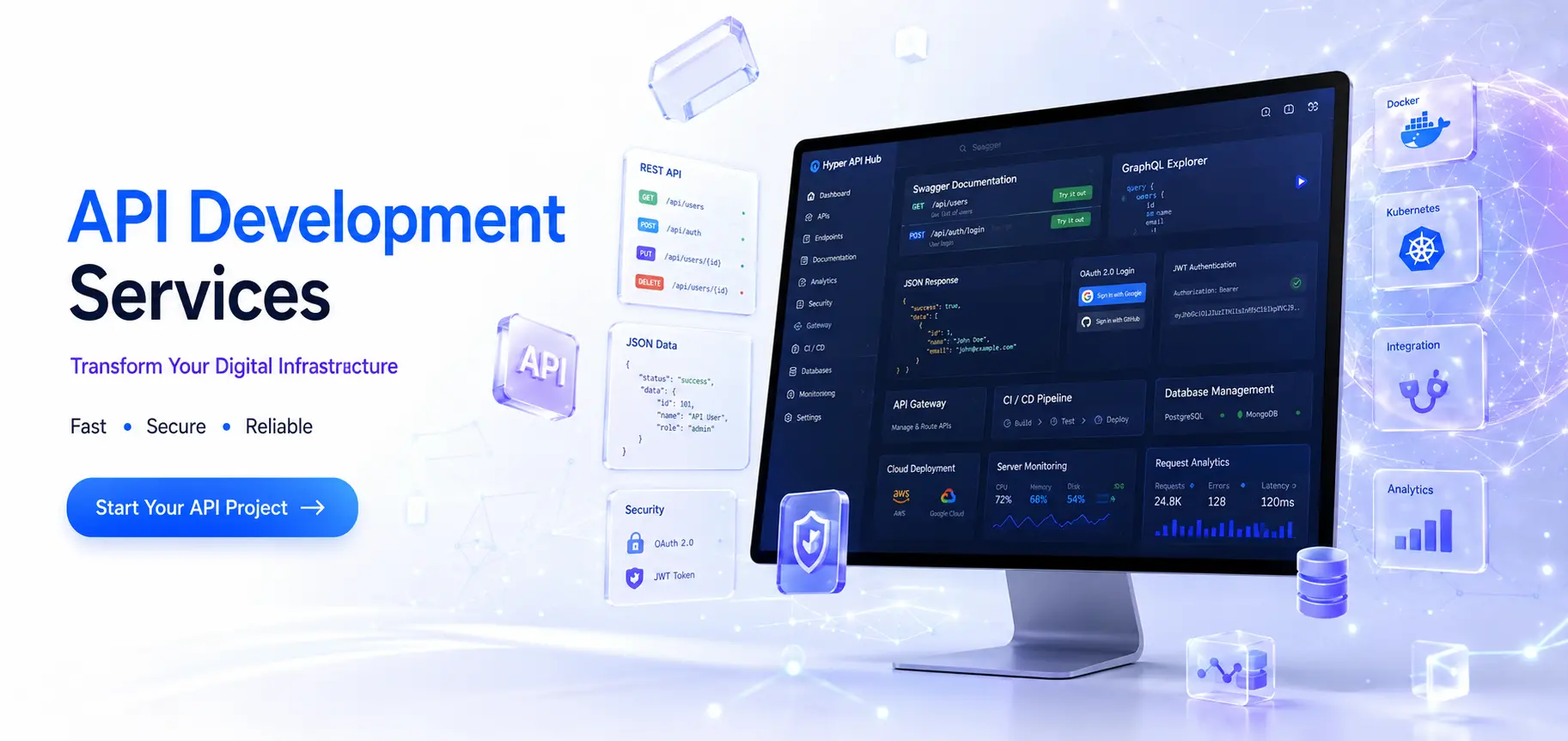
Real numbers, not vague ranges. Costs below are typical for a professionally built API with proper security and documentation — not a bare-minimum prototype.
Simple — Basic REST API, limited endpoints, API key authentication, and a single system connection. Typical Cost: $2,000–$8,000 | Timeline: 2–4 weeks.
Moderate — User management, multiple integrations, OAuth 2.0, and moderate data handling. Typical Cost: $8,000–$25,000 | Timeline: 4–10 weeks.
Enterprise — High transaction volume, real-time features, multi-system architecture, and compliance requirements. Typical Cost: $25,000–$75,000+ | Timeline: 3–6 months.
These are general industry ranges, not a quote. Your actual cost depends on the number of integrations, security requirements, and whether you're building fresh or modernizing something existing.
Building it yourself makes sense when: You have in-house engineers with real API experience, the project is simple, and you have time to absorb the learning curve if something goes wrong.
Hiring an agency makes sense when: You need it done right the first time, security or compliance is non-negotiable, your in-house team is already stretched thin, or bug fixes are costing more than a proper build would have.
What tends to go wrong doing it alone: Skipped documentation, security added as an afterthought, and no load testing. These problems often cost more to fix later.
Security isn't a feature you add — it's a decision you make at the design stage.
Authentication — OAuth 2.0 and JWT tokens for user-facing APIs; API keys for service-to-service calls.
Authorization — Role-based access control so users and systems can only do what they're supposed to.
Rate Limiting — Protection against abuse and accidental overload.
Input Validation — Every request is checked server-side and never trusted blindly from the client.
Encryption — HTTPS everywhere, with additional encryption for sensitive data in transit and at rest.
Compliance Support — Architecture built with HIPAA, PCI DSS, or GDPR requirements in mind when your industry demands it.
We test against the OWASP API website security Top 10 before anything goes live.
It's the process of building a set of rules that lets two pieces of software exchange data automatically, instead of a person doing it by hand.
A simple RESTAPI typically takes 2–4 weeks. A moderately complex API with multiple integrations takes 4–10 weeks. Enterprise-grade APIs with compliance requirements can take 3–6 months.
Simple APIs generally run $2,000–$8,000. Moderate complexity projects run $8,000–$25,000. Enterprise APIs with high security and compliance needs can exceed $75,000. Exact cost depends on integrations, security requirements, and architecture.
REST uses fixed endpoints that return set data structures. GraphQL lets the client request exactly the fields it needs in a single query. REST is simpler and cheaper for most projects; GraphQL is worth the extra setup when a frontend needs flexible, efficient data fetching.
Yes, mainly in banking, insurance, and government systems with legacy infrastructure and strict compliance needs. It's rarely chosen for new public- facing APIs.
If existing third-partyAPIs (Stripe, Twilio, Google Maps) already do what you need, use them — building your own would be wasted effort. A custom API makes sense when your business logic or data structure is genuinely unique.
It's a reference guide explaining how developers should use yourAPI — its endpoints, required data, and expected responses. Without it, every new developer has to reverse-engineer the API from the code, which slows everything down.
Through authentication (OAuth 2.0, JWT), authorization (role- based access), rate limiting, input validation, and encryption — all designed in from the start rather than added after launch.
Yes. You can build an API layer on top of an older system without rebuilding it, letting it connect to modern tools while staying exactly where it is.
API development is building a newAPI from scratch. API integration is connecting your systems to an API that already exists (yours or a third party's). Most projects involve some of both.
A mid-sized logistics company came to us with a familiar problem: their dispatch software and client-facing tracking portal didn't talk to each other. Every shipment update had to be entered twice, manually, by a small operations team that was already stretched thin.
Mistakes were common, and customers noticed.
We built a REST API that sat between the two systems, pulling live status updates from the dispatch software and pushing them to the tracking portal automatically. We also added a webhook layer so customers received real-time notifications.
The whole build took six weeks, including testing and documentation. The operations team stopped double-entering data entirely, and customer complaints about incorrect tracking information dropped to nearly zero within the first month.
Eighteen months later, the same API is still running, and we've extended it twice — once for a new carrier integration and once for a mobile app.
That's the real test of a good API: it should still be quietly working, unnoticed, years after launch.
Common Mistakes Businesses Make with API Development
Skipping documentation. It feels optional until a new developer joins the team and has no idea how anything connects.
Treating security as a later step. Retrofitting authentication into a live API is far harder — and riskier — than designing it in from day one.
Building for today's traffic only. An API that works fine at 100 users can fall over completely at 10,000 if nobody load-tested it.
No versioning strategy. Changing an API without versioning breaks every app already using it — including your own.
Choosing GraphQL because it's trendy, not because it fits. It solves a specific problem. If you don't have that problem, REST is simpler and cheaper.
It's the process of building a set of rules that lets two pieces of software exchange data automatically, instead of a person doing it by hand.
A simple RESTAPI typically takes 2–4 weeks. A moderately complex API with multiple integrations takes 4–10 weeks. Enterprise-grade APIs with compliance requirements can take 3–6 months.
Simple APIs generally run $2,000–$8,000. Moderate complexity projects run $8,000–$25,000. Enterprise APIs with high security and compliance needs can exceed $75,000. Exact cost depends on integrations, security requirements, and architecture.
REST uses fixed endpoints that return set data structures. GraphQL lets the client request exactly the fields it needs in a single query. REST is simpler and cheaper for most projects; GraphQL is worth the extra setup when a frontend needs flexible, efficient data fetching.
Yes, mainly in banking, insurance, and government systems with legacy infrastructure and strict compliance needs. It's rarely chosen for new public- facing APIs.
Have questions or need expert guidance? Our team is ready to help you with the right technology solutions for your business.