
Hyper Software ne hamare business ko online ek nayi pehchan di. Website professional, fast aur SEO optimized hai. Website Design & Development ke liye best company.

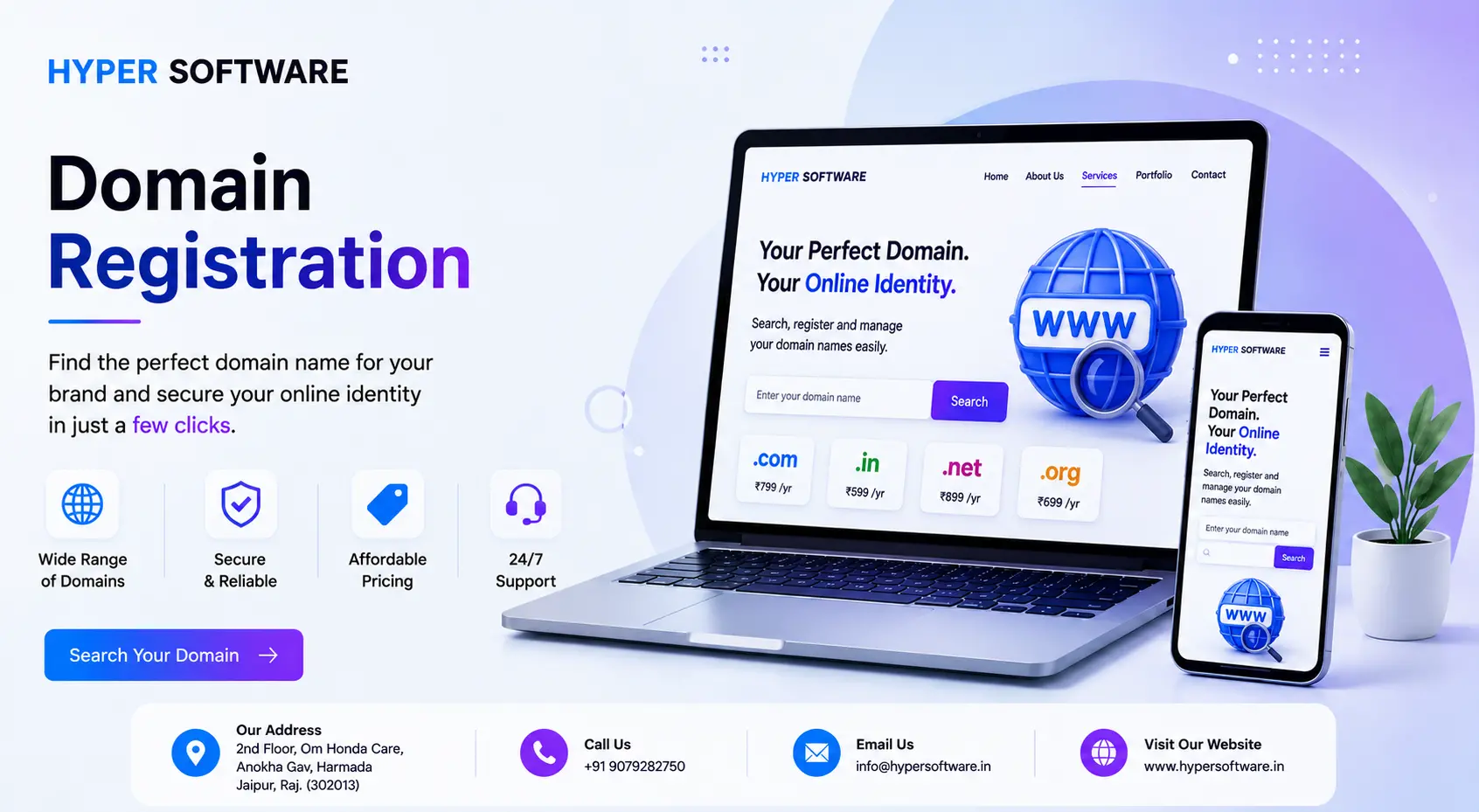
Domain registration is how you legally reserve a web address, like yourbusiness.com, so that it's yours and no one else can use it. You pick a name, choose an extension, verify your details, and pay an annual fee to a registrar. Do it right the first time and you never think about it again. Get it wrong, and you could lose your domain, your website, and your business email setup overnight.
At Hyper Software, we've registered and managed domains for clients across India and abroad since 2020. This page walks you through exactly how the process works, what it costs, and where most people go wrong — then shows you how we handle it for you, start to finish.
Think of a domain name as your street address on the internet. Without it, people can't find your website, and you can't have a professional email like yourname@yourbusiness.com. A domain registration is your legal right to use that address for a fixed period, usually one to ten years, through a company called a registrar.
Here's the part most guides skip: you don't actually own your domain the way you own a piece of land. You're leasing the right to use it. Miss a renewal and it can be picked up by someone else, including a competitor, within days.
A domain is also one of the few brand assets you control completely. Your social media handle can get suspended. Your marketplace listing can get delisted. Your domain, as long as you renew it, stays yours.
Get Free Consultation Within Minutes
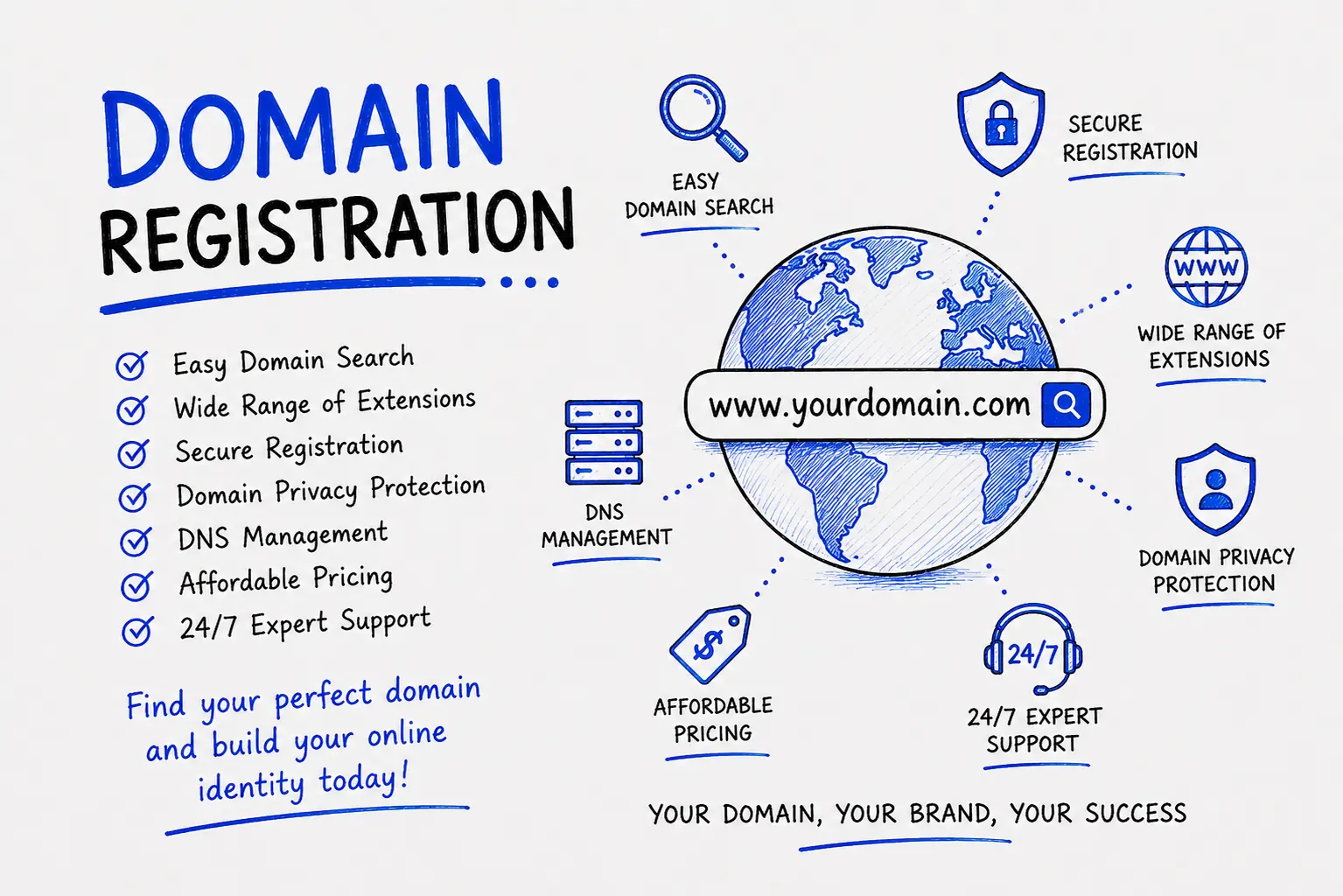
We don't just sell you a domain name and disappear. Here's what's included when you register through us:
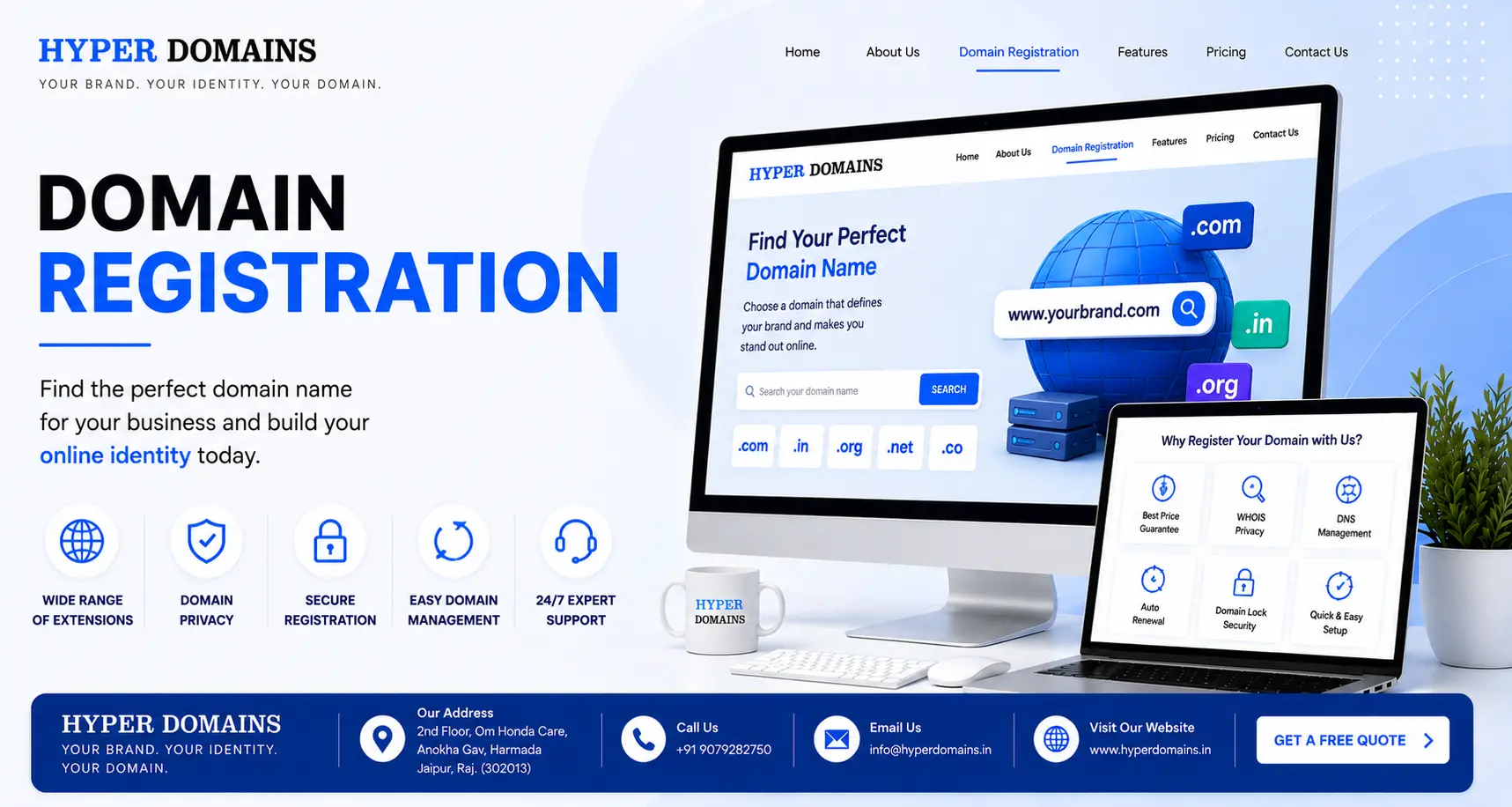
New Domain Registration — search, availability check, and registration across all major extensions: .com, .in, .co.in, .net, .org, .io, .co, and 500+ others.
Domain Transfer — moving a domain from another registrar to us, or from us to another provider if you ever need to, with zero downtime.
Bulk Domain Registration — for agencies and businesses managing multiple brands or client sites, at flat, transparent pricing.
DNS Management — pointing your domain to your hosting, email provider, or third-party tools like landing page builders, handled correctly the first time.
WHOIS Privacy Protection — your personal contact details stay off the public WHOIS lookup database, included free rather than sold as an upsell.
Domain Renewal Management — we track expiry dates and handle renewals so you never lose a domain to a missed payment.
1. Search for availability. We check your preferred name across every extension you're considering.
2. Choose the right extension. Based on your audience and budget (more on this below).
3. Provide ownership details. Name, address, email, and phone number for the WHOIS record.
4. Complete verification. For .in domains, this means NIXI eKYC using Aadhaar or PAN, completed within 7 days of registration.
5. Payment and confirmation. Your domain goes live, usually within minutes for most extensions.
6. DNS setup. We connect your domain to your hosting, email, or landing page so it actually works.
Most registrations complete same-day. .in domains can take a little longer if eKYC verification is delayed on the registrant's end.
The extension you pick affects trust, memorability, and sometimes even search visibility for local audiences.
|
Extension |
Best For |
Typical Price Range (India) |
|
.com |
Global businesses, most trusted and recognized |
₹400 – ₹999/year |
|
worldwide |
||
|
.in |
Businesses targeting Indian customers specifically |
₹250 – ₹999/year |
|
.co.in |
Indian companies where the exact .com/.in name is taken |
₹300 – ₹700/year |
|
.org |
NGOs, nonprofits, associations |
₹400 – ₹900/year |
|
.net |
Tech companies, alternative when .com is unavailable |
₹450 – ₹999/year |
|
.io |
Startups, SaaS, and tech products |
₹1,500 – ₹3,500/year |
|
.co |
Short, brandable alternative to .com |
₹800 – ₹2,000/year |
Prices vary by promotion and registry pricing changes, so always confirm current rates before you commit — this table is a planning guide, not a live price list.
Expert tip: if your primary market is India, .in and .com together (pointing to the same site or redirecting) protects your brand better than either one alone. We've seen businesses lose customers to a competitor who grabbed the extension they skipped.
Hyper Software ne hamare business ko online ek nayi pehchan di. Website professional, fast aur SEO optimized hai. Website Design & Development ke liye best company.

Three numbers matter far more than the flashy "starting at ₹99" banner you'll see everywhere:
1. Registration price — what you pay in year one.
2. Renewal price — what you pay every year after, which is almost always higher.
3. Add-on costs — privacy protection, transfer fees, and premium domain pricing, which some registrars bury in fine print.
As a rule, GST at 18% applies on top of the listed domain price in India, and most registrars now include WHOIS privacy for free rather than as a paid extra. A domain that looks cheap at ₹99 for year one but jumps to ₹1,500 at renewal is not actually the cheaper option over three years. We quote renewal pricing upfront, not just the first-year rate.
For most generic extensions (.com, .net, .org), you only need your name, email, phone number, and address.
For .in domains, Indian government rules require additional verification through NIXI:
This eKYC step trips up more first-time registrants than anything else in the process. We handle the verification flow for our clients so it doesn't get missed.
Both are valid choices. It depends on how much time you want to spend and how much risk you're comfortable taking on.
|
Do It Yourself |
Hire an Agency (Hyper Software) |
|
|
Cost |
Lowest upfront cost |
Slightly higher, bundled with setup |
|
Time |
30–60 minutes ifyou know what you're doing |
10 minutes ofyour time, we |
|
required |
handle the rest |
|
|
Risk of |
Higher — wrong DNS records, missed eKYC, |
Low — we track renewals |
|
mistakes |
forgotten renewals |
and handle verification |
|
Best for |
Technical users registering a single personal |
Businesses who want it |
|
domain |
done correctly and want |
|
|
ongoing support |
||
|
What can go |
Choosing the wrong extension, letting a domain |
N/A — these are exactly the |
|
wrong alone |
lapse, exposing personal contact details, misconfigured DNS breaking email or website |
mistakes we're hired to prevent |
If you're comfortable in a registrar's dashboard and only need one domain, DIY works fine. If you're managing a business, multiple domains, or you've been burned by a missed renewal before, an agency relationship pays for itself the first time it prevents an outage.
A Jaipur-based apparel brand came to us after their previous domain lapsed without warning — their web developer had registered it under a personal Gmail account that no longer worked, so the renewal notice never reached anyone. By the time they noticed, the domain had been picked up by a domain reseller asking for a steep buyback price.
We helped them register a new domain under the company's own verified details, set up auto-renewal on a company email and phone number, added WHOIS privacy, and configured DNS for their new hosting and business email in the same session. Two years ater, that domain has never lapsed, and it's now linked to three additional protective extensions we registered alongside it.
Domain registration is the process of reserving a unique web address through an accredited registrar so it's legally yours to use for a set period, typically renewed annually.
Prices generally range from ₹250 to ₹999 per year for standard extensions like .in and .com in the first year, with renewal pricing often higher — always confirm both before buying.
Most domains go live within minutes of payment. .in domains require eKYC verification within 7 days to remain active.
No. NIXI requires eKYC verification using Aadhaar or PAN for all .in domain registrations, completed within 7 days of purchase.
A domain is your web address; hosting is the server space where your website's files actually live. You need both for a live website, but they can be purchased separately or together.
Yes. Domain transfers are allowed after 60 days from registration and typically take 5–7 days to complete.
It enters a grace period during which you can still renew it, followed by a redemption period with a higher fee, and finally becomes vailable for anyone to register.
It's strongly recommended. Without it, your name, address, email, and phone number are publicly visible in the WHOIS database.
.in for businesses targeting Indian customers specifically, .com for businesses with global ambitions, and ideally both if your budget allows.
Yes, and it's recommended for brand protection — registering the .com, .in, and common misspellings prevents competitors or scammers from using them.
Most generic domains (.com, .net, .org) go live within minutes of payment confirmation. .in domains are typically active immediately but require eKYC completion within 7 days to stay active. Domain transfers between registrars usually take 5–7 days due to the mandatory transfer lock period set by ICANN.
No. A domain is just the address; you still need hosting and a built website for it to show anything when someone visits.
Yes. You can register and hold a domain with no website attached, though you'll need hosting eventually to actually launch a site.
It enters a grace period, then a more expensive redemption period, and if still unrenewed, becomes publicly available again for anyone toregister.
No. A domain name is unique — once registered, it can't be registered again by anyone else until it's released.
No, but owning a trademark on the name gives you legal standing to reclaim a domain if someone else registers it in bad faith.
Have questions or need expert guidance? Our team is ready to help you with the right technology solutions for your business.