
Hyper Software ne hamare business ko online ek nayi pehchan di. Website professional, fast aur SEO optimized hai. Website Design & Development ke liye best company.

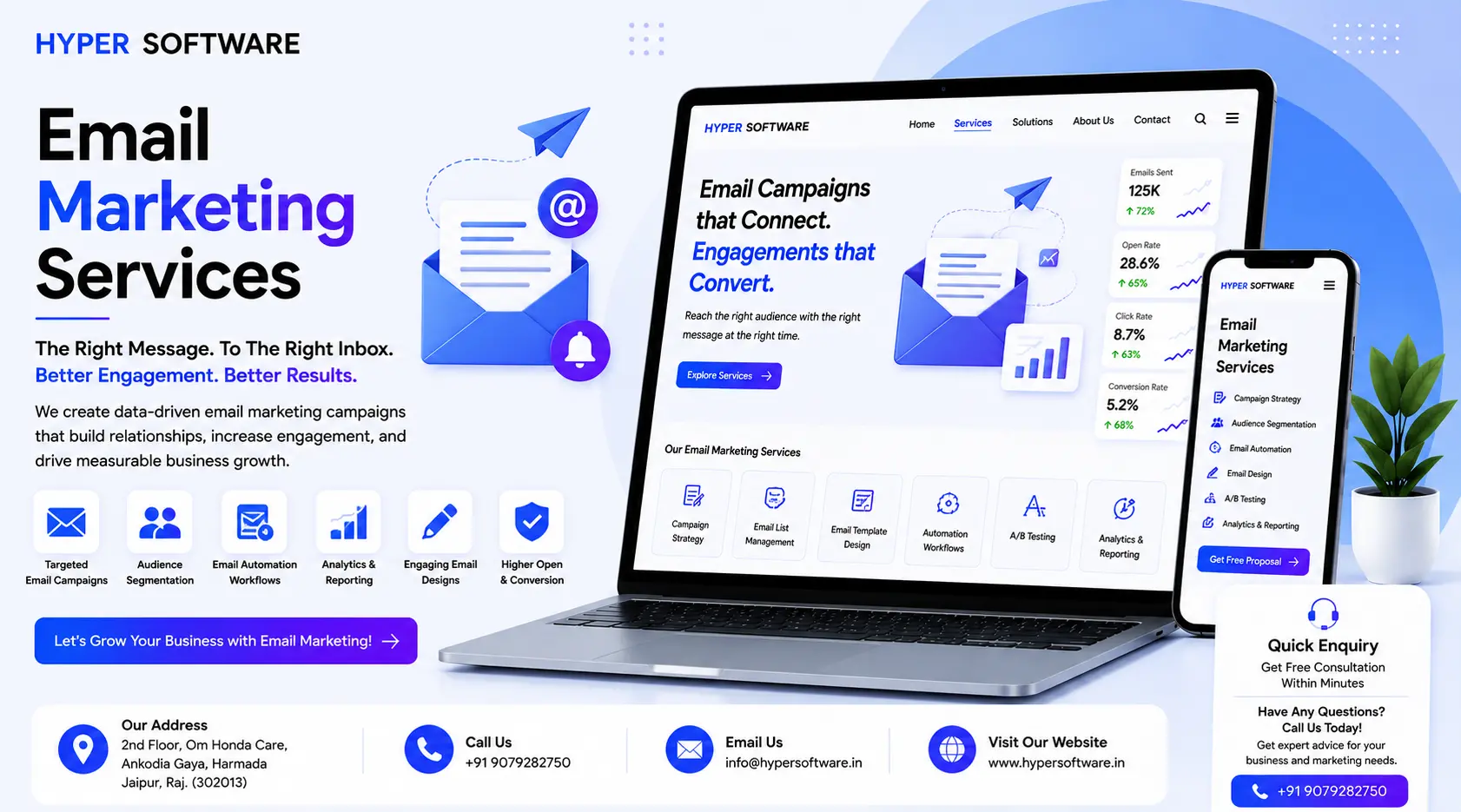
Email marketing is the practice of sending targeted, permission-based emails to build relationships, promote products, and turn subscribers into repeat customers. Done right, it's still the highest-ROI channel in digital marketing — email returns roughly $36 to $42 for every $1 spent, well ahead of paid search or social ads. Done badly, it's just noise sitting in a spam folder.
That gap between "done right" and "done badly" is where most businesses lose money. They either send inconsistent newsletters with no strategy, or they buy an email tool and never get around to setting up automation. Hyper Software runs email marketing programs for businesses worldwide — strategy, copywriting, design, automation, and the technical deliverability work that decides whether your emails even get opened in the first place.
Email marketing is a form of direct digital marketing where a business email setup sends emails to a list of people who've agreed to receive them, with the goal of building trust, driving sales, or keeping customers engaged over time. It covers everything from a one-off promotional blast to a fully automated sequence that responds to what a subscriber does on your website.
Unlike social media, you own your email list. No algorithm decides who sees your message, and no platform can shut down your account overnight. That's why so many businesses treat email as their most reliable channel, not their flashiest one.
Get Free Consultation Within Minutes
Marketers keep predicting email's death. It hasn't happened, and the numbers explain why.
None of that happens by accident. It happens because someone set up the segmentation, wrote the sequence, and kept an eye on deliverability. That's the actual job.
Hyper Software ne hamare business ko online ek nayi pehchan di. Website professional, fast aur SEO optimized hai. Website Design & Development ke liye best company.

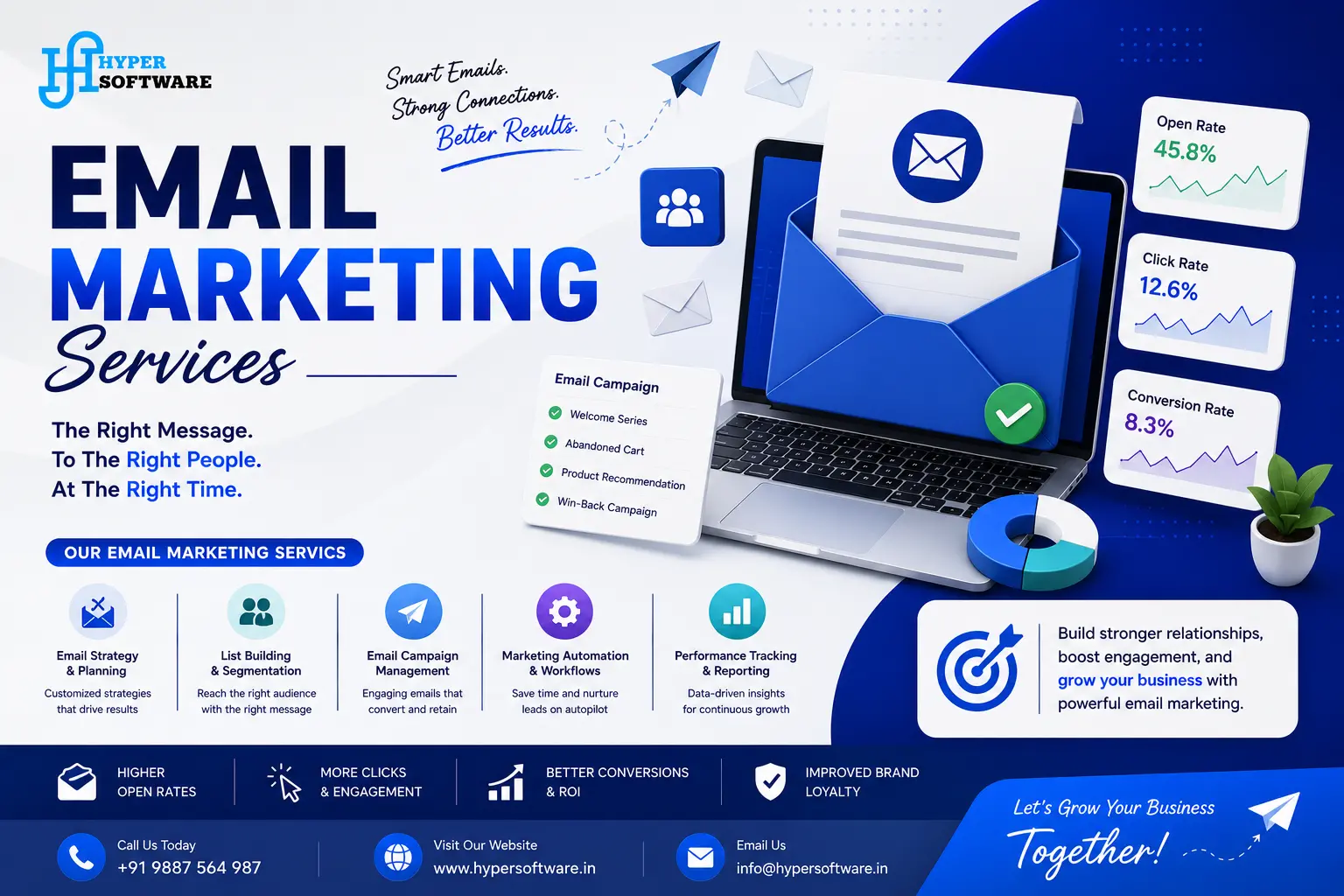
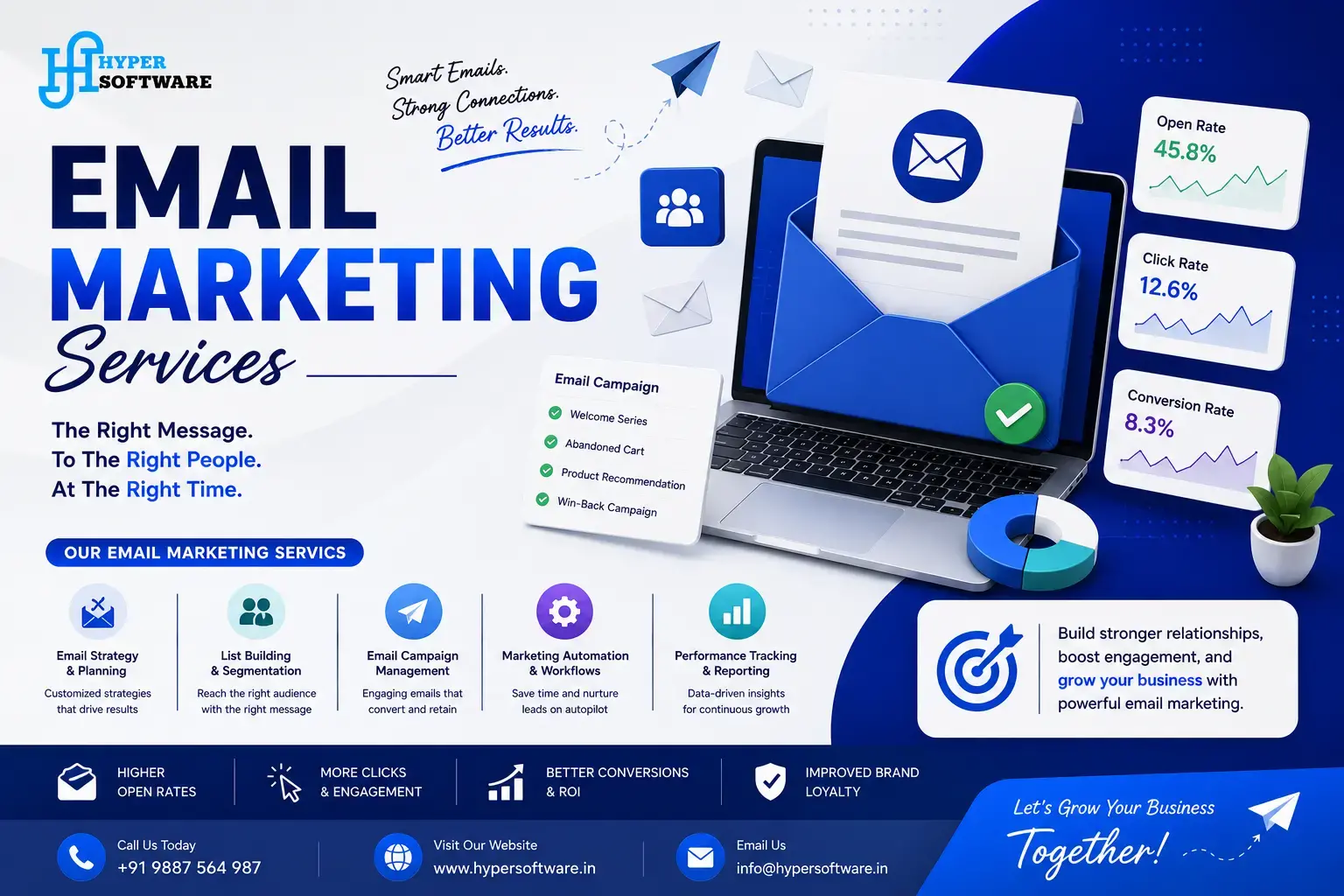
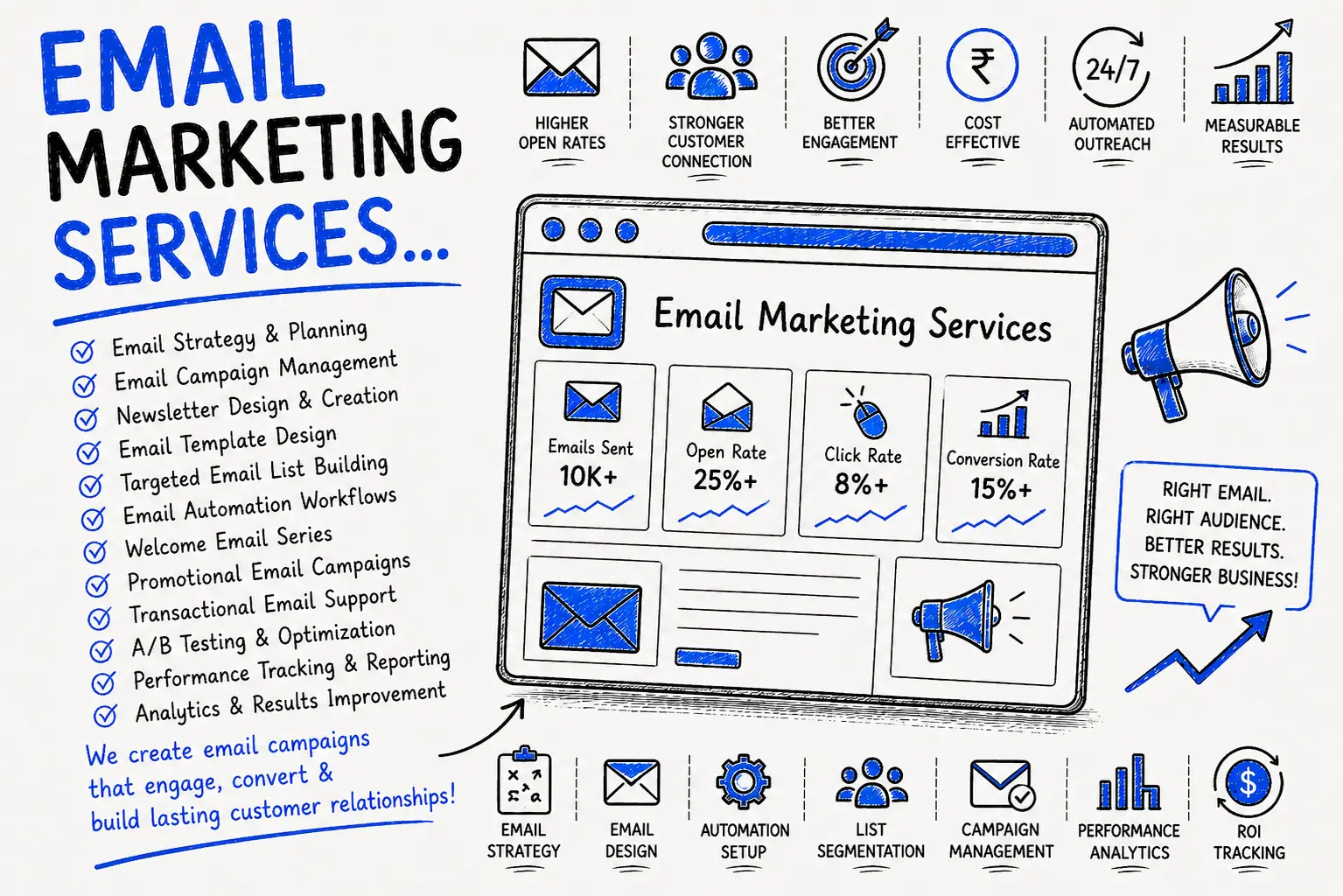
We don't sell "email marketing" as one vague package. Here's exactly what's included when you work with us.
Email Marketing Strategy
Before we write a single subject line, we map out your audience, your sending cadence, and where email fits alongside your other channels. A B2B software company and a fashion eCommerce brand need completely different email strategies, and we build yours around your actual sales cycle, not a template.
Campaign Design and Copywriting
We write and design the emails themselves — subject lines, body copy, and mobile- responsive templates that match your brand. Every email is built to be read on a phone first, since most people open email on mobile.
Marketing Automation and Drip Sequences
This is where the real revenue sits. We build welcome series, abandoned-cart flows, post- purchase sequences, re-engagement campaigns, and lead-nurturing drips inside your ESP (Klaviyo, Mailchimp, HubSpot, ActiveCampaign, Brevo, or whatever platform you're already using).
List Segmentation and Management
We segment your list by behaviour, purchase history, engagement level, or lifecycle stage, so a first-time visitor and a five-year customer never get the exact same email. We also handle list hygiene — removing dead addresses and cutting bounce rates before they hurt your sender reputation.
Reporting and Analytics
You get a straight answer to "is this working," backed by opens, clicks, conversions, and revenue attributed to email, not just vanity metrics dressed up in a pretty dashboard.
Plenty of businesses start with DIY email marketing, and for a small list, that's often the right call. The question is when it stops making sense.
| Factor | DIY | Hiring an Agency |
|---|---|---|
| Best For | Businesses with fewer than 1,000 subscribers sending simple newsletters. | Growing businesses, eCommerce stores, B2B companies, and brands needing automation and lead generation nurturing. |
| Typical Monthly Cost | Free to ₹2,000–₹3,500 for basic email marketing tools. | ₹15,000–₹1,00,000+ per month, depending on campaign size and requirements. |
| Time Required | 5–10 hours per week for planning, creating, testing, and sending emails. | Minimal effort — you review campaigns and approve content marketing while the agency handles execution. |
| Automation Depth | Usually limited to a basic welcome email or simple autoresponder. | Complete automation including welcome sequences, abandoned cart recovery, lead nurturing, win-back campaigns, upsell flows, and customer lifecycle emails. |
| Deliverability Setup | Often overlooked or configured incorrectly, increasing the risk of emails landing in spam. | Properly configured SPF, DKIM, DMARC, domain authentication, list hygiene, and ongoing deliverability monitoring. |
| Common Challenges | Emails landing in spam, poor list segmentation, inconsistent sending schedules, low open rates, and limited reporting. | Significantly lower risk, with professional campaign management, advanced segmentation, A/B testing, analytics, and continuous optimization. |
If you're sending one newsletter a month to a small list, DIY tools like Mailchimp's free tier are genuinely fine. Once you need automation, segmentation, or you're managing more than a couple thousand contacts, the time you'd spend learning deliverability and automation setup usually costs more than hiring it out.
Pricing varies a lot depending on list size, automation complexity, and whether you need copy and design included.
Software costs sit on top of this — most ESPs charge ₹800 to ₹8,000+ per month depending on list size, separate from the strategy and management fee. Ask any provider for a clear breakdown of what's covered before you sign anything; "email marketing package" means very different things at different agencies.
A mid-sized home décor eCommerce brand came to us with a Mailchimp account, a 12,000- person list, and one newsletter a month that barely moved sales. They had no automation at all — every abandoned cart, every new signup, went completely unfollowed.
We started with a deliverability audit and found their sender reputation was already taking a hit from an old, unsegmented list. We cleaned it, set up proper authentication, then built three automation flows: a welcome series, an abandoned-cart sequence, and a 60-day win- back campaign for inactive subscribers. We also split their list by purchase category so promotions actually matched what each subscriber had bought before.
Within three months, their abandoned-cart flow alone was generating measurable weekly revenue on its own, and their overall email-attributed sales had grown well past what the monthly newsletter used to bring in — from a channel they'd already been paying for and barely using.
Email marketing is sending targeted, permission-based emails to build relationships and drive sales. It includes newsletters, promotional campaigns, and automated sequences like welcome series or abandoned-cart emails.
Because it consistently delivers a higher return than most other digital channels, and you own the list outright — no platform algorithm controls who sees your message.
Newsletter marketing is one type of email marketing, usually recurring updates sent to your whole list. Email marketing is the broader discipline that also includes automation, segmentation, and one- off promotional campaigns.
It's a system of pre-built email sequences triggered by subscriber behaviour, like signing up, abandoning a cart, or going quiet for 60 days, so relevant emails go out without manual work each time.
For small businesses, expect roughly ₹3,500 to ₹25,000 per month. Larger programs with full automation typically run ₹25,000 to over ₹1,00,000 per month, plus separate ESP software costs.
Automated flows like abandoned-cart recovery can show results within the first week. Newsletter and nurture campaigns usually take 30 to 60 days to stabilise and show a clear trend.
Averages sit around 20–28% across industries, though this varies a lot by sector, and Apple's Mail Privacy Protection has made open rate less reliable than click and conversion data.
No. A smaller, well-segmented, engaged list often outperforms a large, unsegmented one, since email revenue depends more on relevance than raw list size.
An ESP (like Mailchimp or Klaviyo) is the software you send emails through. An agency is the team that builds your strategy, writes and designs campaigns, sets up automation, and manages the ESP for you.
Yes, and often especially well. B2B emails tend to see higher click-to-open ratios than B2C, largely because content is more targeted and sent to a smaller, more relevant list.
We work inside the ESP you already use, or help you choose one if you're starting fresh: Mailchimp, Klaviyo, HubSpot, ActiveCampaign, Brevo, Zoho Campaigns, and Salesforce Marketing Cloud, among others. We also integrate email with your CRM development so customer data flows both ways instead of living in two disconnected systems.
Compliance isn't optional, and it's not just a legal checkbox — it directly affects deliverability. The US CAN-SPAM Act / email compliance requires a clear opt-out in every commercial email and accurate sender information. The EU's GDPR requires explicit consent before you email anyone in the EU, plus clear data-handling practices. India's Digital Personal Data Protection Act sets similar consent and data-handling requirements for Indian subscribers. We build every campaign around opt-in consent and clean unsubscribe handling from day one, whichever regions your list spans.
A full email marketing service covers strategy, list segmentation, campaign design and copywriting, automation setup, deliverability management, A/B testing, and monthly reporting — not just sending newsletters.
Yes. Email marketing continues to deliver the highest ROI of any digital channel, averaging $36 to $42 per $1 spent, largely driven by automated flows like welcome series and cart recovery.
Costs typically range from ₹15,000 to over ₹1,00,000 per month depending on list size, automation complexity, and whether design and copywriting are included.
Yes, for a small list with simple newsletters, most free or low-cost tools work fine. Once you need automation, segmentation, or deliverability management, an agency usually saves more time and money than it costs.
Email marketing is sent to people who've opted in and can unsubscribe anytime. Spam is unsolicited and usually violates laws like CAN-SPAM or GDPR.
Have questions or need expert guidance? Our team is ready to help you with the right technology solutions for your business.