
Website launch hone ke baad customer enquiries me noticeable increase hua. SEO aur speed optimization ka result clearly dekhne ko mila. Excellent work.

Looking for a team that can turn your idea into a working iPhone app? Hyper Software builds custom iOS apps using Swift / SwiftUI for startups and businesses across the world, from the first wireframe to a live listing on the App Store. We handle design, backend, testing, and post-launch support under one roof, so you deal with one team, not five vendors.
Quick Answer: iOS app development is the process of designing, building, testing, and launching an application for iPhone and iPad using Apple's Swift language and Xcode tools. A typical custom iOS app takes 3 to 9 months to build, depending on features, and costs between $8,000 and $150,000+. Hyper Software delivers native and cross-platform iOS apps with transparent pricing and a dedicated development team.
Native iOS apps (Swift/SwiftUI) perform better and get first access to newApple features; cross-platform apps are faster and cheaper if you need iOS and Android together.
Costs typically run $8,000–$25,000 for a simple app, $25,000–$80,000 for mid-complexity, and $80,000–$150,000+ for enterprise-grade apps.
Apple's App Store review usually adds 1–3 weeks to any launch timeline.
Hyper Software offers fixed-cost quoting after discovery, plus post-launch maintenance so your app doesn't break on the next iOS update.
📞Talk to our iOS team: +91 9079282750 |🌐www.hypersoftware.in
iOS app development means building software that runs on Apple devices, iPhone, iPad, Apple Watch, and Apple TV, using Apple's official tools: Swift, SwiftUI, Objective-C, and Xcode. The finished app is submitted to Apple's App Store, where it goes through a review process before it reaches users.
There are two main routes:
Native iOS development — built specifically forApple's operating system using Swift and SwiftUI. Faster, smoother, and able to use every iPhone feature (Face ID, ARKit, Apple Pay, widgets).
Cross-platform development — built once using Flutter or React Native and deployed to both iOS and Android. Cheaper upfront, but a step behind native apps on performance and access to new iOS features.
Get Free Consultation Within Minutes
iPhone users make up a smaller share of the global smartphone market than Android, but they spend far more inside apps. That gap is the whole business case for going iOS-first.
Higher user spending. iOS users consistently spend more on in-app purchases and subscriptions than Android users, which means better revenue per download for paid and freemium apps.
A cleaner device landscape. Apple sells a limited number of device models, so your QA team tests fewer screen sizes and hardware combinations. Fewer devices mean fewer bugs slipping through.
Stronger brand perception. An app that feels native, fast, and well-designed on iPhone builds trust faster than a clunky cross-platform build.
Tighter security. Apple's App Store review and sandboxing rules are strict, which works in your favor if your app handles payments, health data, or personal information.
Early access to new hardware. Face ID, ARKit, widgets, App Clips, and on-device AI (Core ML / ARKit) usually land on iOS first, giving native apps a head start on new experiences.
None of this means you should skip Android app. It means iOS is rarely the platform to cut corners on if your audience includes iPhone users with money to spend.T
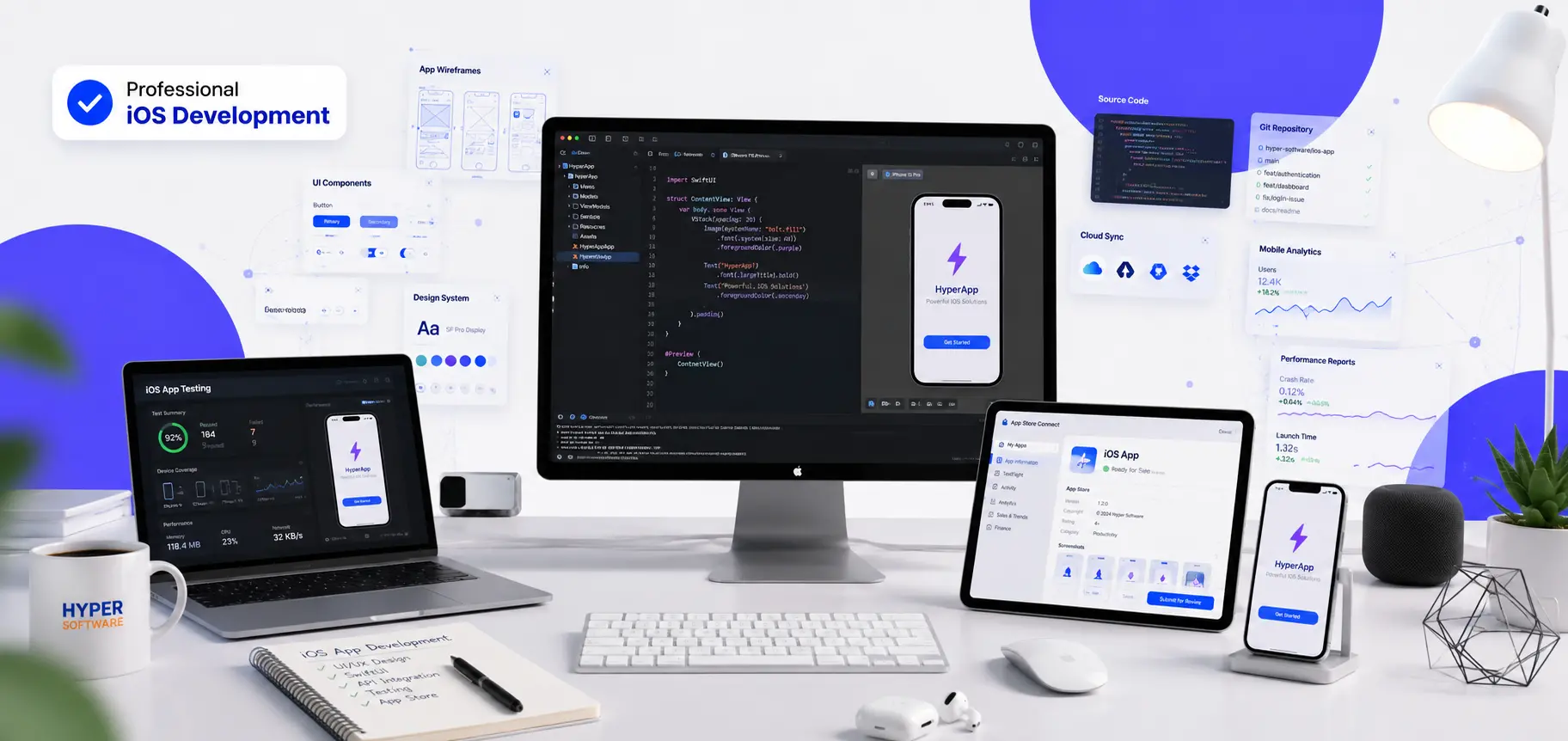
We cover the full lifecycle of an iOS product, not just the coding part.
Native iOS App Development — Apps built in Swift and SwiftUI, optimized for speed, battery life, and Apple's design guidelines.
iPhone & iPad App Development — Interfaces tailored to each screen size, including split-view and multitasking support for iPad.
MVP Development for Startups — A lean, working first version so you can test your idea with real users before committing to the full build.
Enterprise iOS App Development — Apps with role-based access, offline sync, single sign-on, and integration with your existing CRM/ERP integration or internal systems.
UI/UX Design for iOS — Screens designed in Figma following Apple's Human Interface Guidelines, so the app feels familiar to iPhone users from the first tap.
API & Backend Development — Custom backends, third-party integrations (payment gateways, CRM, analytics, maps), and cloud hosting on AWS, Firebase, orAzure.
Apple Watch & Apple TVApps — Companion apps and watchOS/tvOS extensions for brands that want a presence across the whole Apple ecosystem.
App Store Submission & Deployment — We prepare your listing, screenshots, and metadata, and handle the review process end to end.
iOS App Maintenance & Support — Bug fixes, iOS version updates, and performance monitoring after launch, so the app keeps working when Apple ships a new OS.
App Redesign & Modernization — Rebuilding an old Objective-C or UIKit app in SwiftUI, or refreshing the UI of an app that's starting to feel dated.

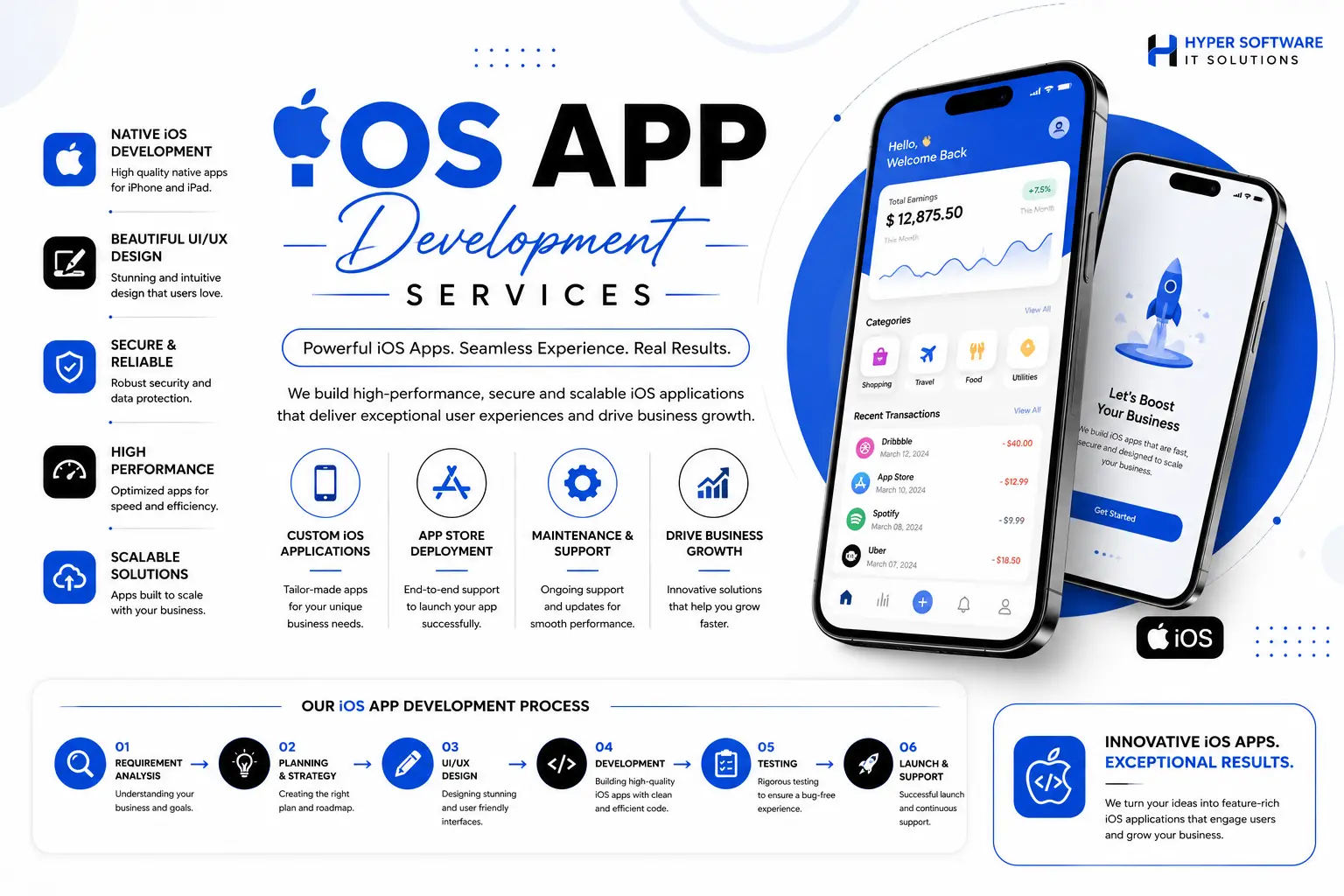
Here's what actually happens after you contact us, step by step.
1. Discovery & Requirement Analysis (1–2 weeks). We learn your business, your users, and what "success" looks like for this app. We turn that into a feature list and a rough scope document.
2. UI/UX Design (2–4 weeks). Wireframes first, then high-fidelity screens in Figma, built to Apple's Human Interface Guidelines. You review and approve every screen before development starts.
3. App Architecture & Backend Setup. We design the database, APIs, and server structure so the app can grow without a rebuild later.
4. Development in Sprints. Our team builds in two-week sprints. You get a working build to review at the end of each sprint, not a black box for three months.
5. QA & Testing. Manual and automated testing across real iPhone and iPad models, covering functionality, performance, and security before anything goes near the App Store.
6. App Store Submission. We prepare the listing, handle Apple's review requirements, and manage any rejections or resubmissions.
7. Launch & Post-Launch Support. We monitor crash reports and user feedback in the first weeks after launch, then move into a maintenance plan. Most clients stay in weekly contact with a project lead throughout, so there's no guessing where things stand.
There's no single number here, and any agency that quotes you a flat price without asking about your features is guessing. Cost depends on the number of screens, backend complexity, integrations, and design polish. That said, here's the general range the industry works within:
| App Type | Typical Features | Cost Range (USD) | Timeline |
|---|---|---|---|
| Simple / MVP App |
Login, basic screens, static content, no custom backend |
$8,000 – $25,000 | 6–10 weeks |
| Mid-Complexity App | User accounts, custom backend, payments, push notifications, APIs | $25,000 – $80,000 | 3–6 months |
| Enterprise / Complex App | AI features, real-time data, advanced security, multiple integrations | $80,000 – $150,000+ | 6–9+ months |
A few things that quietly push cost up: custom animations, real-time chat, HIPAA or PCI- DSS compliance, and Apple Watch companion apps. A few things that bring it down:
starting with an MVP, using managed services like Firebase for auth and notifications instead of building them from scratch, and being ruthless about which features actually matter for version one.
We give a fixed quote after the discovery phase, once we know exactly what you're building, not before.
| Project Size | Design | Development | Testing | Total Timeline |
|---|---|---|---|---|
| Simple App | 1–2 weeks | 4–6 weeks | 1–2 weeks | 6–10 weeks |
| Mid-ComplexityApp | 1–2 weeks | 10–16 weeks | 2–4 weeks | 3–6 months |
| Enterprise App | 4–6 weeks | 24–36 weeks | 4–6 weeks | 6–9+ months |
Apple's app review typically adds another 1–3 weeks on top of this, longer if your app needs resubmission after a rejection.
This is the question almost every client asks in the first call, so here's a straight comparison.
| Factor | Native iOS (Swift/SwiftUI) |
Cross-Platform (Flutter/React Native) |
|---|---|---|
| Performance | Fastest, uses full device hardware |
Slightly slower, one layer removed from hardware |
| Access to new iOS features | Immediate (Face ID, widgets, ARKit) |
Delayed, depends on plugin support |
| Cost | Higher if you also need Android | Lower if you need both platforms |
| Best for | Apps with heavy graphics, AR, health data, or an iPhone-heavy audience | Startups needing both iOS and Android fast, on a limited budget |
| Long-term maintenance | Clean, Apple-supported upgrade path |
Depends on the framework's update cycle |
Some founders try to build the first version themselves using no-code tools or by learning Swift on the side. It's worth being honest about when that works and when it doesn't.
Building it yourself makes sense when:
You're testing a very simple idea with no backend or payments involved.
You already have coding experience and time to spare.
The goal is a personal project or internal tool, not a public product.
What usually goes wrong doing it alone:
No-code tools hit a wall fast once you need custom logic, complex APIs, or offline sync.
App Store rejections pile up without someone who knows Apple's review guidelines.
Security gaps show up later, usually after a data breach or a failed compliance check, not before.
What looked like a 2-month project quietly becomes an 8-month one.
Hiring an agency makes sense when:
You need the app to work reliably for paying customers or employees from day one.
The app touches payments, health data, or any regulated information.
You want a fixed timeline and someone accountable for bugs after launch.
A rough cost comparison: a solo freelancer might charge $20–$60/hour with no backup if they get sick or move on. An agency like Hyper Software gives you a full team (design, development, QA) at a fixed project cost, with support that doesn't disappear after launch.
Healthcare — appointment booking, telemedicine, patient record apps with HIPAA-aware data handling.
E-commerce & Retail — shopping apps, loyalty programs, in-app checkout.
Fintech — secure payment apps, budgeting tools, digital wallets.
Education — e-learning apps, student portals, live class platforms.
Real Estate — property listing apps with map search and virtual tours.
Logistics & On-Demand — delivery tracking, driver apps, dispatch dashboards.
Hospitality & Travel — booking apps, loyalty apps, in-stay concierge apps.
iOS apps are built with Swift forApple devices only, while Android apps are built with Kotlin or Java for a wide range of device brands. iOS development usually involves testing fewer device models, while Android development needs to account for far more screen sizes and hardware combinations.
A simple app typically takes 6 to 10 weeks. A mid-complexity app with custom backend and integrations takes 3 to 6 months. Enterprise apps with advanced features can take 6 to 9 months or longer.
Costs generally range from $8,000 for a simple MVP to $150,000 or more for a complex, enterprise-grade app. The final number depends on features, design complexity, and integrations, so it's worth getting a scoped quote rather than trusting a flat number.
Development teams do, since Xcode (Apple's development tool) only runs on macOS. As a client, you don't need one. You just need a browser to review designs and builds.
Swift is the current standard, paired with SwiftUI for the interface. Older apps sometimes still use Objective-C, mostly for maintaining legacy code.
Go native if your audience is mostly iPhone users or your app needs deep hardware access like ARKit or HealthKit. Go cross- platform if you need both iOS and Android fast on a tighter budget.
Yes, though a good conversion involves more than wrapping your website in a browser shell. We typically rebuild the core flows natively so the app performs and feels like a proper iPhone app, not a website in disguise.
It includes preparing your app listing, screenshots, privacy details, and metadata, then submitting forApple's review. Review usually takes a few days to a couple of weeks, and rejections for guideline issues are common if the process isn't handled by someone experienced.
Yes. We offer maintenance plans covering bug fixes, iOS version compatibility updates, and performance monitoring, since Apple's yearly OS updates can break parts of an app that isn't kept current.
Yes, with offline-first architecture using local storage like Core Data, then syncing data once the connection returns. This needs to be planned during the discovery phase, not added later.
A retail chain based in Rajasthan came to us with a common problem: their in-store loyalty program was running on paper punch cards, and they were losing repeat customers who simply forgot to bring the card. They wanted a simple iPhone app that customers could actually be bothered to install.
We started with a two-week discovery phase to strip the idea down to what mattered: a
digital loyalty card, push notifications for offers, and a store locator. No login walls, no clutter. We built it natively in SwiftUI so it felt fast and familiar from the first launch, integrated Apple Wallet so loyalty cards could live on the lock screen, and connected it to their existing point-of-sale system through a custom API.
The app went from wireframe to App Store approval in about ten weeks. Within the first two months, the client saw a noticeable jump in repeat visits from app users compared to their old punch-card system, and support requests dropped because customers could see their points balance without asking staff. The lesson for us, and for anyone reading this: the apps that win aren't the ones with the most features. They're the ones that solve one real
problem cleanly.
Skipping the discovery phase. Jumping straight to design without defining the core problem leads to feature creep and budget overruns.
Ignoring Apple's Human Interface Guidelines. Apps that don't feel "native" get rejected more often and get uninstalled faster.
Building for every device from day one. Trying to launch on iPhone, iPad, and Apple Watch simultaneously in version one usually delays everything.
Underestimating the App Store review guidelines process. Apple rejects a large share of first submissions, mostly for guideline issues that a specialist would catch early.
Choosing the cheapest quote without checking process. A low price with no QA plan or maintenance plan almost always costs more later in rework.
No plan for iOS updates. Apple pushes a new iOS version every year. Apps that aren't maintained start breaking within 12–18 months.
Hyper Software has been building digital products for businesses since 2020, working out of Jaipur and serving clients globally. iOS app development sits alongside our website development, custom software, CRM/ERP, and UI/UX design work, which means your app doesn't get built in isolation. If it needs to talk to a CRM, a website, or an internal system, we already have the team for that under one roof.
Fixed-cost quoting after a proper discovery phase, no surprise bills.
A dedicated project lead you can actually reach, not a rotating support inbox. Native Swift/SwiftUI development plus cross-platform options, so we recommend what fits, not what we happen to sell. Post-launch maintenance plans so your app doesn't break the next time Apple
updates iOS.
Global delivery, with development and support hours that work for US, UK, UAE, and Indian clients.
If you want to talk through your idea before committing to anything, call +91 9079282750 or visit www.hypersoftware.in
A native app is installed from the App Store and can access device hardware directly (camera, Face ID, notifications). A PWA runs in a browser and has more limited access to those features, but is cheaper and faster to build.
We followApple's App Transport Security requirements, use encrypted data storage, and build in compliance measures like HIPAA or PCI-DSS handling where the app requires it, particularly for healthcare and fintech clients.
Yes, we build companion watchOS and tvOS apps alongside the main iPhone app when a client's product genuinely benefits from being on those devices.
We reviewApple's rejection notes, fix the flagged issue, and resubmit. Most rejections come down to guideline details (like privacy disclosures or incomplete features) rather than major redesigns.
Yes. Hyper Software serves clients across the US, UK, UAE, Australia, and beyond, with development and communication scheduled to fit different time zones.
Have questions or need expert guidance? Our team is ready to help you with the right technology solutions for your business.