Hyper Software ne hamare business ko online ek nayi pehchan di. Website professional, fast aur SEO optimized hai. Website Design & Development ke liye best company.

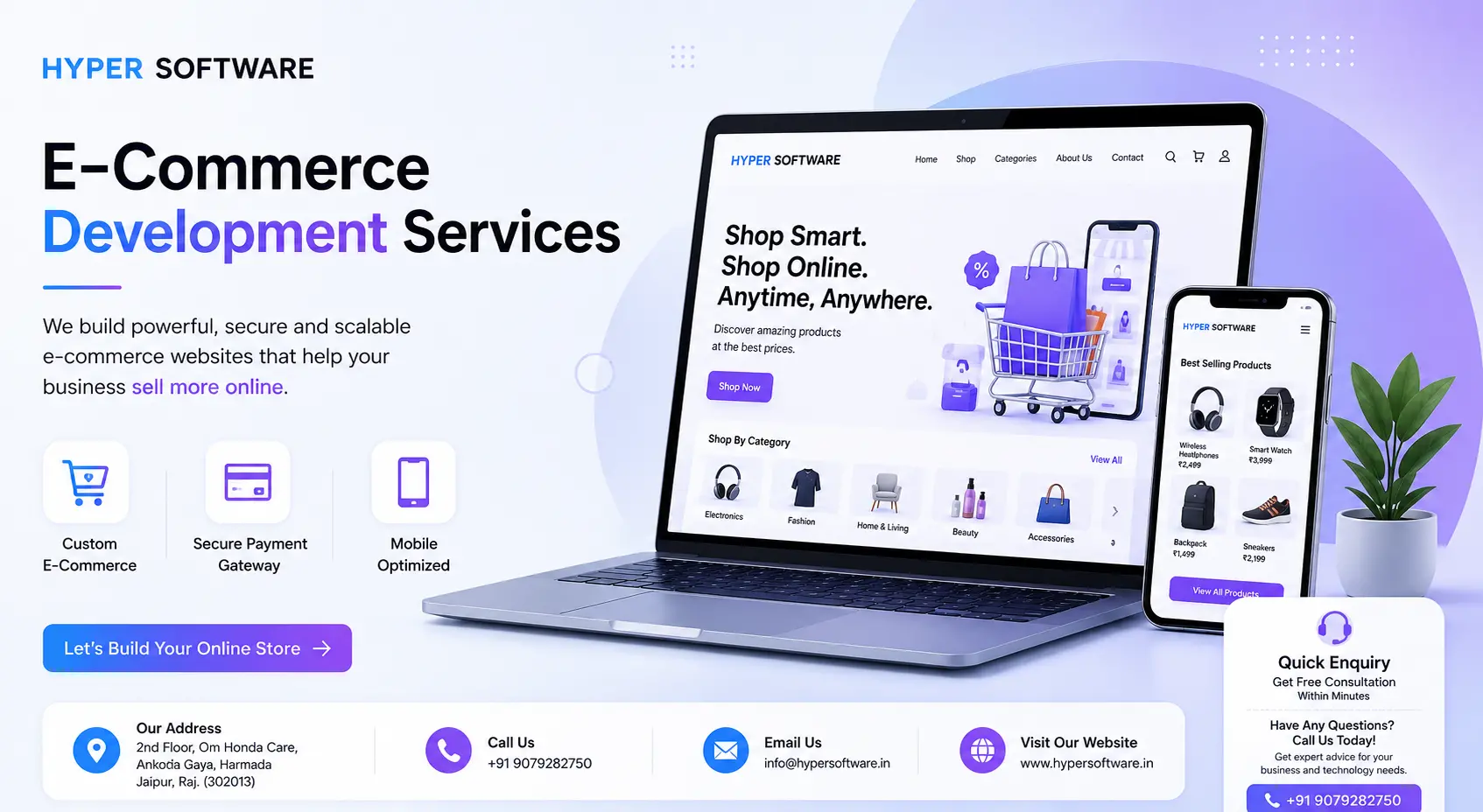
E-commerce development is the process of building an online store — the design, the coding, the payment setup, and the testing — so your business can sell products or services on the internet. Done right, it turns a simple idea into a working sales channel that runs 24 hours a day. Done poorly, it turns into a slow, clunky site that loses customers at checkout.
At Hyper Software, we build ecommerce websites for businesses across the world, from first-time D2C brands launching their very first store to established companies migrating off a platform they've outgrown. This page walks you through what ecommerce development actually involves, what it costs, how long it takes, and what to watch out for before you sign off on a project.
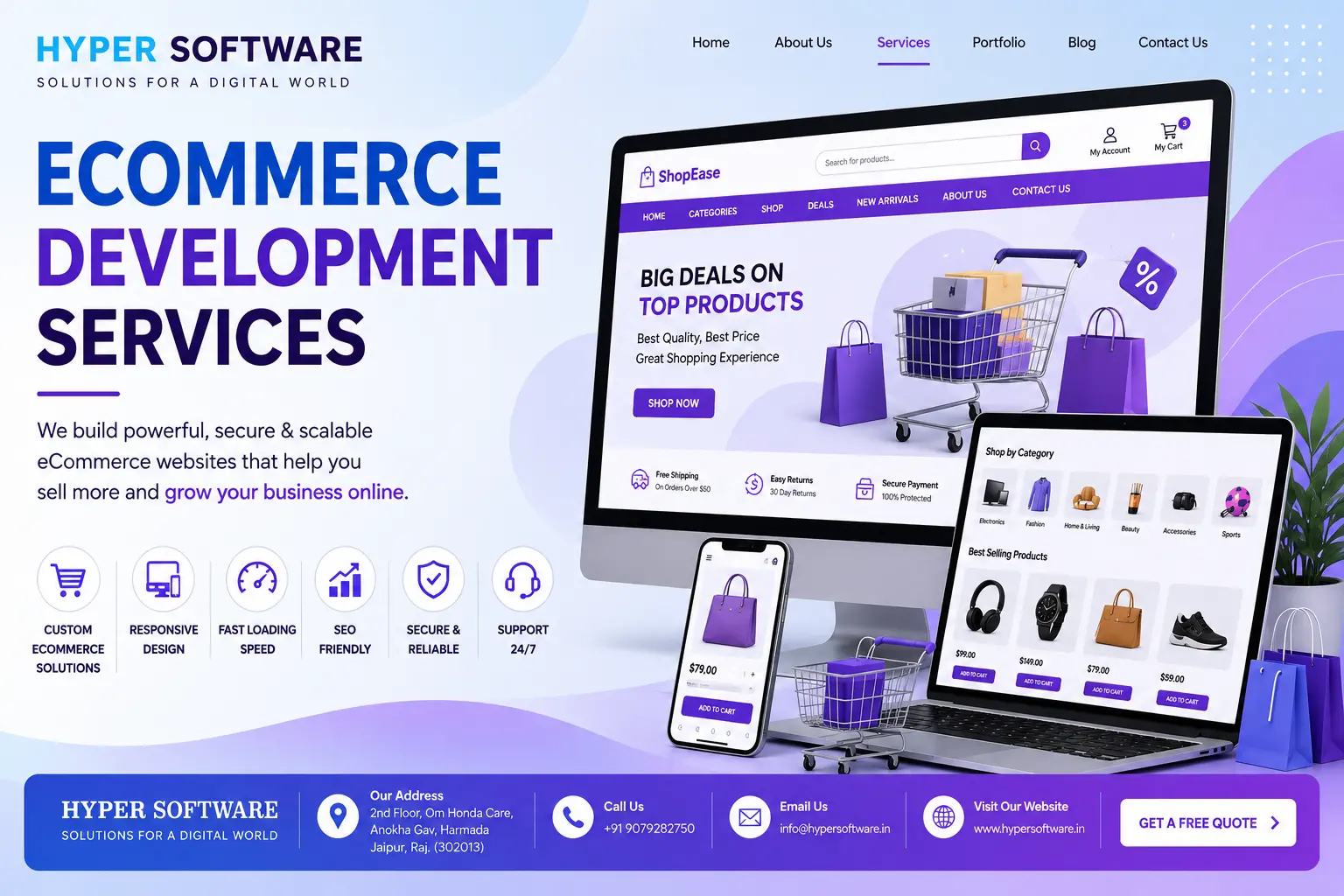
E-commerce development means building the technology behind an online store: the product pages, shopping cart, checkout, payment gateway, order management, and everything that connects them. It's not just design. A store can look beautiful and still fail if the checkout is slow, the payment gateway isn't configured properly, or the site crashes under traffic during a sale.
Good ecommerce development covers three layers working together:
The front end — what shoppers see and click: product pages, search, filters, cart, checkout.
The back end — what runs behind the scenes: inventory, order processing, tax rules, shipping logic, admin dashboards.
The integrations — the systems that connect to the store: payment gateways, CRM, ERP, email marketing, and shipping carriers.
Miss any one of these layers, and the store either looks unfinished or breaks under real use.
Get Free Consultation Within Minutes
Not every business needs the same kind of store. Here's how the main types break down:
B2C (Business to Consumer): A single brand selling directly to shoppers. This is the most common setup — think of a clothing brand or a home goods store.
B2B (Business to Business): Wholesale ordering, tiered pricing, and bulk quotes for buyers who are other businesses, not individual shoppers.
D2C (Direct to Consumer): A manufacturer selling straight to the public, cutting out retail middlemen.
C2C (Consumer to Consumer): A marketplace where individuals sell to each other, with your platform taking a cut or a listing fee.
Multi-vendor marketplace: Several sellers listing products under one platform, each with their own dashboard, payouts, and inventory.
Most small and mid-sized businesses fall into B2C or D2C. Marketplaces and B2B platforms are more complex builds, and they need custom development almost every time — off-the-shelf themes rarely handle multi-seller logic or tiered wholesale pricing well.
Picking a platform is the single decision that shapes your entire budget and timeline. Here's an honest comparison:
| Platform | Best For | Starting Cost | Strengths | Watch Out For |
|---|---|---|---|---|
| Shopify | Fast launches, small to mid-size online stores | $500–$5,000 (build) + monthly subscription | Managed hosting, quick setup, large app ecosystem | App costs can increase over time; limited flexibility for highly customized workflows |
| WooCommerce | Businesses already using WordPress and content-heavy eCommerce sites | $1,000–$10,000+ | Full control, no platform fee, excellent SEO flexibility | You are responsible for web hosting, security, and maintenance |
| Magento / Adobe Commerce | Large product catalogs, B2B businesses, enterprise-scale stores | $20,000–$120,000+ | Highly customizable, supports high traffic and complex catalogs | Requires experienced developers and has higher maintenance costs |
| Custom Development | Businesses with unique workflows and advanced custom requirements | $10,000–$250,000+ | Complete control, no vendor lock-in, built specifically for your business | Longer development timeline and higher upfront investment |
A practical rule of thumb: if you're launching your first store or run under a few hundred SKUs, Shopify or WooCommerce will save you money and time. If you're running a large catalog, multiple warehouses, or complex B2B pricing rules, Magento or a custom build earns its higher price tag.
Hyper Software ne hamare business ko online ek nayi pehchan di. Website professional, fast aur SEO optimized hai. Website Design & Development ke liye best company.
Here's what actually happens once you decide to work with a development team:
1. Discovery call. We ask about your products, your customers, your competitors, and what's not working with your current setup (if you have one).
2. Platform and scope planning. We recommend a platform based on your catalog size, budget, and growth plans, and lay out exactly what's included.
3. UI/UX design. Wireframes first, then full visual design — product pages, category pages, cart, and checkout, built around how your customers actually shop.
4. Development. Front-end and back-end coding, theme or template customization, and database setup for your product catalog.
5. Integrations. Payment gateways, shipping calculators, tax rules, CRM/ERP connections, and email marketing tools get wired in.
6. Testing. We test checkout flows, payment processing, mobile responsiveness, and page speed before anything goes live. This is the step most rushed agencies skip.
7. Launch and handover. Your store goes live, your team gets trained on the admin panel, and we hand over documentation.
8. Support. Bug fixes, updates, and feature additions after launch — a store is never really "done."
We usually recommend at least two rounds of testing before launch, because checkout bugs are the single most expensive thing to discover after you've already started running ads.
Regardless of platform, a serious online store needs:
Skip any of these, and you'll be adding them later anyway, usually at a higher cost than if you'd built them in from the start.
Here's a realistic breakdown, based on what actually gets built at each tier:
Costs vary by region too. Development teams in India typically deliver the same scope of work at 40–60% of what agencies in the US, UK, orAustralia charge, without cutting corners on quality — which is one reason a large share of Hyper Software's clients are outside India.
Timelines stretch when requirements change mid-project or when feedback rounds get delayed. The single biggest thing you can do to keep a project on schedule is have your product data (names, prices, images, descriptions) ready before development starts, not during it.
This is the question almost every business owner asks before they commit to a budget.
What DIY usually costs you: time. Expect 20–40 hours of setup, tutorials, and troubleshooting for a simple store. And when something breaks, like a payment gateway that stops connecting, there's no one to call.
What can go wrong doing it alone: the most common issues we see when businesses come to us after a DIY build are broken payment gateways, poor mobile performance, no proper backup or security setup, and stores that technically "work" but convert poorly because the checkout has too much friction.
B2C ecommerce sells directly to individual shoppers. B2B ecommerce handles wholesale ordering, tiered pricing, and bulk quotes for business buyers, and usually needs more custom development.
For a basic store with standard plugins, no. For custom features, payment gateway troubleshooting, or performance issues, yes — WooCommerce's flexibility comes with more technical responsibility than a hosted platform like Shopify.
Magento (Adobe Commerce) is still a strong choice for large catalogs and complex B2B requirements, but it needs experienced developers and a higher maintenance budget than Shopify or WooCommerce.
Mobile-responsive design, secure checkout, real-time inventory tracking, SSL and PCI-compliant payments, order tracking, and an admin dashboard your team can use without developer help.
Look at their process (do they test checkout before launch?), ask for real examples of past work, confirm what happens after launch, and get a clear cost breakdown before you sign anything.
Headless commerce separates the front-end (what shoppers see) from the back-end (order and inventory logic), giving businesses more flexibility in design and performance at the cost of a more complex, more expensive build.
Yes. If your current site is on WordPress, adding WooCommerce is usually straightforward. Sites on other platforms may need a rebuild or a migration, depending on the existing structure.
Ongoing maintenance typically runs 10–20% of the original build cost per year, covering hosting, security updates, bug fixes, and small feature changes.
Most stores integrate options like Razorpay, PayU, Stripe, PayPal, and platform-native gateways such as Shopify Payments, depending on the business's country and currency needs.
Yes. Hyper Software works with clients globally, and the entire ecommerce development process, from discovery calls to launch, is handled remotely.
A home décor brand came to us running a WooCommerce store built by a freelancer two years earlier. Their checkout was abandoning nearly 4 out of 5 carts, product images loaded slowly on mobile, and they had no idea their payment gateway was silently failing for international cards.
We started with a full audit, then rebuilt the store on a cleaner WooCommerce setup: compressed and properly sized images, a streamlined one-page checkout, and a second payment gateway as a backup for failed transactions. We also connected their inventory to a simple dashboard so their team could update stock without calling a developer every time.
Within the first two months after launch, mobile page load time dropped from over 6 seconds to under 2, and cart abandonment fell noticeably once the payment failures stopped. The bigger shift was internal: their team could finally manage the store day-to-day without waiting on outside help for routine changes.
Founded in 2020 and based in Jaipur, Rajasthan, Hyper Software has worked with businesses across industries and countries on websites, custom software, mobile apps, ecommerce platforms, CRM and ERP systems, and digital marketing. A few things set the way we approach ecommerce projects apart:
We build ecommerce platforms for retail, fashion, home goods, electronics, food and beverage, B2B wholesale, and niche D2C brands, for clients based in India and
internationally. Since the entire development process happens remotely, your physical location doesn't limit which platform, features, or level of customization we can deliver.
Ecommerce development is the process of building the technology behind an online store — design, coding, payment integration, and testing — so a business can sell products or services online.
Costs range from $500 for a basic template store to $100,000+ for an enterprise-grade custom platform. Most small and mid-sized businesses spend between $5,000 and $25,000 for a custom-designed store.
A template-based store takes 2–4 weeks. A custom-designed store typically takes 6–12 weeks. Enterprise or marketplace builds can take 4–9 months.
Shopify is best for fast launches with managed hosting and less technical overhead.WooCommerce suits businesses already using WordPress that want more control over hosting and customization. Neither is universally "better" — it depends on your technical comfort and budget.
Yes, for a small store with a simple catalog, using Shopify or WooCommerce templates. It takes time to learn the platform, and you won't have support if something like a payment gateway breaks.
Have questions or need expert guidance? Our team is ready to help you with the right technology solutions for your business.