Hyper Software ne hamare business ko online ek nayi pehchan di. Website professional, fast aur SEO optimized hai. Website Design & Development ke liye best company.

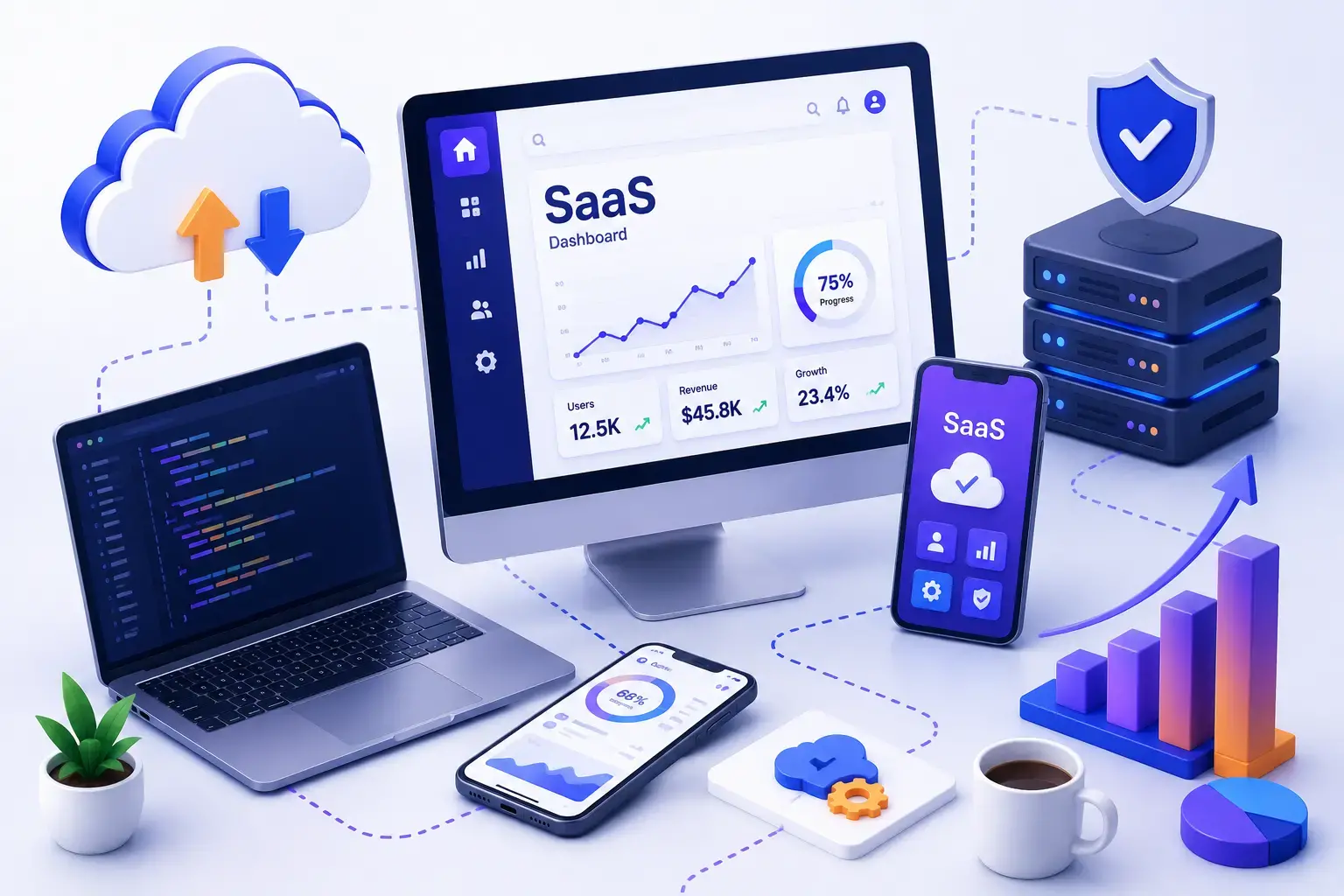
If you're searching for a SaaS development partner, here's the short answer: SaaS development is the process of building cloud hosting software that customers use through a browser on a subscription basis, rather than installing it on their own machines. It covers everything from the first wireframe to the servers it runs on, and it doesn't stop at launch —a SaaS product keeps evolving for as long as it has paying users.
Hyper Software has been building SaaS platforms, CRMs, ERPs, and custom web application cloud products for businesses since 2020. This page walks through what SaaS development actually involves, what it costs, how long it takes, and how to decide whether to build in- house, hire freelancers, or bring in a team like ours.
SaaS stands for Software as a Service. Instead of selling a one-time software license, you host the application on the cloud and charge customers a recurring fee — monthly or yearly— to use it. Think Gmail, Slack, or Zoom. Nobody installs a disc. You log in, and the software just works.
SaaS development is what happens behind that login screen. It includes:
Multi-tenant architecture — one codebase serving many customers, with each customer's data kept separate and secure.
Subscription billing — plans, trials, upgrades, downgrades, and payment processing.
User and role management — admins, team members, guests, each with different permissions.
A scalable backend — one that handles 10 users on day one and 10,000 without a rebuild.
Ongoing delivery — updates ship to every customer at once, with no manual installs.
That last point is what makes SaaS development different from regular web app development. You're not shipping a product once. You're running one, continuously, for as long as it exists.
Get Free Consultation Within Minutes
We get this question in almost every discovery call, so let's answer it directly.
Lower upfront cost for the customer. No servers to buy, no IT team to hire just to keep the lights on. That's a big reason SaaS adoption keeps climbing year after year.
Predictable revenue for you. A subscription model gives you recurring revenue instead of one-time sales, which is exactly why investors like SaaS businesses.
Centralized updates. Fix a bug once, and every customer gets the fix instantly. No chasing down who's still on version 3.2.
Built-in scalability. Cloud infrastructure lets you add server capacity as your user base grows, instead of guessing your hardware needs two years out.
We don't offer one flavor of SaaS development. Most clients fall into one of these buckets:
New SaaS product development (MVP to full platform). You have an idea, maybe a rough spec, maybe just a problem you know needs solving. We take it from concept through a working MVP, then scale it based on real user feedback.
SaaS product modernization. You already have a SaaS product, but it's slow, hard to maintain, or built on an outdated stack. We re-architect it without breaking what your existing customers depend on.
Turning internal software into a SaaS product. You built a tool for your own team, and now other companies want to buy it. We handle the multi-tenancy, billing, and website security work needed to sell it safely.
SaaS integrations and API development. Your product needs to talk to Stripe, Slack, Salesforce, or a client's internal system. We build and maintain those connections.
White-label SaaS development. You want to resell a SaaS product under your own brand without building it from scratch in-house.
Each of these needs a different starting point, which is why our first call is always about scoping the right one for you, not selling you the biggest package.
Hyper Software ne hamare business ko online ek nayi pehchan di. Website professional, fast aur SEO optimized hai. Website Design & Development ke liye best company.
Here's the process we actually follow, not a marketing version of it.
1. Discovery and Requirement Gathering
We start by understanding your business goal, not just the feature list. Who's the end user? What's the core problem you're solving? What already exists in the market, and where does it fall short? This stage usually takes 1–2 weeks and ends with a documented scope, not a guess.
2. Market and Competitor Research
Before wireframes, we look at what's already out there. If three competitors already do X well, we don't waste your budget rebuilding X — we find where they're weak and build there instead.
3. UX/UI Design
Wireframes first, then clickable prototypes, then full visual design. We test the flow before writing a single line of backend code, because fixing a confusing user flow in Figma costs a fraction of what it costs to fix in production.
4. Technical Architecture and Tech Stack Selection
This is where multi-tenancy, database design, and cloud provider decisions get made. Get this wrong, and every feature you add afterward gets more expensive. Get it right, and scaling becomes a configuration change, not a rebuild.
5. Development (Agile Sprints)
We build in 1–2 week sprints, with something demoable at the end of each one. You see progress every two weeks, not just at the very end of a six month contract.
6. QualityAssurance and Security Testing
Manual and automated testing, plus specific checks for multi-tenant data isolation —making sure CustomerA can never see Customer B's data, even by accident. This is non-negotiable for any real SaaS product.
7. Deployment and Launch
We handle server setup, CI/CD pipelines, domain and SSL configuration, and a staged rollout so launch day doesn't turn into a fire drill.
8. Post-Launch Support and Scaling
Launch is the start, not the finish line. We monitor performance, fix issues fast, and help you plan the next round of features based on real usage data, not assumptions.
Expert tip: most SaaS projects that go over budget don't fail because of bad code — they fail because step 1 was rushed. A vague scope at the start almost always turns into expensive scope creep by month three.
This is the question everyone actually wants answered, so let's be direct about it. Globally, SaaS development costs typically fall into three tiers:
| Tier | What's Included | Typical Cost (Global) | Typical Cost (India-based Team) |
|---|---|---|---|
| Simple MVP | Single user role, core feature, basic authentication, no billing | $15,000 – $40,000 | ₹6L – ₹18L |
| Standard SaaS Product | Multiple roles, subscription billing,Stripe Billing, integrations, admin dashboard | $40,000 – $120,000 | ₹18L – ₹60L |
| Enterprise / Complex SaaS | Advanced multi-tenancy, compliance (GDPR/HIPAA/SOC 2 compliance), AI features, high-availability infrastructure | $120,000 – $500,000+ | ₹60L – ₹2Cr+ |
What actually drives the cost:
Don't forget the costs after development: hosting, third-party service fees (Stripe, email, monitoring), and ongoing maintenance typically run 15–25% of your original build cost per year. If your SaaS costs ₹15,00,000 to build, plan for roughly ₹2,25,000–₹3,75,000 a year to keep it running, secure, and updated.
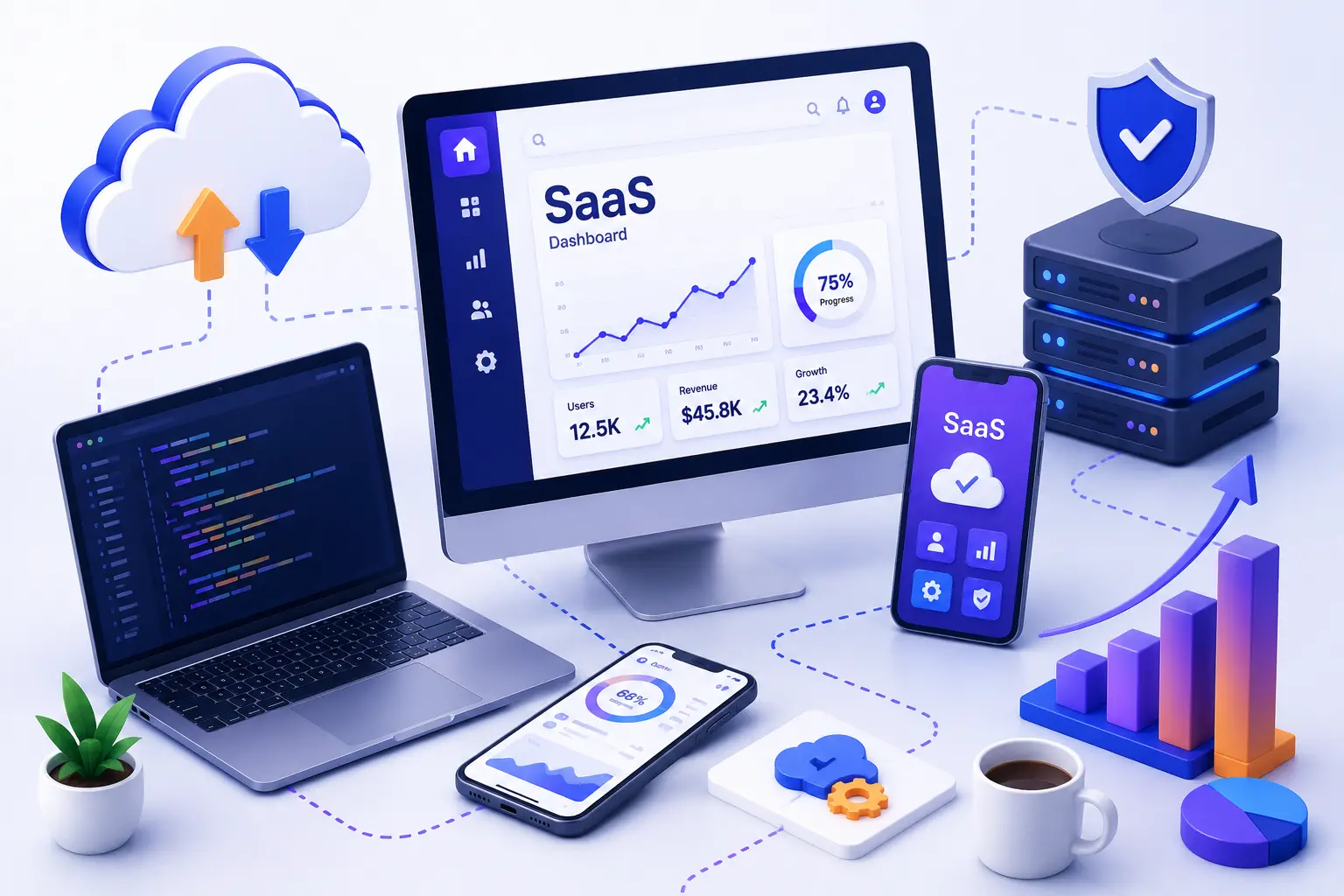
Simple MVP: 2–4 months
Standard SaaS product: 4–8 months
Enterprise-grade platform: 8–18 months
These are ranges, not promises — a poorly scoped project can blow past any of these no matter who builds it. The single biggest lever you control is how disciplined the discovery phase is before development starts.
We pick the stack based on your product's needs, not around what we happen to know. That said, here's what we reach for most often, and why:
Frontend: React, Next.js — fast, well-documented, huge talent pool if you ever bring development in-house later.
Backend: Node.js, Python (Django/FastAPI) — reliable forAPI-heavy SaaS applications.
Database: PostgreSQL for relational data, with tenant isolation built into the schema design from day one.
Cloud infrastructure: AWS, Google Cloud, or AWS / Azure multi-tenancy, depending on your compliance and geographic needs.
Billing: Stripe or Razorpay (for India-based billing), integrated at the architecture level, not bolted on later.
DevOps: Docker, CI/CD pipelines (GitHub Actions or GitLab CI) so releases are routine, not risky.
Common mistake we see: picking microservices architecture before you have paying customers. It sounds impressive, but for most early-stage SaaS products, a well-structured monolith is faster to build, easier to debug, and cheaper to run. You can split it into services later, once you actually know which parts need to scale independently.
A logistics company came to us with a real problem: their dispatchers were tracking deliveries across three spreadsheets and a WhatsApp group. Orders were getting missed, and customers had no way to track their own shipments.
We started with a two-week discovery phase and quickly realized they didn't need a massive platform — they needed one core workflow done well: order creation, dispatcher assignment, and a customer-facing tracking link.
We built a focused MVP in nine weeks: a dispatcher dashboard, role-based access for drivers and admins, and a simple tracking page customers could open without logging in. We deployed it on AWS with automated backups and a staging environment for safe testing of future updates.
Within the first month, missed deliveries dropped noticeably and support calls asking "where's my order" nearly disappeared, since customers could just check the tracking link themselves. Six months later, we added route optimization and a billing module, turning it from an internal tool into a product they now license to two partner companies.
The lesson we took from it, and one we apply to every client since: the smallest version that solves the real problem beats the most feature-complete version that ships six months late.
SaaS development is the process of designing, building, and maintaining cloud-based software that customers use on a subscription basis through a web browser, rather than installing it locally.
Regular web apps are often single-tenant tools built for one client. SaaS applications are built for many customers on shared infrastructure, with subscription billing, tenant isolation, and continuous updates built in from the start.
It depends on your feature scope, but simple MVPs typically start around ₹6–18 lakh, with standard products in the ₹18–60 lakh range. We provide a detailed estimate after a discovery call, since ranges without context aren't very useful.
Most MVPs take 2–4 months. Full platforms typically run 4–8 months, and enterprise-grade builds can take 8 months or more, depending on integrations and compliance requirements.
We recommend an MVP first for almost every client. It's the fastest way to validate demand before committing a full development budget.
We typically use React or Next.js on the frontend, Node.js or Python on the backend, PostgreSQL for the database, and AWS, Google Cloud, orAzure for hosting — chosen based on your specific compliance and scale needs.
Yes. We regularly convert internal tools or on-premise software into multi-tenant SaaS products, including the billing and access-control work that requires.
Yes, we're happy to sign an NDA before any detailed discovery call.
You do. Once the project is delivered and paid for, full source code and IP rights belong to you.
Yes. We offer ongoing maintenance packages covering bug fixes, security updates, performance monitoring, and feature iterations after launch.
Healthcare — patient management, appointment scheduling, telehealth platforms
Logistics and supply chain — dispatch, tracking, and route management tools
Finance and fintech — invoicing, expense management, lending platforms
Real estate — property management and tenant portals
Education — learning management systems, student portals
Retail and eCommerce — inventory, order management, and multi-vendor platforms
HR and recruitment — applicant tracking, payroll, and HR management tools
Each of these has its own compliance and workflow quirks. We scope those specifics during discovery, not after development starts.
Building every feature before launch. The longer you wait to get real users, the longer you're guessing. We push clients toward a genuinely minimal MVP, even when it feels uncomfortable.
Skipping multi-tenancy planning. Retrofitting proper tenant isolation into a live product with paying customers is one of the most expensive fixes in SaaS. We design for it from day one, even in the MVP.
Ignoring churn signals in the tech stack. Slow load times and clunky onboarding kill retention just as fast as missing features. We treat performance as a feature, not an afterthought.
No plan for scaling infrastructure. A product that works fine for 50 users can fall over at 5,000 if the database and server setup weren't built with growth in mind. We architect for the next stage, not just the current one.
Underestimating ongoing costs. Founders budget for the build and forget hosting, monitoring, and maintenance. We give clients a realistic post-launch number before they sign off on a build, not after.
SaaS application development services
custom SaaS development company
SaaS product development company
SaaS MVP development
hire SaaS developers India
enterprise SaaS development services
SaaS software development cost
SaaS development means building cloud-hosted software that customers access through a browser on a subscription basis, instead of installing it on their own device. It includes the application itself, the cloud infrastructure it runs on, and the billing system behind it.
A simple MVP takes 2–4 months. A standard SaaS product with billing and multiple user roles takes 4–8 months. An enterprise-grade platform can take 8–18 months depending on compliance and integration needs.
Costs typically range from $15,000 for a simple MVP to $500,000+ for a complex enterprise platform. India-based development teams can deliver the same scope for roughly 40–70% less than US or Western European teams.
SaaS? Multi-tenant architecture means one application instance serves multiple customers, with each customer's data logically separated and secured, instead of running a separate copy of the software for every client.
Almost always, build the MVP first. It validates whether people actually want your product before you spend the budget a full platform requires, and it gives you real user feedback to guide what to build next.
Have questions or need expert guidance? Our team is ready to help you with the right technology solutions for your business.