
Hyper Software ne hamare business ko online ek nayi pehchan di. Website professional, fast aur SEO optimized hai. Website Design & Development ke liye best company.

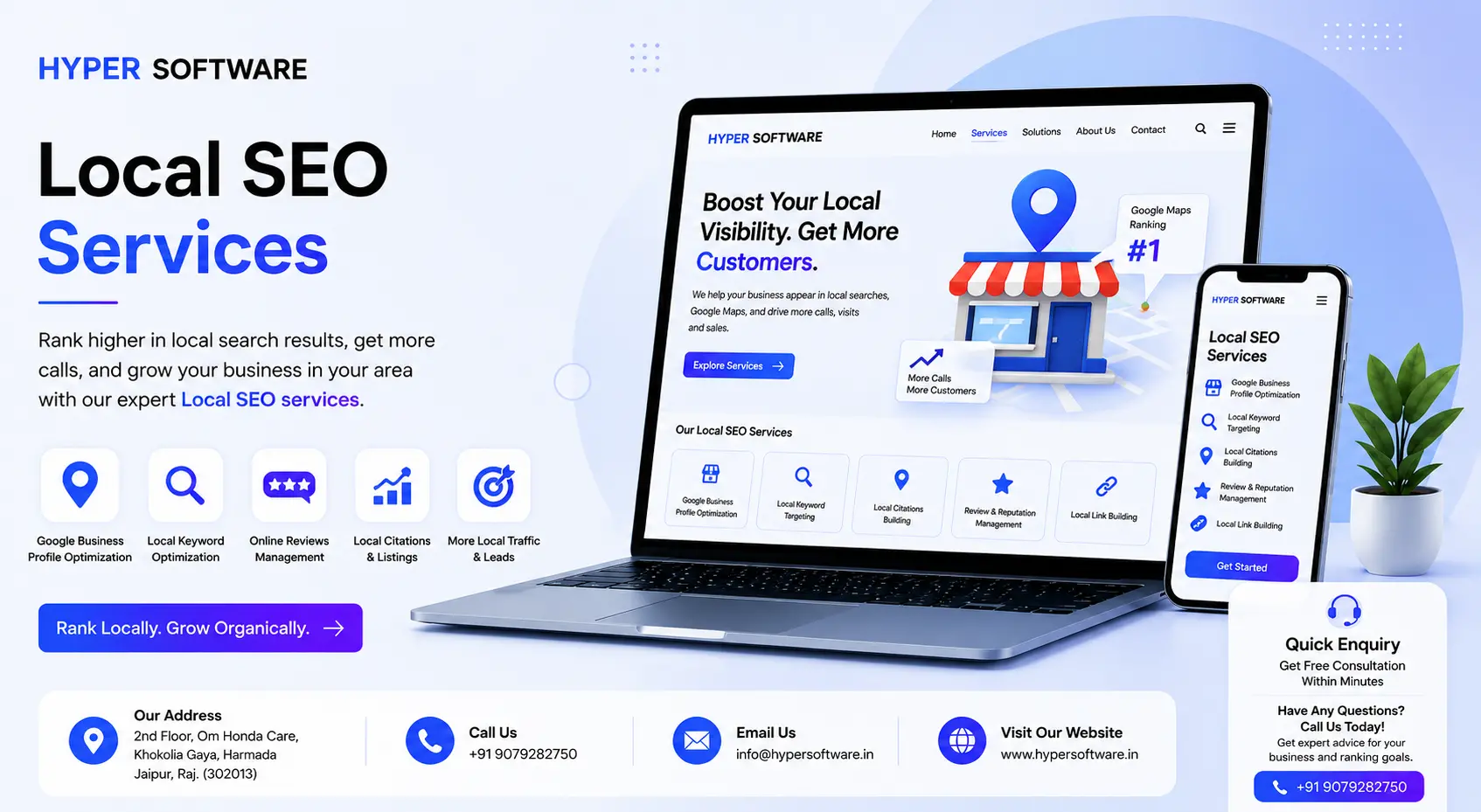
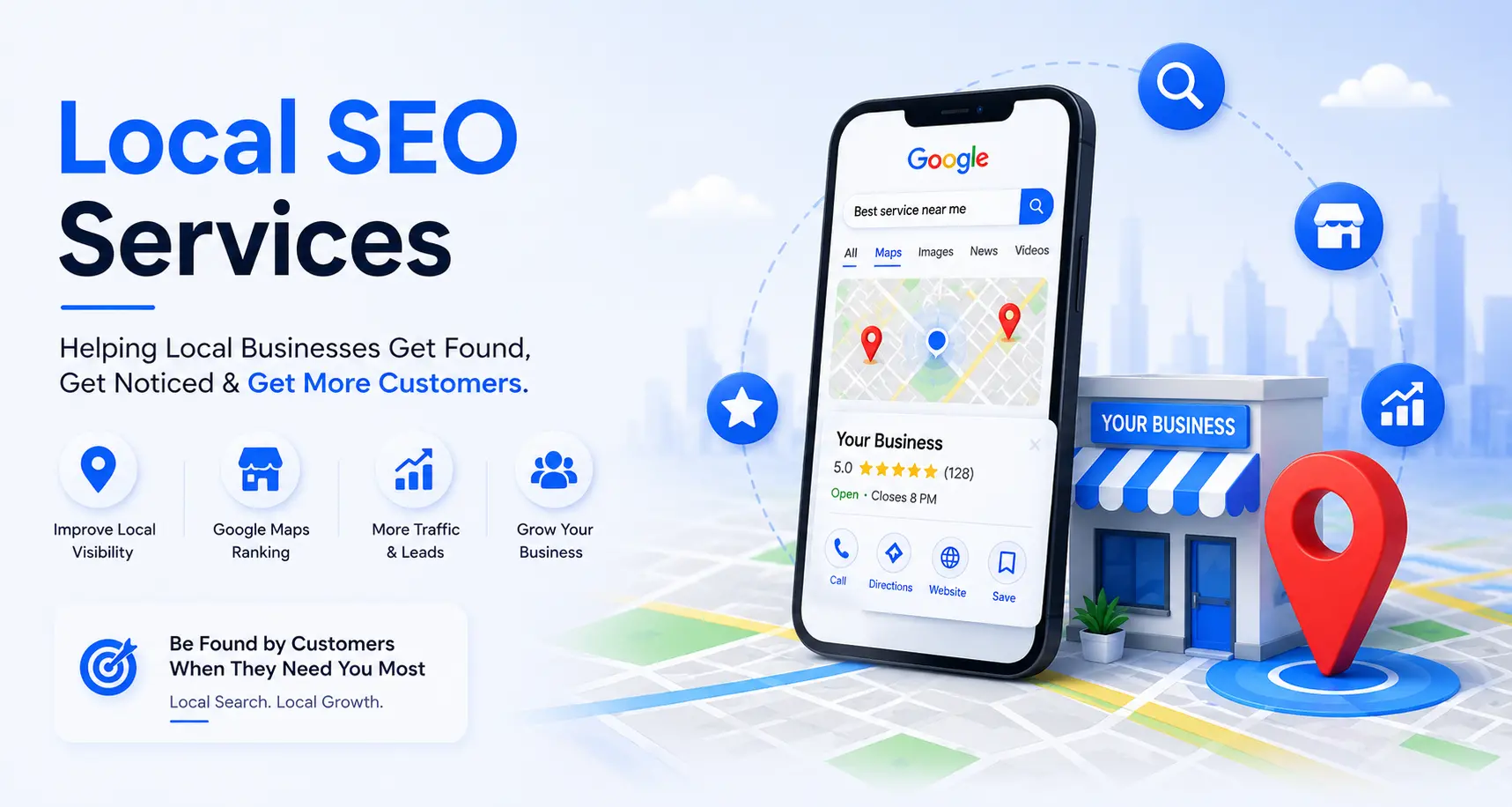
Local SEO is the work of optimizing your Google Business Profile, website, and online reputation so your business shows up when nearby customers search for what you sell. If someone types "electrician near me" or "best bakery in Jaipur" and you're not in the results, that sale just walked to your competitor instead. That's the entire problem local SEO exists to solve.
At Hyper Software, we build and run local SEO campaigns for small businesses, service providers, and multi-location brands, both in India and for clients around the world. This page covers exactly what local SEO is, how Google decides who ranks, what it costs, and how our team handles it from day one to month twelve.
Local SEO is the process ofimproving your visibility in location-based search results, so your business appears in Google's map pack, local organic istings, and now, AI-generated search summaries, whenever someone nearby searches for your product or service. It's different from standard SEO in one important way: intent. Someone searching "best CRM software" wants information. Someone searching "CRM company near me" or "software company in Jaipur" wants to call, visit, or book something today. Local SEO is built entirely around that second kind of searcher, the one who's ready to act, not just browse.
Here's the part most business owners don't realize until it's explained plainly: you don't need to be the biggest company in your city to rank first. A well-optimized small business regularly beats a much larger one that's ignored its Google Business Profile for two years.Local search rewards attention, not just size.
Get Free Consultation Within Minutes
More than 9 out of 10 consumers now use location-based keywords when they search for a business to visit or hire. That's not a marketing stat someone made up to sell you a service. It's how people actually search now, whether they're looking for a plumber, a dentist, or a software vendor.
Here's what that means in practical terms. If your business doesn't show up in the map pack or the top local results, you're invisible to a huge share of ready-to-buy searchers, even if your website is well-designed and your service is excellent. Nobody can hire you if they can't find you.
A few things have shifted the stakes even higher going into 2026:
The businesses that treat local SEO as a one-time task, set it up and forget it, are the oneslosing ground right now. The ones treating it as an ongoing habit are pulling ahead.
Google uses three main factors to decide who shows up in local search results: relevance,distance, and prominence. Understanding these isn't optional if you want to actuallyinfluence your ranking instead of guessing.
Relevance is how well your business profile and website match what someone searched for.If you're a "software development company" but your GBP category is set to "computer repair," you're fighting an uphill battle you created yourself. Getting your categories,services, and descriptions specific and accurate matters more than most people expect.
Distance is exactly what it sounds like: how close your business is to the person searching,or to the location they typed in. This one is mostly out of your control. You can't move your office to be closer to every searcher. What you can do is make sure your service area is set up correctly so Google nderstands where you're willing to work, not just where your office sits.
Prominence is your reputation, both online and off. This includes your review count and quality, how often people mention your business, and how authoritative your website looks to Google. This is the factor where consistent effort pays off the most, because prominence builds over months, not overnight.
Here's a mistake we see constantly: business owners obsess over keywords in their website copy while their Google Business Profile sits half-finished with no photos, no posts, and reviews from three years ago. Google weighs the GBP heavily for local queries. Fixing your profile often moves the needle faster than any amount of blog writing.
Hyper Software ne hamare business ko online ek nayi pehchan di. Website professional, fast aur SEO optimized hai. Website Design & Development ke liye best company.

These terms get thrown around interchangeably, and that confusion costs business owners money when they buy the wrong service.
Regular SEO targets broad, often national or global search intent. Think "best project management software" or "CRM comparison 2026." There's no location attached to the intent.
Local SEO targets searches tied to a place, whether that's a city name typed into the query or an implied "near me" based on the searcher's location. It leans heavily on your Google Business Profile, citations, and reviews, on top of your website.
GEO (Generative Engine Optimization) and AEO (Answer Engine Optimization) are newer disciplines focused on getting your content quoted directly inside AI Overviews, ChatGPT answers, and voice assistant responses. For local businesses, this now overlaps heavily with local SEO, because AI tools pull local answers straight from Google Ads Business Profiles and well-structured local content.
The practical takeaway: a local business in 2026 needs all three working together, not one instead of the others. A page that ranks well but never gets quoted byAI Overviews is leaving visibility on the table, and a business with a great GBP but a weak website struggles to convert the traffic that finds it.
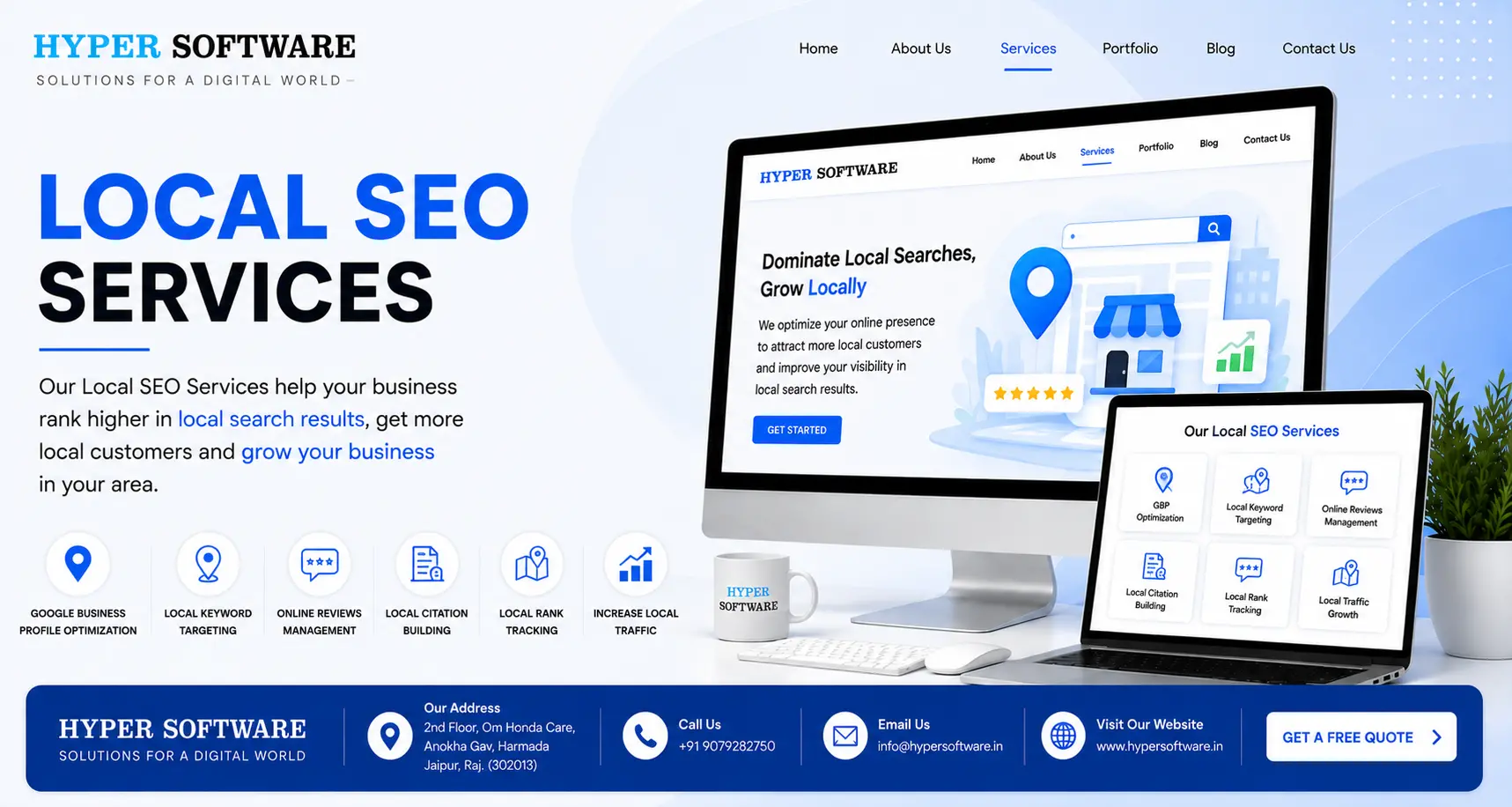
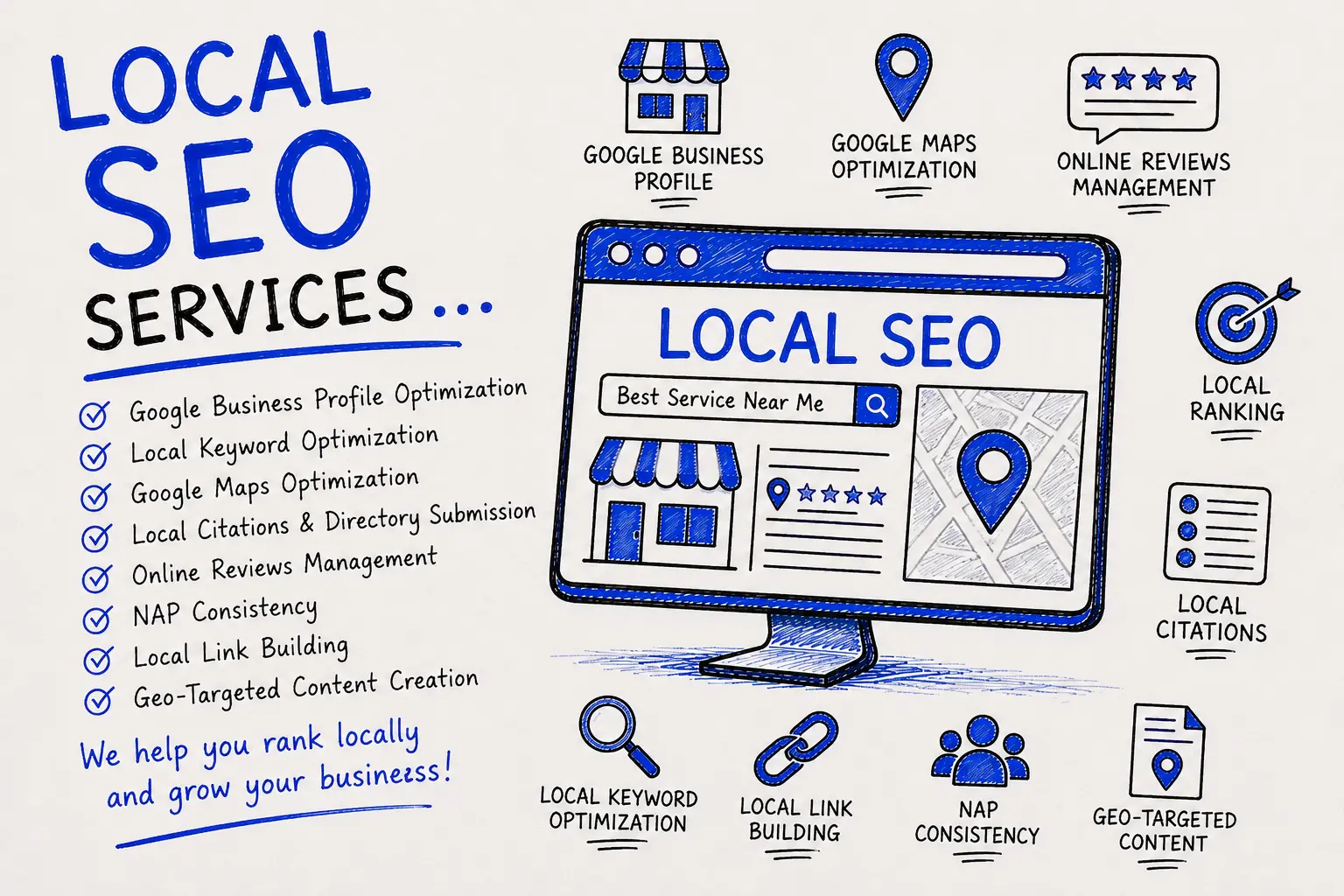
We don't sell a single generic "local SEO package." We build a plan around what's actually broken or missing for your specific business, then execute it.Here's what that work typically includes:
Local Keyword Research We identify the exact terms your real customers search, including city names, neighborhood terms, and "near me" variations, then map them across your website and profile without stuffing.
On-Page Local SEO Title tags, meta descriptions, headings, and page content are optimized for local intent, including dedicated location pages or service-area pages where they genuinely help.
Citation Building and NAP Consistency We build and correct your business listings across relevant directories, making sure your Name, Address, and Phone number match everywhere. Inconsistent NAP data is one of the quietest local ranking killers out there.
Review Generation and Management We set up a simple, ethical system to request reviews from real customers consistently, and we help you respond to every review, good or bad, the right way.
Local Link Building We pursue links from local business associations, chambers of commerce, local news mentions, and relevant local directories, never from spammy link farms.
Local Schema Markup We recommend an help implement LocalBusiness, Service, and FAQ schema so search engines and AI tools can read your business information cleanly and accurately.
Multi-Location SEO For franchises and businesses with more than one branch, we build individual, non-duplicated location pages and manage separate GBP listings so every branch competes fully in its own area.
Here's how a Local SEO engagement with us actually runs, phase by phase.
Phase 1: Audit (Weeks 1–2) We audit your Google Business Profile, website, current citations, and competitor rankings in your area. You get a plain-English report on exactly what's broken and what's already working.
Phase 2: Foundation Fixes (Weeks 2–6) We fix the GBP, correct NAP inconsistencies across existing citations, and resolve any technical issues on your website blocking local visibility.
Phase 3: Content Marketing and Citations (Ongoing, Months 2–4) We build out location or service- area pages, publish regular GBP posts, and add new citations on relevant, high-quality directories.
Phase 4: Reviews and Authority (Ongoing, Months 3+) We roll out the review lead generation system and start local link outreach, both of which build momentum that compounds over time.
Phase 5: Track, Report, Adjust (Every Month) You get a monthly report showing ranking movement, GBP performance, and calls or form submissions tied back to local search, not vanity metrics with no connection to your revenue.
A home services client came to us with a Google Business Profile that hadn't been touched in over a year and a website with no location pages at all. They were doing decent work but consistently losing local jobs to a competitor with worse reviews and an objectively less professional website.
We started with the GBP: fixed the category, added real photos of completed jobs, wrote out every service they actually offered, and set up a weekly posting habit. At the same time, we cleaned up their citations, since their business name was listed three different ways across old directories, which was quietly confusing Google.
Within the first two months, they moved from not appearing in the map pack at all to showing up in the top three results for their core service term in their city. By month four, after we'd layered in a steady review request system and a handful of local link mentions, inbound calls from Google Search and Maps had roughly doubled compared to their baseline.
Nothing about this was a trick. It was fixing the fundamentals that had been ignored for years, in the right order, and staying consistent with reviews and updates instead of stopping after the first improvement.
Local SEO isn't impossible to do yourself, especially for a single location in a low-competition market. But it's worth being honest about the real trade-offs before you decide.
| Factor | Doing It Yourself | Hiring a Local SEO Agency |
| Time | 5–10+ hours a week ongoing, more | Minimal, mostly reviewing reports and |
| investment | during setup | approving content |
| Learning | Steep; ranking factors and Google's | Already handled by people doing this daily |
| curve | rules change often | |
| Typical cost | "Free" but paid for in your own time | ₹15,000–₹80,000/month (India) or $300– |
| $2,000/month (global), depending on scope | ||
| Risk of | Higher; keyword stuffing, fake | Lower; experienced teams know what |
| mistakes | reviews, or category errors can | Google flags |
| trigger suspensions | ||
| Speed to | Usually slower, since testing and | Typically 3–6 months to solid movement, |
| results | correcting eats time | sometimes faster on quick wins |
| Best fit for | Single location, low competition, tight budget, and time to spare | Competitive cities, multiple locations, or businesses that need results without the |
| learning curve |
If you're a single-location business in a small town with light competition, DIY local SEO with consistent effort can genuinely work. If you're competing in a busy market, managing more than one location, or you simply don't have the time to learn this properly, an experienced team gets you there faster and with fewer costly mistakes along the way.
Local SEO pricing varies more than most services because "local SEO" gets used to describe wildly different scopes of work. A ₹5,000 quote and a ₹50,000 quote might both be labeled "local SEO," but they're rarely doing the same thing.
In India, basic local SEO packages, mostly GBP setup and a handful of citations, typically start around ₹10,000 to ₹20,000 a month. A full-service package including content, review management, and local link building generally runs ₹25,000 to ₹80,000 a month, depending on your city's competition level. A dental clinic in a metro city and one in a small town will not pay the same rate, because the amount of competing effort required is genuinely different.
For global clients, typical local SEO retainers run $300 to $2,000 a month for small to mid-sized businesses, with enterprise or multi-location campaigns going higher. Rates from India-based teams like ours are often lower than US or UK equivalents for comparable,sometimes better, quality of work.
Whatever quote you're comparing, ask exactly what's included: how many GBP posts per month, how many citations, whether reviews are actively managed, and whether reporting is tied to real business outcomes like calls and form fills, not just keyword rank screenshots.
Inconsistent NAP data. Your business name, address, and phone number need to match exactly across your website, GBP, and every directory. Even small differences, like "St."versus "Street," confuse Google more than people expect.
Ignoring the Google Business Profile after setup. Claiming your GBP and never touching it again is one of the most common mistakes we see. Google favors profiles that stay active with regular posts, updated photos, and responses to reviews.
Choosing the wrong primary category. This single setting affects which searches you're even eligible to appear for. Getting it wrong quietly caps your visibility no matter what else you fix.
Buying fake reviews or review "packages." This isn't a shortcut anymore, it's a real risk.Google's spam enforcement has gotten sharper at catching patterns of fake or incentivized reviews, and getting caught can mean losing your listing entirely.
Skipping service-area pages for multi-service businesses. If you offer five services across three neighborhoods, one generic homepage rarely ranks for all of it. Dedicated, genuinely useful pages for each combination do the heavier lifting.
Treating local SEO as a one-time project. Rankings earned through consistent effort tend to hold. Rankings earned through a short burst of activity tend to slide back once that activity stops.
Local SEO works especially well for businesses where customers are actively searching nearby for a service they need soon:
If your business depends on people nearby choosing you over the business down the street, local SEO applies to you, regardless of industry.
Local SEO is the work of making your business easy to find when people nearby search for what you offer, mainly through your Google Business Profile, website, and reviews.
Most businesses see early movement in 4 to 8 weeks after fixing basic Google Business Profile issues, with stronger, more stable results typically building over 3 to 6 months.
Yes. Regular SEO targets broad, often national search intent, while local SEO focuses specifically on location-based searches like "near me" or a named city.
Yes, it's essential. Your Google Business Profile is one of the strongest signals Google uses to decide who appears in local search results and the map pack.
Most local SEO packages in India range from ₹10,000 to ₹80,000 per month, depending on your city's competition level and how much of the work is included.
Yes, especially for a single location in a low-competition area, but it takes consistent weekly effort and a real understanding of Google's current rules to avoid costly mistakes.
Relevance, distance, and prominence. Relevance is how well you match the search, distance is how close you are to the searcher, and prominence is your overall reputation and authority.
Yes. Review quantity, quality, and especially recency directly influence how Google ranks your business in local search results.
NAP stands for Name, Address, and Phone number. Keeping these identical across your website and every online directory helps Google trust your business information, which supports your rankings.
Yes. Service-area businesses like plumbers or cleaners can still rank well by correctly setting their service area in Google Business Profile, even without a public-facing location.
Use this as a starting point if you want to gauge how much work your current setup actuallyneeds:
1. Claim and fully verify your Google Business Profile
2. Choose the most accurate primary category, plus relevant secondary categories
3. Add complete, accurate business hours, services, and products
4. Upload real photos, not stock images, and update them regularly
5. Post to your GBP at least weekly
6. Check your NAP consistency across your website and top directories
7. Set up a simple, ethical system to request reviews after every job or visit
8. Respond to every review within 48 hours
9. Add location or service-area pages if you serve more than one area
10. Add LocalBusiness and FAQ schema to your website
11. Build citations on relevant, high-quality local directories
12. Track your map pack rankings monthly, not just once
AI Overviews are becoming a real local search surface. Google increasingly generates summarized answers for "best [service] near me" style queries, pulling from Google Business Profiles and well-structured website development content. Businesses with thin or generic
profiles are getting skipped entirely.
Review recency is weighted more heavily than raw review count. A steady flow of new reviews now outperforms a large pile of old ones sitting untouched.
Google's spam enforcement keeps tightening. Fake addresses, keyword-stuffed business names, and bought reviews carry real suspension risk now, not just a minor penalty.
Structured, genuinely useful content is winning over keyword-stuffed pages. Google's algorithm has gotten noticeably better at rewarding real answers to real local questions over pages built purely to rank.
Hyper Software has been building digital solutions since 2020 from our base in Jaipur, Rajasthan, and we work with businesses across India and internationally. We don't outsource your local SEO work to a disconnected freelancer network. Our own team handles your Google Business Profile, citations, content, and reporting directly, so there's one accountable point of contact throughout.
We combine local SEO with our broader capability in web development, software, and digital marketing, which means if your website itself is holding back your rankings, we can fix that too, not just work around it.
Inconsistent listings can confuse Google about which information is accurate, which weakens trust signals and can hold back your local rankings even if everything else is done well.
Increasingly, yes. These tools often pull local business information directly from Google Business Profiles and well-structured website content, so a weak profile now affects visibility beyond just Google Search too.
Yes, but each location needs its own optimized Google Business Profile and, ideally, its own dedicated page, rather than one generic page trying to represent every branch.
The map pack is the group of typically three business listings, shown with a map, that appears at the top of local search results for relevant queries.
Ads? Paid ads stop delivering visibility the moment you stop paying. Local SEO builds visibility that keeps working over time, though it takes longer to build initially.
Have questions or need expert guidance? Our team is ready to help you with the right technology solutions for your business.