Hyper Software ne hamare business ko online ek nayi pehchan di. Website professional, fast aur SEO optimized hai. Website Design & Development ke liye best company.

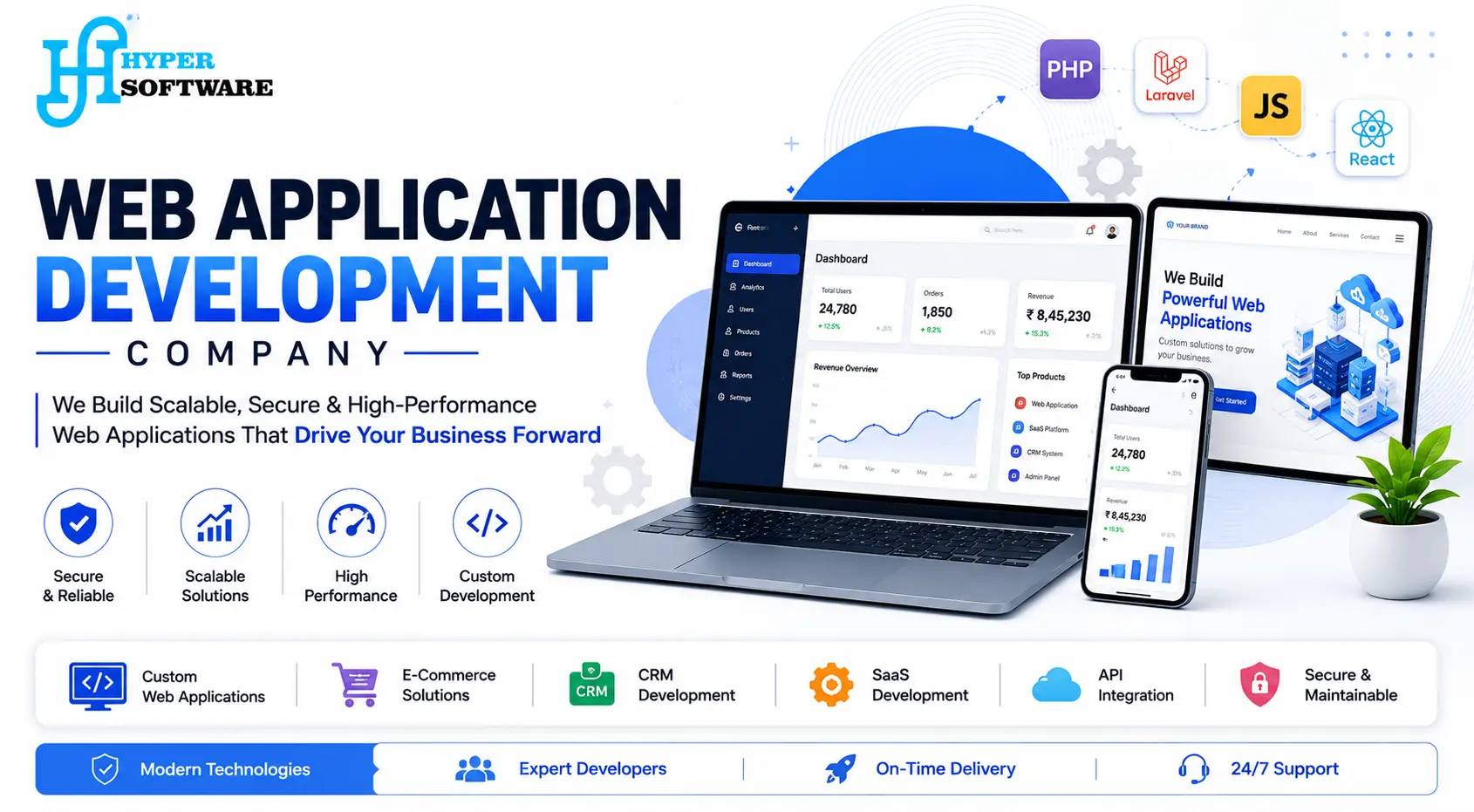
A web application is software your team and customers use straight from a browser — no download, no installation. Think custom dashboards, client portals, booking systems, or a full SaaS product. Hyper Software designs and builds these from the ground up, for businesses in India and clients across the US, UK, Australia, and the Middle East.
If you've been running your business on spreadsheets, email chains, and three different tools that don't talk to each other, a custom web application is usually the fix. Let's walk through what it actually involves, what it costs, and how we do it.
Web application development is the process of designing, building, testing, and maintaining software that runs inside a web browser and requires a server to process data. Unlike a static website, a web app lets users log in, submit information, and get results back based on what they do — a client portal, an inventory system, or a project management tool are all web applications.
The line between "website" and "web application" comes down to interactivity. A website mostly informs. A web application does work: it stores data, runs logic, and changes based on the user. If your site needs logins, dashboards, forms that save data, or anything that behaves differently for different users, you're talking about a web application, not a brochure website.
Get Free Consultation Within Minutes
Not every business needs the same kind of web app. Here's what we typically build, and who each one fits.
Custom Business Portals
Client portals, vendor portals, and employee self-service systems that centralise information and cut down on emails and phone calls.
SaaS Platforms
SaaS development software products you sell to other businesses on a subscription basis — built with billing, user roles, and onboarding baked in from day one.
CRM and ERP Systems
Custom-built systems when off-the-shelf CRM or ERP software doesn't match how your business actually runs. We connect these to your existing tools instead of forcing you to change your whole workflow.
eCommerce Web Applications
Beyond a standard online store — think custom checkout flows, B2B ordering portals, or marketplaces with multiple vendors and complex pricing rules.
Enterprise Dashboards and Internal Tools
Reporting dashboards, workflow automation tools, and internal systems that replace manual, error-prone processes.
Progressive Web Apps (PWAs)
Web apps that behave like a mobile app — they load fast, work offline, and can send push notifications, without needing an app store listing.
Hyper Software ne hamare business ko online ek nayi pehchan di. Website professional, fast aur SEO optimized hai. Website Design & Development ke liye best company.
Here's exactly how a project moves from idea to a live, working application. No step is skipped, and nothing gets built without your sign-off first.
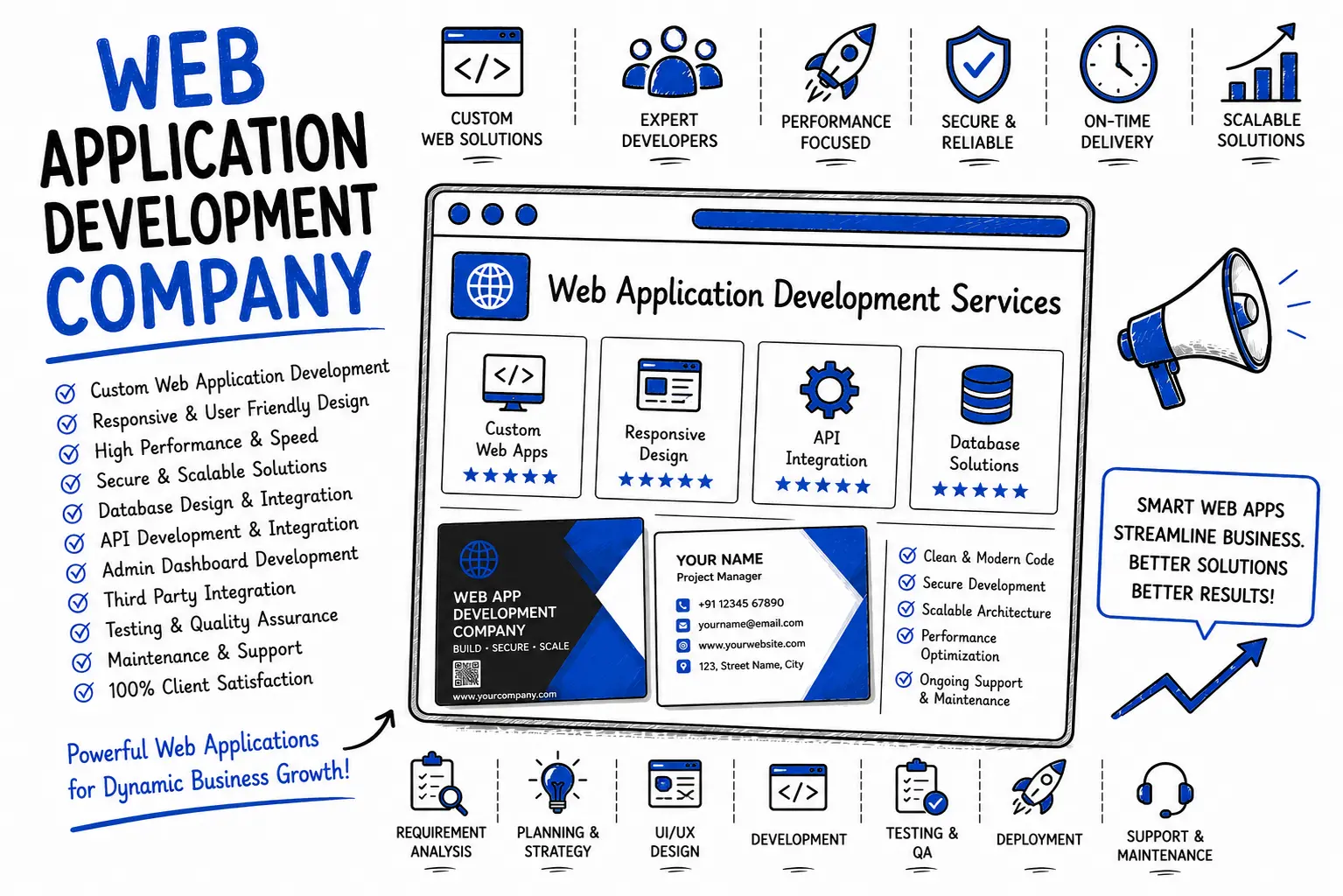
1. Discovery and Requirement Mapping — We sit down with you, in person or on a call, to understand your business process, your users, and what “done” actually looks like. This is where scope gets defined, so nothing gets built twice.
2. UI/UX Design — We map user flows and design wireframes, then high-fidelity screens. You review and approve the design before any code is written.
3. Architecture and Tech Stack Selection — We choose the front-end, back-end, database, and hosting setup based on your actual scale needs — not whatever framework happens to be trendy that month.
4. Development — Our developers build the application in sprints, usually two weeks each, so you see working progress regularly instead of waiting months for a single reveal.
5. Quality Assurance and Testing — Every feature is tested manually and, where it makes sense, with automated tests — functionality, security, load handling, and cross-browser checks.
6. Deployment — We move the application to production, set up hosting and monitoring, and run a final check before it goes live to real users.
7. Support and website maintenance — Bugs get fixed, security patches get applied, and we're available for feature updates as your business grows. This step never really ends.

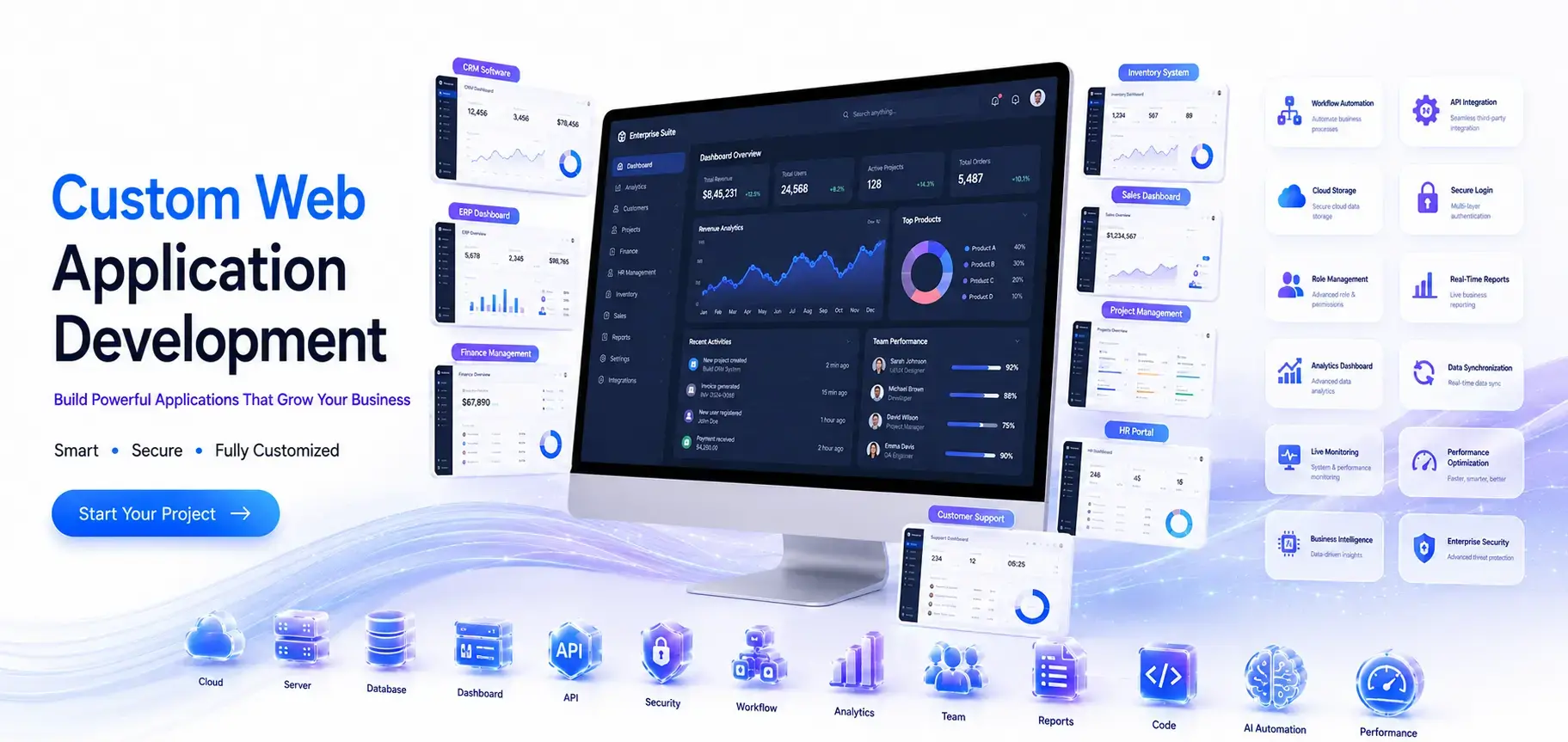
We pick the stack that fits your project, not the one we're most bored of using. Common choices:
| Layer | Technologies |
|---|---|
| Front-end | React, Angular, Vue.js, HTML5/CSS3 |
| Back-end | Node.js, Python (Django/Flask), PHP (Laravel), .NET |
| Database | PostgreSQL, MySQL, MongoDB |
| Cloud & DevOps | AWS / Azure, Google Cloud, Azure, Docker, CI/CD pipelines |
| Mobile-ready |
Progressive Web App (PWA) support for app-like experience without a native build |
We'll recommend a stack during discovery based on your budget, team's technical comfort, expected user load, and long-term maintenance plans — and explain the trade-offs in plain terms, not jargon.
This is the question everyone actually wants answered, so here it is straight: cost depends almost entirely on scope, not on which country you hire from. As a rough industry-wide guide:
| Project Type | Typical Range | What's Included |
|---|---|---|
| Simple MVP / prototype | Lower end of the range | Core features only, one or two user roles, basic design |
| Mid-complexity business application | Mid-range |
Custom UI, multiple user roles, third-party integrations, admin panel |
| Enterprise-grade / high- complexity system | Higher end |
Advanced security, multiple integrations, high user load, custom reporting |
Exact figures vary widely by scope and are best confirmed after a discovery call — we'll give you a written quote, not a vague "it depends." What we can tell you plainly: the biggest cost drivers are the number of user roles and workflows, third-party integrations (payment gateways, CRMs, API development), design complexity, and whether the app needs to handle real-time data. Add-ons like advanced analytics, multi-language support, or video/audio features
push the cost up too. Contact us at +91 9079282750 for a free scoping call and a written estimate based on your actual requirements.
A simple MVP with core features can often be ready in a matter of weeks. A mid-complexity business application usually takes a few months from discovery to launch. A large enterprise system with multiple integrations and compliance requirements can take six months to a year. Timelines stretch when scope changes mid-project — which is exactly why the discovery phase matters so much.
Should you build it yourself with no-code tools, or bring in a team like ours? Here's an honest breakdown.
| Factor | DIY / No-Code | Hiring a Development Company |
|---|---|---|
| Best for |
Simple internal tools, quick idea validation |
Anything customer-facing, scalable, or business-critical |
| Cost upfront | Lower | Higher, but planned and predictable |
| Customisation | Limited by the platform's templates | Fully custom to your exact process |
| Security |
Depends entirely on the platform provider |
Built and tested to your specific requirements |
| Scaling | Often hits a wall as users grow |
Architected to handle growth from the start |
| What can go wrong | You outgrow the platform and rebuild from scratch later; data lock-in; limited support | Requires clear communication upfront and a defined scope to avoid delays |
If you're validating an idea with a handful of users, no-code tools are a fair starting point. The moment your app needs to scale past a few hundred users, handle sensitive data, or integrate with other systems, the cost of "free" no-code tools shows up later — usually as a full rebuild.
Built around your process, not the other way around — You don't bend your workflow to fit generic software.
Scales with you — Architecture is planned for growth from day one, not patched later.
Full ownership of your code and data — No monthly per-seat licensing traps.
Integrates with the tools you already use — Instead of replacing them all at once.
Competitive advantage — A tool your competitors using off-the-shelf software simply don't have.
The trade-off: Custom development takes more planning time upfront and costs more initially than a subscription tool.
For most growing businesses, that upfront investment pays back within the first year through time saved and errors avoided.
We've seen these come up again and again with new clients before they worked with us:
Skipping the discovery phase. Jumping straight to development without a written scope almost always leads to scope creep and budget overruns later.
Choosing the cheapest quote without checking what's excluded. A low quote that doesn't include testing, deployment, or a support period isn't actually cheaper.
Building every feature in version one. Trying to launch with everything at once delays your time-to-market and increases risk. Start with the features that matter
most, then expand.
No plan for maintenance. A web application isn't a one-time purchase. Security patches, bug fixes, and updates are ongoing, and businesses who skip this find their
app breaks or becomes a security risk within a year or two. Not testing with real users before full rollout. Internal assumptions about how people will use the app often don't match reality.
We work with React, Angular, and Vue.js on the front-end; Node.js, Python, PHP, and .NET on the back-end; and PostgreSQL, MySQL, or MongoDB for databases, hosted on AWS, Google Cloud, orAzure.
Yes. We offer ongoing maintenance, security patching, bug fixes, and feature updates after launch, since a web application needs continuous care, not a one-time build.
Security is built into the development process, not added afterward — covering access control, encrypted data storage, and testing against common vulnerabilities before launch.
Yes. We regularly integrate custom web applications with existing CRM, ERP, accounting software, and payment gateways so businesses don't have to abandon tools they already rely on.
Yes. We help startups define a minimum viable product focused on core features first, so you can test the market before investing in a full- scale build.
Off-the-shelf software is built for a general use case and often requires you to change your workflow to fit it. Custom development is built around your specific process, at a higher upfront cost but with no long-term workflow compromises.
Yes. Hyper Software works with clients across India, the US, UK, Australia, and the Middle East, using remote collaboration tools and clear time-zone-friendly communication.
It starts with a free discovery call to understand your requirements, followed by a written scope and quote. Once approved, we move into design, development, testing, and deployment in planned sprints.
Yes. We handle upgrades, technology migrations, and modernisation of legacy web applications, including moving old systems to modern, more secure tech stacks.
Yes. UI/UX design is part of our standard process — we design and get your approval on wireframes and screens before any development begins.
One client, a distribution business in Rajasthan, was running order tracking across three separate spreadsheets and a WhatsApp group. Orders slipped through, stock counts were often wrong by the time anyone checked, and their sales team spent hours each week just reconciling numbers.
We started with a two-week discovery phase to map their actual order flow, from purchase order to delivery. From there, we built a custom web application with role-based logins for sales staff, warehouse staff, and management, a live inventory dashboard, and automatic low-stock alerts. We integrated it with their existing accounting software so nobody had to enter the same data twice.
The system went live in under three months. Within the first quarter of use, the client reported catching stock discrepancies same-day instead of weeks later, and their sales team stopped manually reconciling spreadsheets altogether. That's the kind of outcome we aim for on every project — not just working software, but time and errors saved.
Healthcare, fintech and financial services, logistics and distribution, retail and eCommerce, education, real estate, manufacturing, and professional services. Each industry brings its own compliance and workflow requirements, and we adjust our approach — and our security checklist — accordingly.
Founded in 2020 and based in Jaipur, Rajasthan, Hyper Software has grown by focusing on one thing: building software that actually fits how a business works, not forcing a business to work around software. We handle web application development alongside custom software, mobile apps, eCommerce platforms, CRM and ERP systems, UI/UX design, and business automation — which means your web app doesn't exist in isolation. It's built to work with everything else you need.
We work with clients across India and internationally, with clear written scopes, milestone- based delivery, and direct access to your development team throughout the project — not just a account manager relaying messages.
Ready to talk about your project? Call us at +91 9079282750 or visit www.hypersoftware.in for a free consultation.
Custom software development company
Mobile app development company
SaaS application development services
Progressive web app (PWA) development
Enterprise web application development
CRM and ERP software development
UI/UX design services for web applications
Web application development is the process of building browser-based software that lets users log in, submit data, and interact with a system — unlike a static website, it runs logic and stores data based on user actions.
A website mainly displays information, while a web application lets users interact with data — submitting forms, logging in, and getting personalised results. A blog is a website; a customer portal is a web application.
A web application runs in a browser and works across any device with internet access, while a mobile app is installed from an app store and built for a specific operating system (iOS orAndroid). Progressive Web Apps sit in between, offering app-like features through a browser.
Cost depends on scope: a simple MVP costs less than a mid-complexity business application, and an enterprise system with multiple integrations costs the most. Contact us for a written estimate based on your specific requirements.
A simple MVP can take a few weeks, a mid-complexity application usually takes a few months, and a large enterprise system can take six months to a year, depending on scope and integrations.
Have questions or need expert guidance? Our team is ready to help you with the right technology solutions for your business.