Hyper Software ne hamare business ko online ek nayi pehchan di. Website professional, fast aur SEO optimized hai. Website Design & Development ke liye best company.

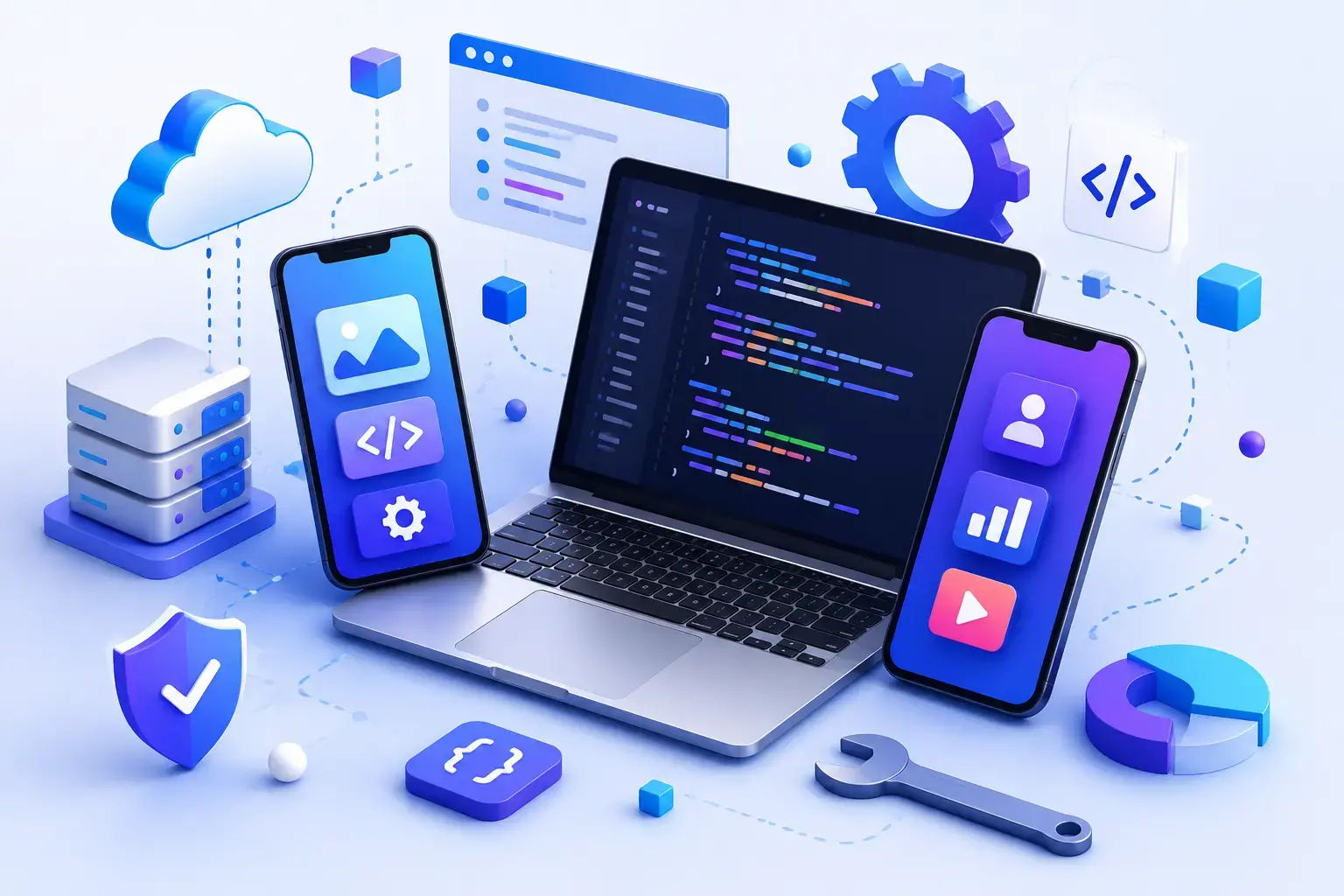
Software development is the process of turning a business problem into a working application — through planning, design, coding, testing, and ongoing support. If you're comparing software development companies right now, here's the short version: the right partner should be able to explain your entire process before they write a single line of code, give you real cost numbers instead of "it depends," and hand you full ownership of what they build.
Hyper Software has been building custom web application, web platforms, and mobile apps for clients across India, the US, the UK, and the Middle East since 2020, from our team in Jaipur, Rajasthan. This page covers what software development actually involves, what it costs, when custom software makes sense (and when it doesn't), and how our process works from the first call to post-launch support.
Software development is the full lifecycle of building an application: understanding what a business needs, designing how it should work, writing the code, testing it, launching it, and maintaining it after go-live. It's not just "coding" — a developer who jumps straight to writing code without understanding the business problem usually builds the wrong thing, just very neatly
Most businesses actually need a mix of both. We'll get into how to decide further down this page
Get Free Consultation Within Minutes
Custom software development. Applications built around how your business actually works, not the other way around. This covers internal tools, workflow automation systems, and standalone products
Enterprise software development. Larger systems built for scale — think multidepartment platforms, role-based access, and integration with existing enterprise tools. These projects need heavier architecture planning up front because retrofitting scale later is expensive.
SaaS development. For founders building a product to sell as a subscription. We handle multi-tenancy, billing integration, and the infrastructure decisions that make a SaaS product survive its first real growth spike.
Web application development. Browser-based platforms, portals, and dashboards — no installation needed, works across devices
Custom CRM development and ERP development. Purpose-built systems for sales pipelines, inventory, HR, or finance, instead of paying per-seat for a generic tool that only fits 70% of your process.
API development and third-party integration. Connecting your software to payment gateways, shipping providers, marketing tools, or other internal systems so data moves automatically instead of being copy-pasted.
Legacy software modernization. Rebuilding or re-architecting an old system that's become slow, insecure, or impossible to find developers for, without starting completely from zero.
Mobile app development. Native and cross-platform apps (Flutter, React Native) that work alongside your core software rather than as a separate disconnected product.
Every project follows the same seven stages. Skipping any of them is usually where "the developer disappeared for two months" stories come from
1. Discovery and requirements. We ask the unglamorous questions: who uses this, what decisions does it need to support, what already exists that we need to connect to. This becomes a Software Requirement Specification (SRS) document that both sides sign off on before any design work starts
2. UI/UX design. Wireframes first, then high-fidelity screens. You approve the flow before we build it — changing a screen in Figma costs nothing; changing it after development costs real time.
3. Development. Front-end and back-end built in parallel using an Agile methodology, sprint-based approach, usually two-week cycles with a working demo at the end of each one.
4. Quality assurance. Functional testing, website security checks, and load testing where relevant. We test throughout development, not just at the end — catching a bug in week 3 is cheap; catching it in week 12 is not.
5. Deployment. Moving the application to production, whether that's cloud hosting (AWS / Azure / Google Cloud) or your own infrastructure, with a rollback plan in case something needs to be reversed
6. Training and handover. Documentation and walkthroughs so your team can actually use and, if needed, maintain the system.
7. Post-launch support. Bug fixes, monitoring, and feature additions after go-live. Software isn't "done" at launch — it's just usable.
|
Factor |
Custom Software |
Off-the-ShelfSoftware |
|
Upfront cost |
Higher |
Lower |
|
Long-term cost (5+ years, per seat/licence fees) |
Often lower — no recurring per-user fees |
Can exceed custom cost at scale |
|
Fit to your exact workflow |
Built around it |
You adapt to the tool |
|
Ownership ofsource code |
Yours |
Vendor's |
|
Time to launch |
Weeks to months |
Immediate |
|
Best for |
Unique processes, competitive differentiation |
Standard, well-solved problems (basic accounting, email) |
A rough rule of thumb we use with clients: if you're bending your business around a tool's limitations more than twice a week, custom is worth pricing out.
Building in-house makes sense if software is genuinely your core product and you can afford to hire, manage, and retain a full team long-term. It gives you full control day to day, but hiring alone can take 2–4 months per role, and a small in-house team has no backup when someone leaves mid-project.
Hiring an agency makes sense for most businesses that need software as a tool to run their business, not as the business itself. You get a ready team — architects, developers, QA, project managers — without the hiring cycle, and the agency carries the delivery risk. The trade-off is less day-to-day control and a need to pick a partner carefully, since quality varies a lot between agencies.
What goes wrong doing it alone: the most common failure isn't bad code, it's an unclear scope. A founder hires one freelance developer, requirements shift every few weeks because there's no signed-off SRS, and six months later there's a half-built product and a drained budget. A structured agency process with a locked discovery phase avoids this almost entirely.
Hyper Software ne hamare business ko online ek nayi pehchan di. Website professional, fast aur SEO optimized hai. Website Design & Development ke liye best company.
Costs vary a lot by scope, so treat this as a planning range, not a quote:
|
Project Type |
Typical Cost Range (India) |
Typical Timeline |
|
MVP / basic application |
₹1.5–5 lakh ($1,800–$6,000) |
4–8 weeks |
|
Mid-complexity custom software or |
₹5–25 lakh ($6,000–$30,000) |
3–6 months |
|
SaaS |
||
|
Enterprise-grade platform with integrations |
₹25 lakh–1 crore+ ($30,000– $120,000+) |
6–12+ months |
Engagement models work differently too. Fixed-price suits a locked, well-documented scope. Time-and-material suits a product that will keep changing as you learn from users. Dedicated team suits long-term, ongoing development where you want a consistent team embedded with you month over month.
One number businesses consistently underestimate: post-launch maintenance typically runs 15–25% of the original build cost every year — security patches, OS/browser compatibility updates, and small feature fixes. Budget for it from day one instead of being surprised by it in month two
Building from India generally runs 50–80% lower than equivalent US or UK agency rates for comparable quality, mainly due to cost-of-living differences rather than a difference in skill.
We're not the biggest software company in India, and we're not trying to be. We keep teams small and senior enough that the person who understood your requirements in week one is still on the project in month four. Every engagement starts with a signed-off SRS, every sprint ends with something you can actually click through, and you own 100% of the source code we write for you.
How we helped — a real example: A logistics business in Rajasthan came to us running their entire fleet dispatch process through WhatsApp groups and Excel sheets. Drivers missed assignments, and the owner had no visibility into which trucks were idle. We spent the first two weeks just mapping the actual workflow before designing anything. What we built was a dispatch dashboard with real-time driver status, automated assignment based on location, and a simple mobile view drivers could use without training. It launched in nine weeks. Within the first month, missed assignments dropped noticeably and the owner could finally see fleet utilization in one screen instead of piecing it together from chat messages.
Software development is the process of designing, building, testing, and maintaining applications that solve a specific business problem, from the first requirements discussion through post-launch support.
Costs typically range from ₹1.5–5 lakh ($1,800–$6,000) for a basic MVP to ₹25 lakh–1 crore+ ($30,000–$120,000+) for an enterprise-grade platform, depending on complexity, integrations, and team size.
A basic MVP usually takes 4–8 weeks. Mid-complexity custom software takes 3–6 months, and enterprise platforms can take 6–12 months or more.
Custom software is built specifically around your workflow and you own the code. Off-the-shelf software is a pre-built tool many businesses share, usually with a recurring licence fee and limited flexibility.
With Hyper Software, yes — full source code ownership transfers to you once the project is delivered and paid for, as stated in the contract.
A Software Requirement Specification is a written, signed-off document covering exactly what the software must do before development starts. It's the single biggest safeguard against scope creep and budget overruns.
Fixed-price works when your scope is locked and well-documented. Time-and-material works better when you expect the product to evolve as you learn from real users.
Yes, typically 50–80% lower for comparable quality, mainly due to differences in cost of living rather than a difference in engineering skill.
Post-launch, you move into a maintenance phase covering bug fixes, security patches, and small feature updates — typically 15–25% of the original build cost annually.
Yes. API development and third-party integration — payment gateways, CRMs, shipping providers, marketing platforms — is a standard part of most projects.
We stay technology-agnostic and pick the stack that fits the project, not the stack we happen to prefer. Commonly used: React, Angular, and Vue for front-end; Node.js, PHP, Python, and Java for back-end; Flutter and React Native for cross-platform mobile; MySQL, PostgreSQL, and MongoDB for databases; and AWS, Azure, and Google Cloud for hosting and infrastructureIndustries We Serve
Logistics and fleet management, e-commerce and retail, healthcare and clinics, real estate, education and e-learning, manufacturing, and professional services. Each industry brings different compliance and integration needs — a healthcare system needs different datahandling care than a retail inventory tool, and our process adjusts scope questions accordingly during discovery.
Most mid-complexity projects take 3– 6 months from discovery to launch. A basic MVP can launch in 4–8 weeks, while enterprisegrade systems with multiple integrations can run 6–12 months or longer.
Upfront, usually yes. Over 5+ years, custom software often works out cheaper once you factor in per-seat licensing fees that off-the-shelf tools keep charging indefinitely.
Yes, if it's stated clearly in your contract. Always confirm code ownership in writing before development starts — don't assume it.
Agile builds and reviews in short sprints, so you see working progress every two weeks and can adjust course. Waterfall plans everything upfront and builds in one long sequence, with less room to change direction mid-project.
No. A good development partner explains the process in plain language and translates your business requirements into technical decisions — you shouldn't need to understand code to be involved in the project.
Have questions or need expert guidance? Our team is ready to help you with the right technology solutions for your business.