Hyper Software ne hamare business ko online ek nayi pehchan di. Website professional, fast aur SEO optimized hai. Website Design & Development ke liye best company.

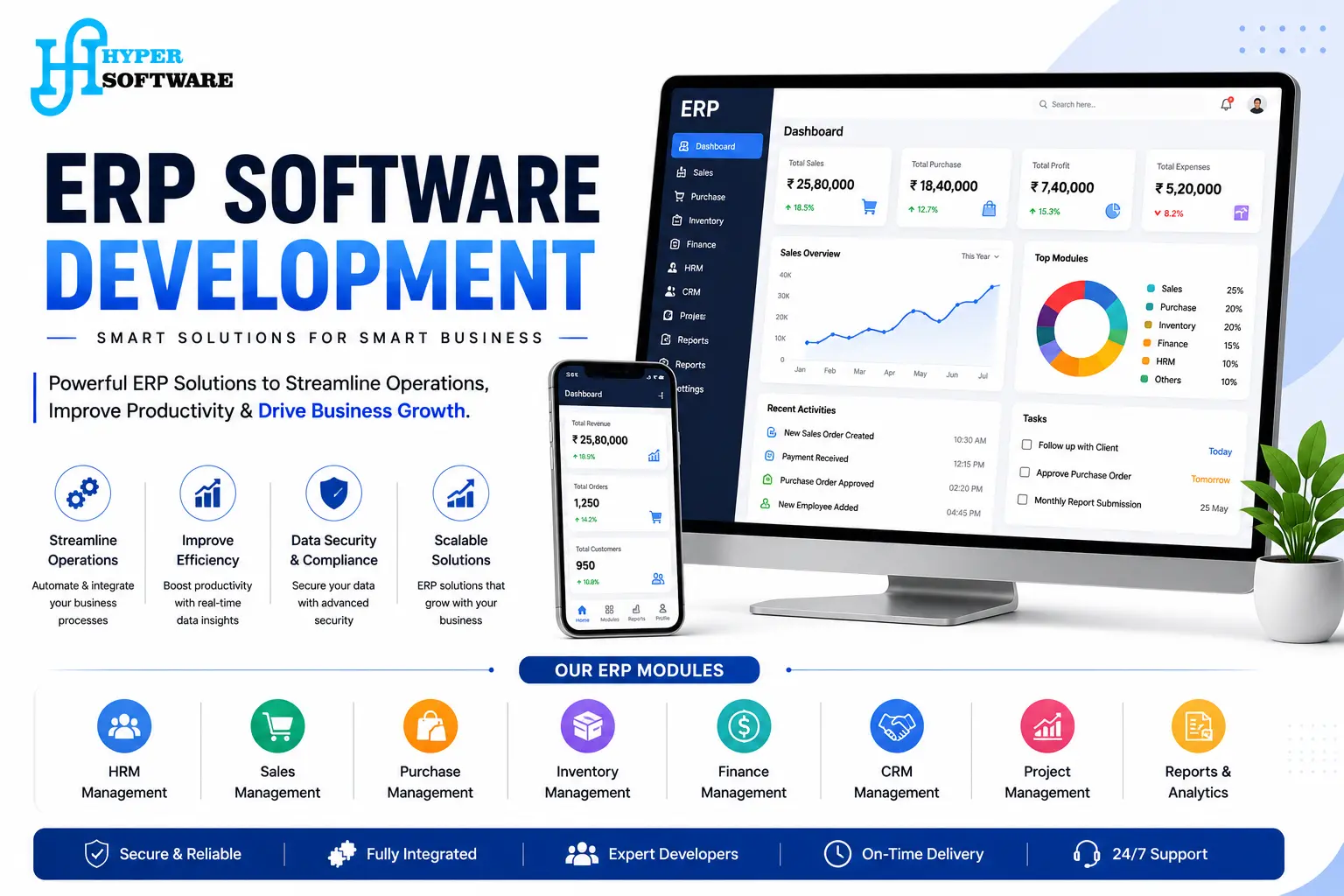
Running your business on five different tools that don't talk to each other? ERP software development is how you fix that — by building one system that connects your finance, inventory, HR, and sales data in real time. At Hyper Software, we design and build custom ERP systems for businesses that have outgrown spreadsheets and off-the-shelf software, whether you're a manufacturer in Jaipur or a distribution company across three countries.
This page covers exactly what ERP development involves, what it costs, how long it takes, and how to decide whether you need a custom build at all.
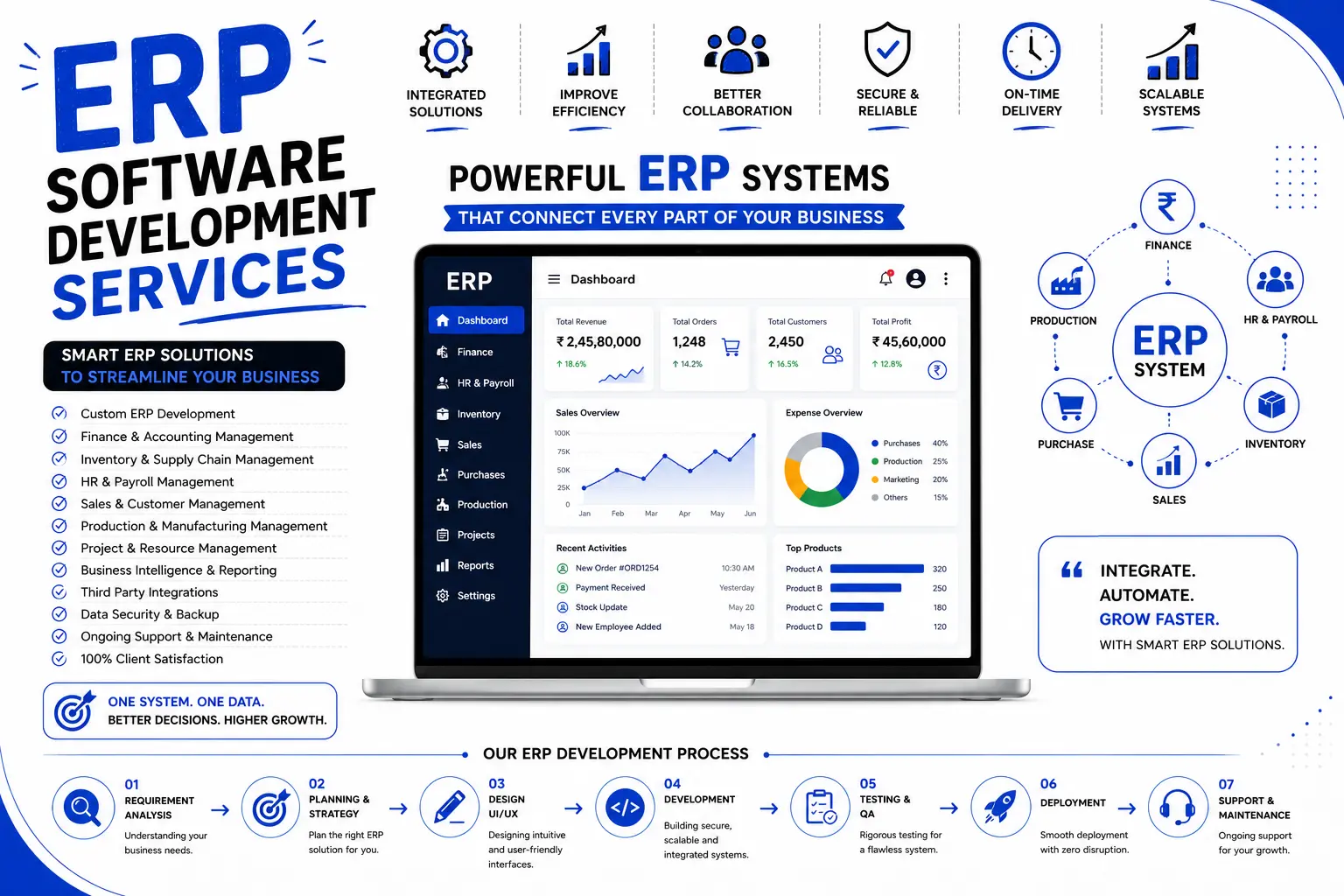
ERP software development is the process of designing, building, and deploying a system that brings your core business functions — finance, inventory, procurement, HR, sales, and production — into one connected platform. Instead of exporting data from one tool and re-entering it into another, everyone works off the same live numbers.
There are two broad paths. You can customize and extend an existing platform like Odoo, Microsoft Dynamics 365, or NetSuite. Or you can build a fully custom ERP from the ground up, tailored to workflows that no off-the-shelf product handles well. Both count as "ERP
software development" — the right one depends on how unusual your processes actually are.
Get Free Consultation Within Minutes
Most businesses don't wake up one day and decide they want an ERP. They get pushed into it. Here's what usually triggers the decision:
Data lives in too many places. Your accountant uses Tally, your warehouse team uses a spreadsheet, and your sales team uses a separate CRM. Nobody has the full picture.
Manual work is eating your margins. Someone is retyping the same invoice data into three systems every day.
Off-the-shelf software can't bend far enough. Your production process, your pricing rules, or your approval chain doesn't fit the standard template — and every workaround creates more manual effort, not less.
You're scaling and it's starting to show. What worked at 20 employees breaks down at 100. Reports take days instead of minutes. Stock counts don't match what's on the shelf.
A well-built ERP fixes this by giving every department one source of truth. Finance sees real inventory value. Sales sees real stock levels. Management sees real numbers, not a spreadsheet from three days ago.
This is the first real decision, and it's worth getting right before you spend a rupee on development.
| Factor | Off-the-Shelf ERP | Custom-Built ERP |
|---|---|---|
| Best for | Standard workflows, faster launch |
Unique processes, competitive differentiation |
| Upfront cost | Lower | Higher |
| Long-term flexibility | Limited — you adapt to the software | High — the software adapts to you |
| Launch time | Weeks to a few months | 3–9 months, sometimes longer |
| Ownership |
You license it; vendor controls the roadmap |
You own the code and the roadmap |
| Ongoing cost | Subscription fees, per-user pricing |
Maintenance and hosting, no per-user licensing |
A rough rule of thumb we use with clients: if your workflows need less than 25–30% customization to fit a platform like Odoo or Dynamics 365, go with a customized off-the-shelf platform. It's faster and cheaper. If you're past that threshold, or your process itself is part of what makes you competitive, a custom build earns its cost back over time.
Hyper Software ne hamare business ko online ek nayi pehchan di. Website professional, fast aur SEO optimized hai. Website Design & Development ke liye best company.

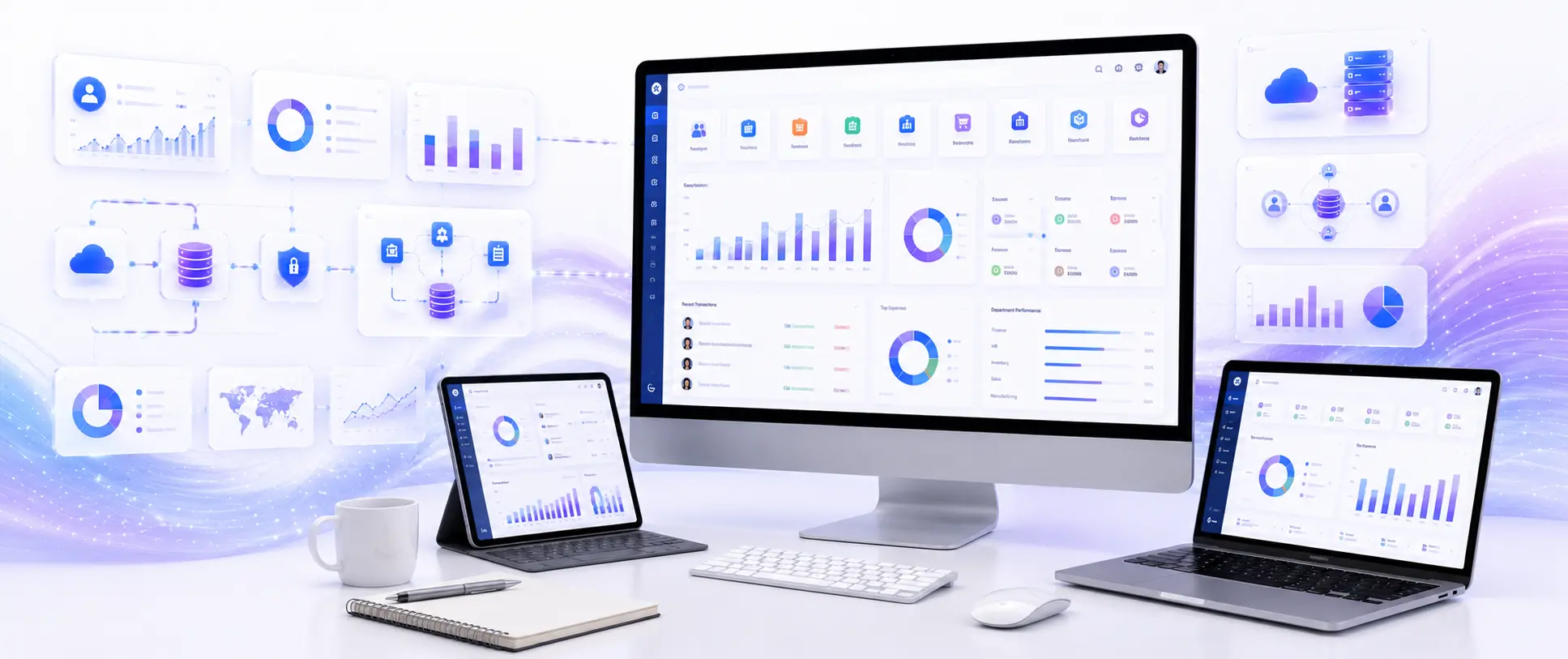
We build and support ERP systems module by module, so you can start with what matters most and expand later.
We also handle legacy system modernization — if you already have an old ERP or a heavily customized Tally/Excel setup, we can migrate you over without losing your historical data.
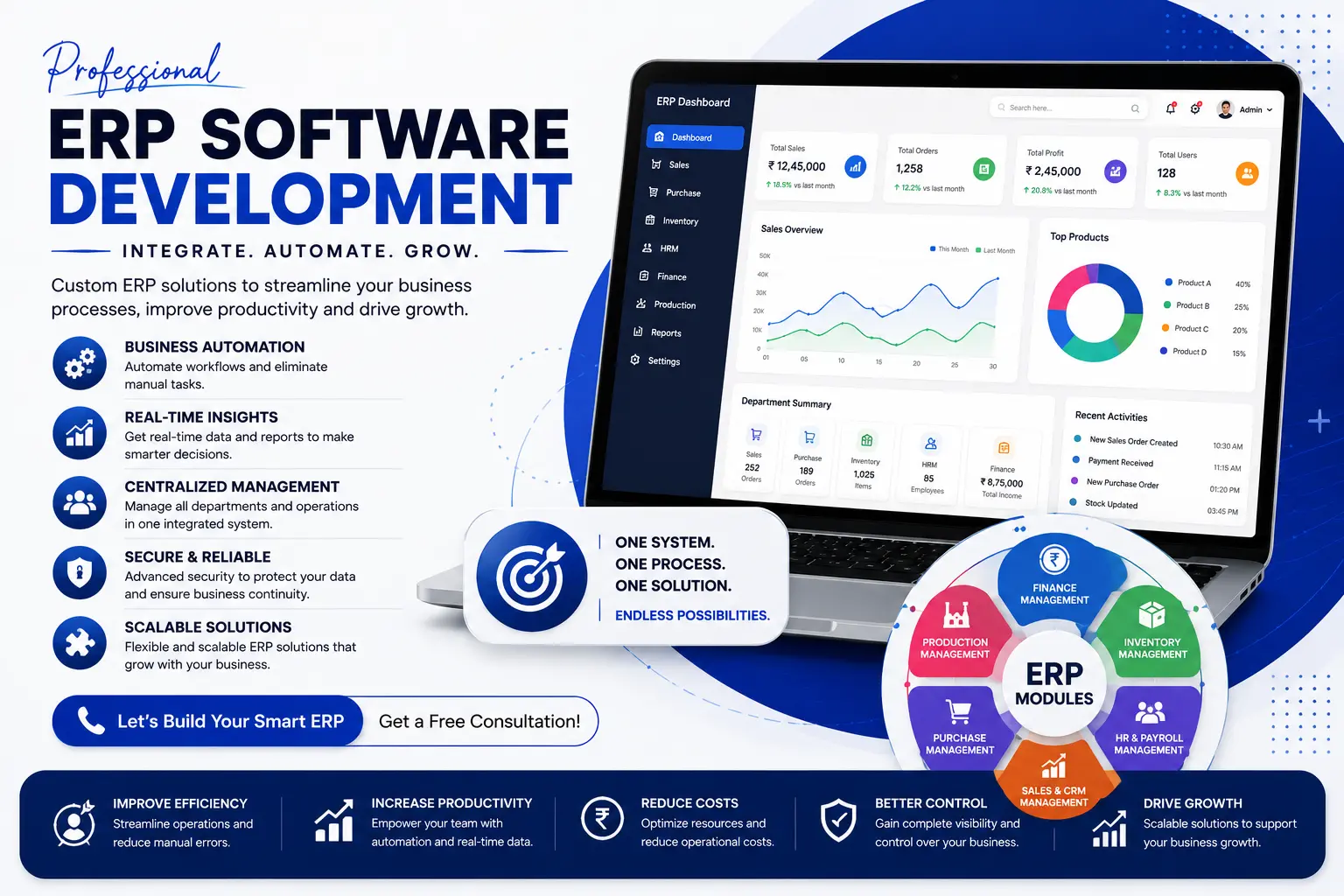
If your industry isn't listed here, that's fine — most ERP logic (finance, inventory, HR) transfers across sectors. We adapt the workflow, not just the interface.

Every ERP project we run follows the same structure. Skipping any of these steps is where most ERP projects go wrong.
1. Discovery & requirement mapping (1–4 weeks). We sit with your team — not just management, but the people who'll actually use the system daily — and document every workflow, pain point, and must-have feature. This becomes your requirements document.
2. System design & architecture (2–5 weeks). We design the data model, choose the tech stack, and build clickable prototypes so you can see the interface before a single line of production code is written.
3. Development in sprints (2–5 months). We build module by module in short cycles, so you see working software every 2–3 weeks instead of waiting until the very end.
4. Data migration. Your existing data — from Tally, Excel, or a legacy system — gets cleaned, mapped, and moved into the new system. This step is almost always underestimated, and we budget real time for it.
5. Testing & QA (2–6 weeks). Beyond our own testing, your team runs UserAcceptance Testing (UAT) using real scenarios from your business, not sample data.
6. Deployment & training. We go live either all at once or in phases, depending on how much risk your business can absorb, and we train your staff module by module.
7. Post-launch support. Bugs, tweaks, and small feature requests in the first few weeks are normal. We stay on to handle them, and offer ongoing maintenance plans after that.
Costs vary widely because "ERP" can mean a 3-module system for a 20-person trading company or a 12-module system for a 500-person manufacturer. Here's a realistic range based on current India market pricing:
| Business Size | Typical Scope | Estimated Cost (INR) |
|---|---|---|
| Small business / startup |
2–4 core modules (finance, inventory, basic reporting) |
₹3,00,000 – ₹15,00,000 |
| Mid-sized company | 5–8 modules, multi-user, integrations | ₹15,00,000 – ₹40,00,000 |
| Large / multi-location enterprise | Full suite, custom workflows, heavy integrations | ₹40,00,000 – ₹1,00,00,000+ |
1. Number and complexity of modules
2. Data migration from legacy systems (often underestimated)
3. Third-party integrations (payment gateways, existing CRM, government portals)
4. Number of users and role-based access requirements
5. Cloud hosting vs on-premise hosting
6. Ongoing maintenance and support (typically 15–20% of build cost annually) We don't quote a number until we understand your workflows — anyone who gives you a fixed price before a discovery call is guessing. Call +91 9079282750 for a scoped estimate based on your actual requirements.
Most ERP projects take 3 to 9 months, start to finish. Here's how that time typically breaks down:
Enterprise-scale projects with many locations or heavy compliance needs can stretch to 12–18 months. The fastest way to shorten this without cutting corners is to launch in phases — get finance and inventory live first, then add HR and manufacturing modules once the core system is stable.
We choose the stack based on your scale and existing systems, not a one-size-fits-all template. Typical components include:
Backend: Node.js, .NET, or Python (Django), depending on team size and integration needs
Frontend: React orAngular for responsive, role-based dashboards
Database: PostgreSQL or MySQL for structured business data; MongoDB where flexible document storage helps
Hosting: AWS, Azure, or Google Cloud for cloud deployments; on-site servers where required
Integrations: RESTAPIs for connecting to Tally, payment gateways, GST portals, and third-party CRM development
This question comes up in almost every first call, so let's be straight about it.
You already have a strong in-house engineering team with spare capacity
ERP is genuinely core to your competitive advantage and you want full internal control
You're comfortable with a longer timeline and the ongoing cost of retaining a dedicated team after launch
What usually goes wrong: in-house ERP builds stall because the team is pulled onto other priorities, nobody has actually built an ERP before so mistakes get repeated, and the "we'll finish it eventually" project quietly runs 2–3x over its original timeline.
You need it live within a realistic timeframe and don't have spare engineering capacity
You want a team that has already solved the data migration, integration, and rollout problems before
You'd rather pay for expertise once than build it from scratch internally
What it costs: development company pricing (as shown above) is often comparable to or less than a full year of in-house salaries for a team big enough to build the same system, and you're not left holding the team once the build is done.
There's no universally right answer — a 300-person manufacturer with an active dev team might build in-house successfully. A 40-person trading company almost never should.
We've seen these enough times to call them out directly:
Skipping proper discovery. Businesses that rush straight to development without mapping real workflows end up rebuilding modules mid-project. The four weeks you "save" upfront usually cost six weeks later.
Underestimating data migration. Years of inconsistent Excel data or a heavily customized Tally setup take real time to clean and map. Budget for this explicitly — it's not a footnote.
Trying to launch everything at once. A "big bang" launch across every department at once is high-risk. Phased rollout — finance and inventory first — gives your team room to adjust.
Ignoring user training. The best-built ERP fails if the warehouse team doesn't know how to use it. Training isn't optional, and it isn't a one-day event.
Over-customizing early. Adding every "nice to have" feature before launch delays the project and inflates cost. Ship the core, then extend based on real usage.
ERP software development is the process of designing and building a system that connects your finance, inventory, HR, sales, and production data into one platform. It can mean customizing an existing platform like Odoo or Dynamics 365, or building a fully custom system from scratch.
Costs typically range from ₹3,00,000 for a small business with a few core modules to ₹1,00,00,000+ for a large enterprise with a full module suite and heavy integrations. The exact cost depends on the number of modules, integrations, and users.
Most ERP projects take 3 to 9 months from discovery to deployment. Enterprise-scale projects with multiple locations can take 12 to 18 months.
If your workflows fit a standard platform with less than 25–30% customization, off-the-shelf ERP is usually faster and cheaper. If your processes are significantly different from the standard template, a custom build pays off over time.
Common modules are finance and accounting, inventory management, procurement, HR and payroll, sales and CRM, and production or manufacturing planning. Businesses typically start with 2–4 core modules and add more later.
Yes. ERP systems are commonly integrated with Tally, payment gateways, GST portals, and existing CRM platforms through APIs, so you don't have to abandon tools that already work.
Cloud ERP has a lower upfront cost, is accessible from anywhere, and scales more easily. On-premise ERP is preferred when data residency, offline access, or specific security requirements matter more than convenience.
Skipping proper discovery and underestimating data migration are the two most common reasons ERP projects run over budget or over timeline.
Yes, once a small business is managing inventory, accounts, and staff across multiple disconnected tools, even a lightweight ERP with 2–3 modules can save significant manual work.
CRM focuses on managing customer relationships, sales pipelines, and communication. ERP is broader — it connects finance, inventory, HR, and operations. Many businesses use both, integrated together.
A mid-sized packaging manufacturer near Jaipur came to us running three separate systems: Tally for accounts, an Excel sheet for raw material inventory that only one person understood, and a paper-based job card system on the production floor. Month-end closing took eight to ten days, and stock discrepancies were a monthly headache.
We started with a four-week discovery phase, mapping their actual production and dispatch workflow rather than assuming a generic manufacturing template would fit. We built a phased rollout: finance and inventory went live first, so the team could adjust without touching production. Job costing and shop-floor tracking followed six weeks later, once the core system was stable.
Within four months of go-live, month-end closing dropped from eight to ten days down to two. Stock discrepancies became rare instead of monthly. And for the first time, the owner could see real gross margin per product line instead of estimating it from three different spreadsheets.
One source of truth across finance, inventory, HR, and sales
Workflows built around how your business actually operates, not a generic template
Full ownership of the code — no forced upgrades or vendor lock-in
Scales module by module as your business grows
Higher upfront cost than off-the-shelf software
Longer initial timeline (months, not weeks)
Requires an experienced development partner — a poorly scoped build can drag on and cost more than planned
Ongoing maintenance is your responsibility (or your development partner's, under a support contract)
Hyper Software has been building custom software,custom web application, ERP systems, CRM platforms, and business automation tools since 2020, based in Jaipur, Rajasthan, and working with clients globally. A few things that shape how we work:
If you're evaluating whether custom ERP makes sense for your business, call +91 9079282750 or visit www.hypersoftware.in for a free requirement discussion. There's no pressure to commit on the first call — we'd rather scope it properly than sell you the wrong solution.
Post-launch, most businesses need a short adjustment period as real usage reveals edge cases. Ongoing support covers bug fixes, small feature requests, and performance monitoring, typically under a maintenance plan.
Yes. If your current system is outdated but your workflows are still valid, we can modernize the existing ERP — upgrading the tech stack, improving the interface, or adding new modules — instead of a full rebuild.
Manufacturing, trading and distribution, retail, healthcare, and logistics see the biggest impact, since these industries usually run complex, interdependent workflows that off-the-shelf tools handle poorly.
This depends entirely on the architecture. A well-built ERP can support anywhere from a handful of users to several hundred, with role-based access controlling what each person can see or edit.
Yes. We offer ongoing maintenance and support plans after deployment, covering updates, bug fixes, performance monitoring, and new feature additions as your business grows.
Have questions or need expert guidance? Our team is ready to help you with the right technology solutions for your business.