
Business website bilkul premium quality ki bani hai. Mobile responsive design aur clean layout ki wajah se customer experience bahut achha ho gaya. Highly recommended.

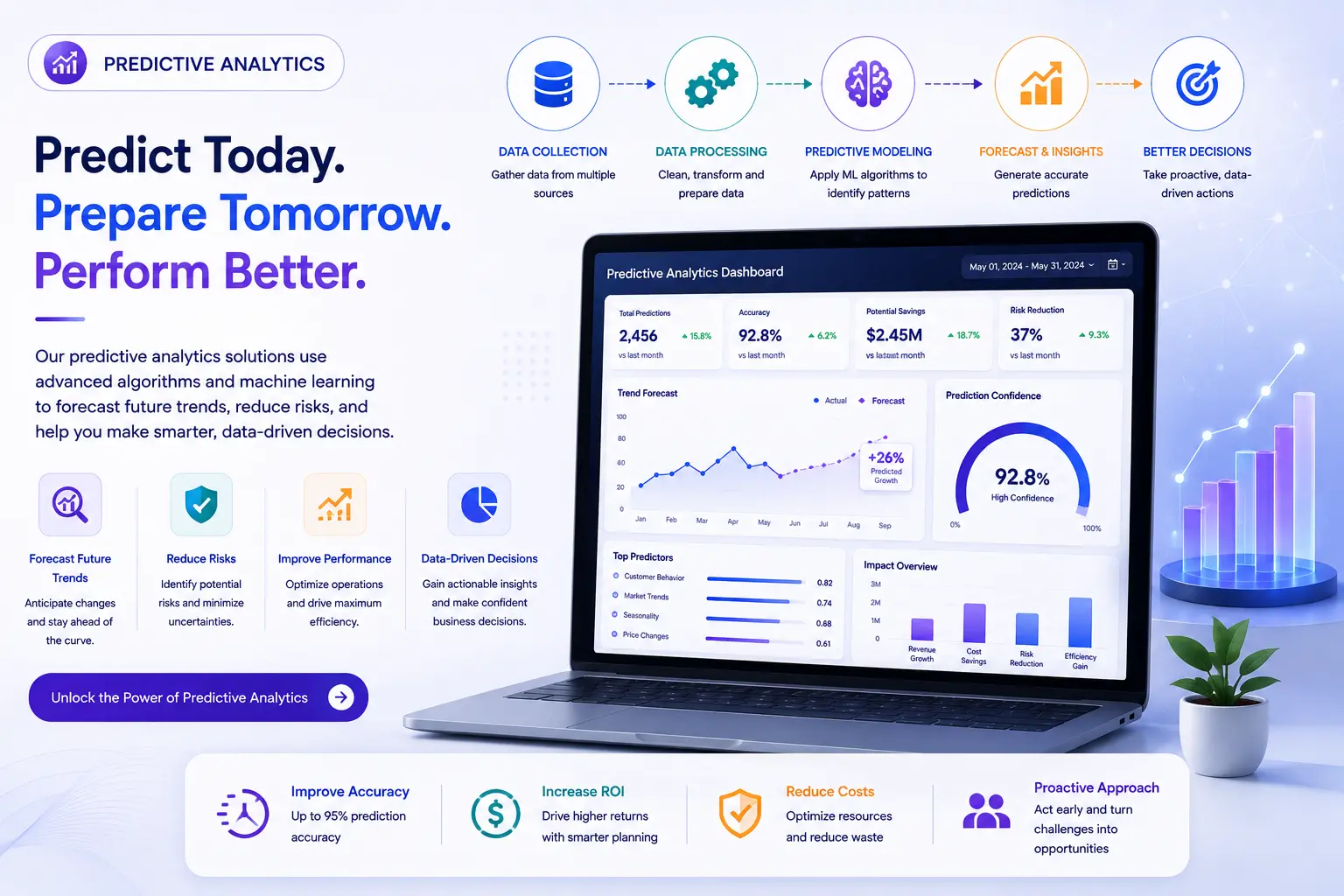
Predictive analytics is the practice of using your historical data, statistics, and machine learning to figure out what's likely to happen next in your business — before it happens. Instead of a report telling you what sold last quarter, a predictive model tells you which customers are about to leave, how much stock you'll need next month, or which machine is likely to break down first.
At Hyper Software, we build predictive analytics models that plug directly into the systemsyou already use — your CRM, your ERP, your website — so the forecast isn't sitting in a slide deck. It's driving an actual decision.If you've ever made a big call based on a gut feeling and later wished you'd had better data, this page is for you.
Predictive analytics uses historical and current data, combined with statistical algorithms and machine learning development, to estimate the probability of a future outcome. It doesn't guarantee what will happen. It tells you what's most likely to happen, based on patterns your business has already shown.
Think of it like a weather forecast. A meteorologist can't promise it will rain tomorrow, but they can tell you there's an 80% chance based on patterns in the data. Predictive analytics does the same thing for your business — churn, demand, risk, and maintenance, instead of clouds and rain.
Under the hood, this usually involves techniques like regression AI data analysis, decision trees, time-series forecasting, and neural networks, depending on what you're trying to predict
Get Free Consultation Within Minutes
Businesses often confuse these three, and it matters, because each one answers a different question.
|
Type |
Question It Answers |
Example |
|
Descriptive Analytics |
What happened? |
"We sold 2,000 units last quarter." |
|
Predictive Analytics |
What's likely to happen? |
"We'll probably sell 2,400 units next quarter." |
|
Prescriptive |
What should we do about |
"Increase stock by 20% and run a promotion in |
|
Analytics |
it? |
week 3." |
Most companies start with descriptive analytics because it's the easiest to build (that's your basic dashboard). Predictive analytics is the next step up, and prescriptive analytics — telling you the exact action to take — is the most advanced and resource-heavy of the three. You don't have to jump straight to prescriptive. Most of our clients get real value stopping at a solid predictive model.
Here's the honest version of what happens once you bring us in, not the marketing version.
1. Data audit. We look at what data you actually have — sales history, CRM development records, sensor logs, whatever's relevant — and check if it's clean enough to model. This step alone kills half the bad predictive analytics projects out there, and we'd rather tell you that on day one than three months in.
2. Use case definition. We pin down exactly what you want predicted. "Improve sales" is not a use case. "Predict which customers will cancel their subscription in the next 30 days" is.
3. Data preparation. Cleaning, merging, and structuring the data so a model can actually scikit-learn from it.
4. Model building. Our data scientists build and test statistical or machine learning models — regression, classification, time-series, or ensemble methods, depending on the use case.
5. Validation. We test the model against data it hasn't seen yet, so you're not trusting a forecast that only works on last year's numbers.
6. Deployment and monitoring. The model goes live inside your existing system, and we monitor its accuracy over time, because models drift as your business changes.
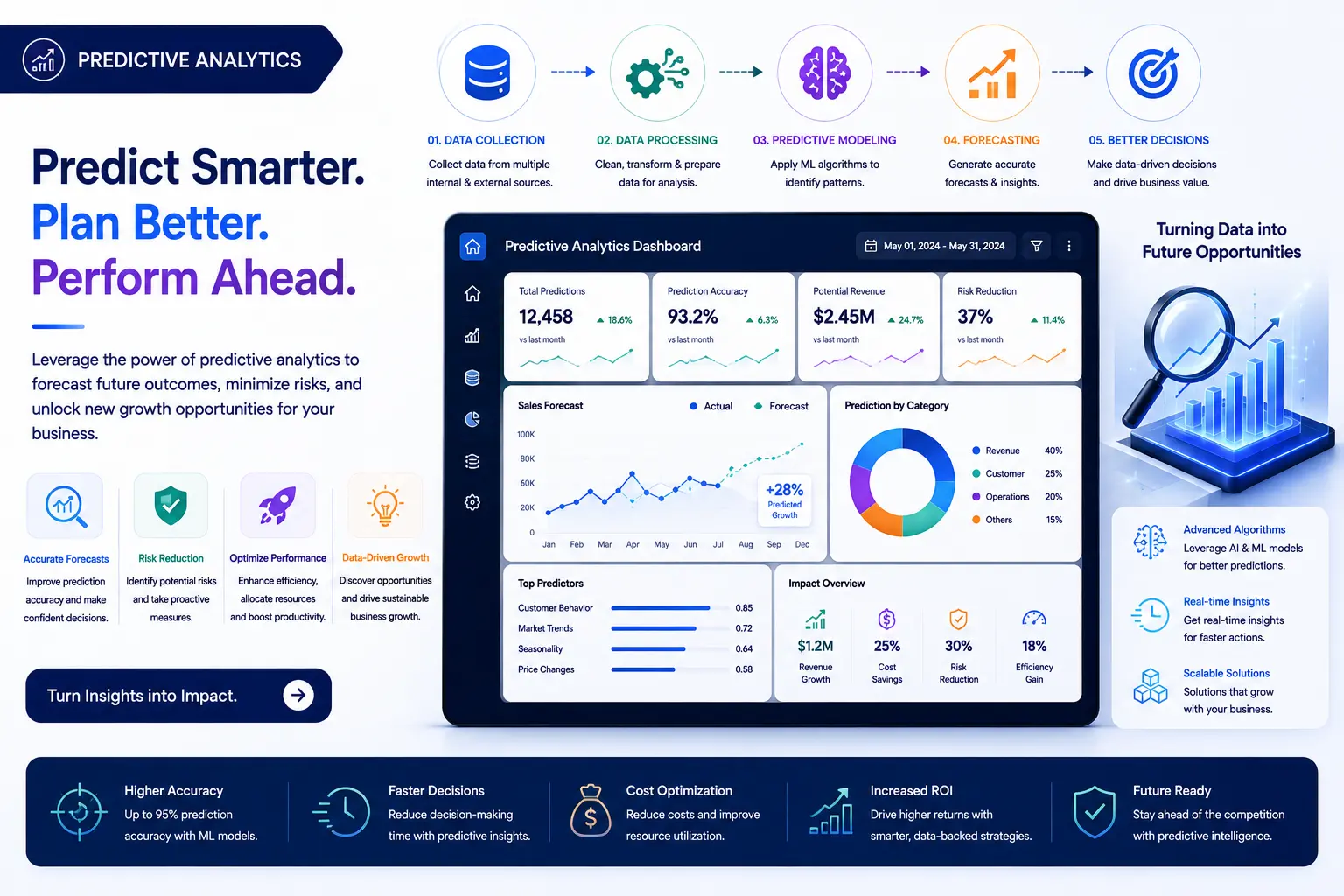
We pick the tool based on the use case, not the other way around:
A mid-size online fashion retailer came to us with a familiar problem: their marketing team was spending most of its budget trying to win back customers who had already left, instead of stopping them from leaving in the first place. They had two years of order history and CRM data sitting mostly unused.
We built a churn prediction model using their purchase frequency, browsing behavior, and support ticket history. Within six weeks, the model was flagging at-risk customers 30 days before they typically canceled. Their team used that window to send a targeted offer instead of a generic newsletter. Within the first full quarter of using the model, they cut customer churn by 18% and reallocated a chunk of their retention budget toward acquisition instead. The model still runs today, retrained quarterly as buying patterns shift.
Fewer surprises. You see problems — stock-outs, churn, equipment failure — before they hit, not after.
Better resource allocation. Spend budget and staff time where the data says it will matter, not where it feels urgent.
Faster, more confident decisions. Leadership stops debating opinions and starts debating a forecast with a confidence score attached.
Compounding advantage. Every quarter of new data makes the model sharper, so the advantage grows instead of fading
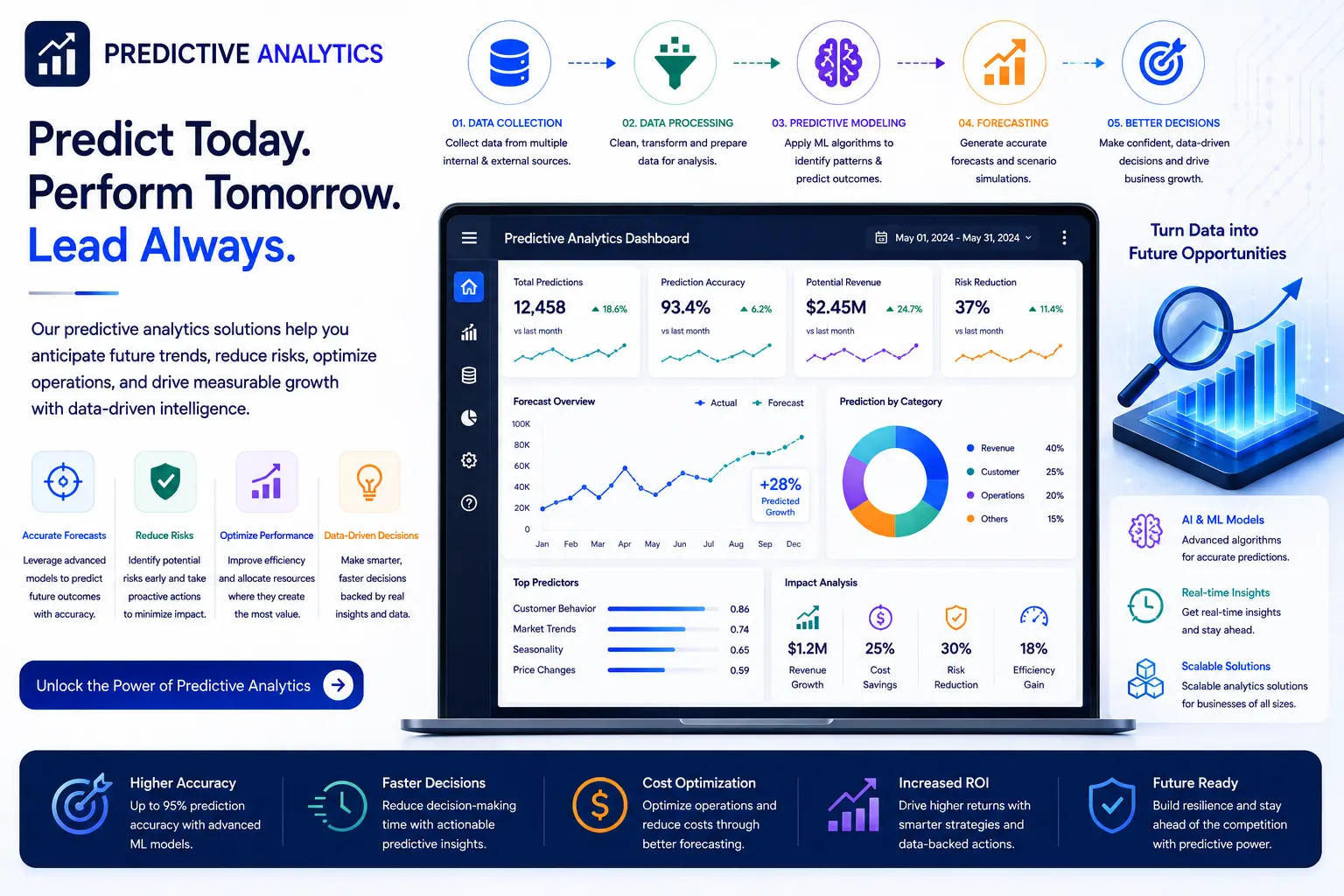
No one selling you predictive analytics should hide these:
|
Do It Yourself |
Hire an Agency |
|
|
When it |
You have an in-house data team and a narrow, |
You need production-grade |
|
makes sense |
well-defined use case |
forecasts feeding real business decisions |
|
Typical cost |
Lower upfront (tool subscriptions), but |
Higher upfront, but includes |
|
hidden cost in stafftime and trial-and-error |
strategy, data cleanup, and |
|
|
deployment |
||
|
Time to |
Slower — most in-house teams learn by |
Faster — an experienced team has |
|
value |
making mistakes first |
already made those mistakes |
|
elsewhere |
||
|
What can go |
Overfitting models that look great on paper |
Less common with an experienced |
|
wrong alone |
and fail in production; misreading correlation |
partner, but you're dependent on |
|
as causation; no plan for retraining |
their ongoing support |
If you already have a data science team and a simple, well-scoped question, no-code tools like Pecan AI solutions or ObviouslyAI can get you a working model quickly and cheaply. If the model needs to plug into real workflows and stay accurate over time, that's when an experienced partner earns its cost.
Predictive analytics is using your past data to make an educated guess about what's likely to happen next in your business, like future sales or customer behavior.
Business intelligence (BI) typically shows what already happened through dashboards and reports. Predictive analytics goes a step further and forecasts what's likely to happen next.
Retail, finance, healthcare, and manufacturing are the heaviest users, mainly for demand forecasting, credit risk, patient outcomes, and equipment maintenance.
A narrow pilot can take 4-8 weeks. A full enterprise rollout with integration and monitoring usually takes 3-6 months.
No, if you work with an outsourced partner like Hyper Software. You do need someone internally who understands the business context well enough to define the right use case.
It varies by use case, but as a rough rule, you want at least several hundred examples of the specific outcome you're predicting, plus 6-12 months of consistent historical data.
Yes, at the individual level for things like churn risk or next-purchase likelihood, though accuracy is always expressed as a probability, not a certainty.
Not necessarily. A focused pilot project using existing, clean data can be done affordably. Costs rise mainly with data cleanup needs and integration complexity, not company size.
Python and R are the most common, alongside SQL for data preparation and cloud platforms like Azure ML or AWS SageMaker for deployment.
Excel forecasting usually applies a simple trendline to past numbers. Predictive analytics uses statistical and machine learning models that factor in multiple variables at once, which is far more accurate for complex behavior like churn or fraud.
Be wary of anyone who quotes a fixed price before seeing your data. Realistically:
The real cost driver isn't the algorithm. It's how much data cleanup and integration work is needed before the model can even be trained. We give an honest estimate after a short data audit, not before.
Hyper Software has been building digital solutions for businesses since 2020, from custom software and mobile apps to CRM, ERP, and automation systems. That background matters for predictive analytics because a forecast is only useful once it's wired into a system your team actually uses every day — and that's exactly the kind of integration work we've done for years, not a side project we picked up recently.
We work with businesses across India and globally, and we scope every predictive analytics engagement around your actual data, not a one-size-fits-all package.
Yes. By flagging at-risk customers before they cancel, teams can intervene early with a targeted offer or support outreach instead of a generic win-back campaign after the fact.
Predictive maintenance uses sensor and equipment data to forecast when a machine is likely to fail, so repairs happen before a costly breakdown instead of after.
Most business models should be reviewed and retrained every few months, since customer behavior and market conditions shift over time and models can lose accuracy.
The biggest risk is acting on a model built from poor-quality or biased data, which can produce confident-sounding but wrong predictions.
Yes. Hyper Software works with clients globally and scopes every predictive analytics project around the client's specific data and business goals, regardless of location.
Have questions or need expert guidance? Our team is ready to help you with the right technology solutions for your business.