
Hyper Software ne hamare business ko online ek nayi pehchan di. Website professional, fast aur SEO optimized hai. Website Design & Development ke liye best company.

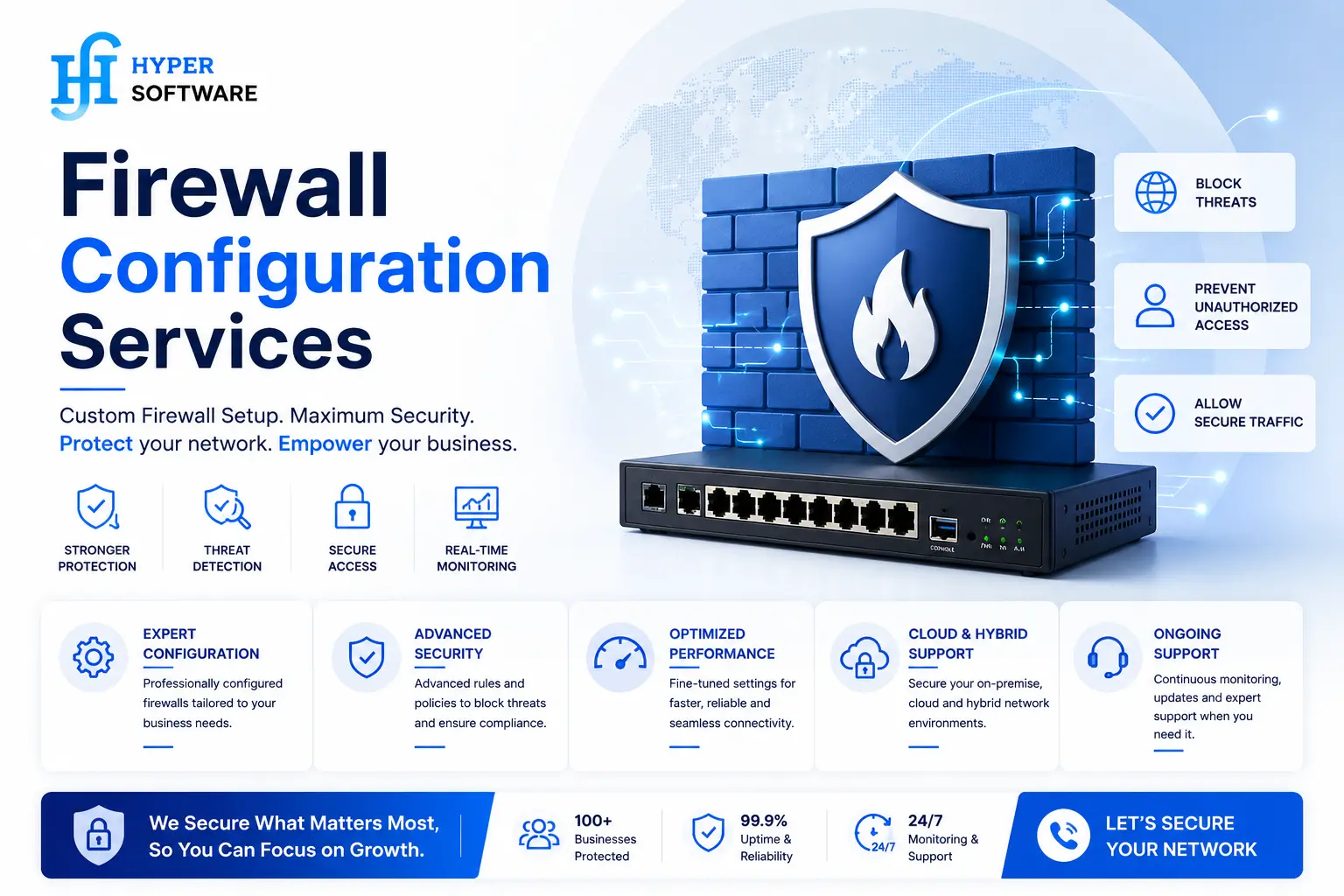
A firewall that's just plugged in isn't doing its job. Firewall configuration is the process osetting up your firewall's rules, zones, and logging so it lets in only the traffic your business actually needs and blocks the rest. Most network breaches trace back to a firewall that was never configured properly in the first place — not a weak product. Hyper Software configures, hardens, and tests firewalls for businesses in India and abroad, on whatever hardware or platform you already run.
If your firewall was set up once, years ago, and nobody's touched it since, it's probably not protecting you the way you think it is. Let's fix that.
Firewall configuration means defining the rules that decide what traffic gets through a firewall and what gets blocked. That includes setting up access control lists, opening only the ports you actually use, creating security zones, enabling logging, and testing everything before it goes live.
A firewall out of the box, running on default settings, isn't secure. It's just a device sitting between your network and the internet, waiting for someone to tell it what to do. Configuration is that instruction.
Think of it like a bouncer at a door. Installing the bouncer doesn't stop trouble — you also need to give them a list of who's allowed in, who isn't, and what to do when someone tries to sneak past. A firewall without proper rules is a bouncer standing there with no list.
Get Free Consultation Within Minutes
Here's the part most vendors don't tell you when they sell you the hardware: the box itself is rarely the problem. Misconfiguration is. Industry research consistently points the same way — a large share of successful network attacks happen because of overly permissive rules, forgotten "allow any-any" entries, or ports left open from an old project nobody remembered to close.
A few things a badly configured firewall can lead to:
None of this needs a sophisticated hacker. Most of it needs one lazy default password or one rule nobody reviewed.
Not every firewall works the same way, and the configuration approach changes depending on what you're working with.
| Firewall Type | How It Works | Best Suited For |
|---|---|---|
| Packet Filtering Firewall | Filters traffic based on IP address, port, and protocol for each packet without tracking previous connections. | Small businesses and basic networks with simple, predictable traffic. |
| Stateful Inspection Firewall | Monitors the state of active connections and allows only legitimate traffic based on connection history. | Most business networks requiring reliable and efficient security. |
| Proxy / Application-Level Gateway | Acts as an intermediary between users and the internet, inspecting application-layer traffic before forwarding requests. | Organizations requiring advanced content filtering, web security, and application control. |
| Next-Generation Firewall (NGFW) | Combines stateful inspection with deep packet inspection, intrusion prevention (IPS), malware removal protection, and application awareness. | Growing businesses, eCommerce platforms, financial institutions, and organizations handling sensitive data. |
| Cloudflare WAF / Virtual Firewall | Delivers firewall protection as a cloud-based service for AWS, Microsoft Azure, Google Cloud, and hybrid environments. | Businesses running cloud-native applications, remote teams, or hybrid cloud infrastructure. |
If you're not sure which one you have, or which one you need, that's usually the first question we answer on a call — no obligation, no upsell pressure.
We don't touch a single rule until we understand your network. Here's how a typical engagement runs:
We also set up scheduled reviews after that, because a firewall that was correct on day one can drift out of date within months if nobody's watching it.
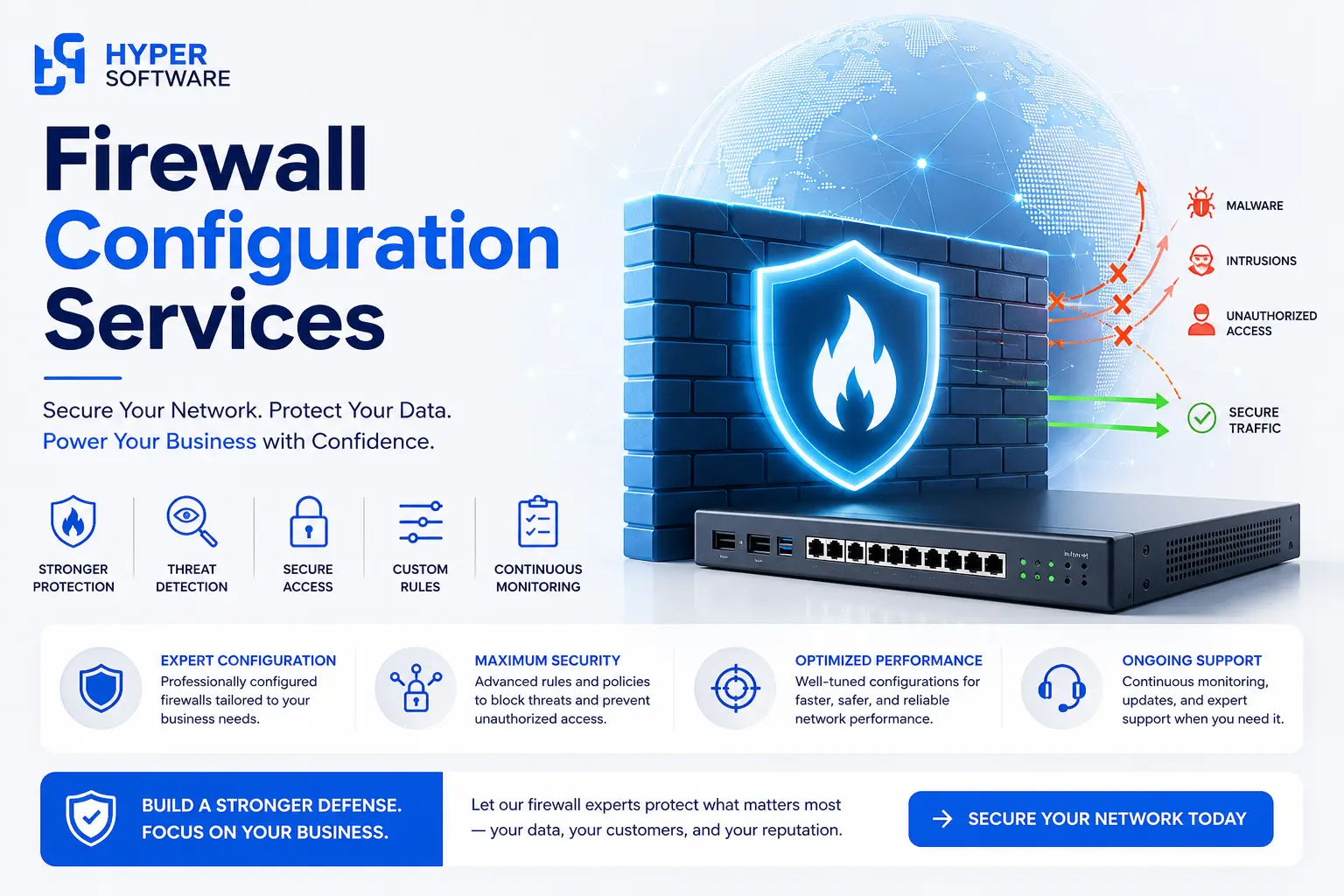
Hyper Software ne hamare business ko online ek nayi pehchan di. Website professional, fast aur SEO optimized hai. Website Design & Development ke liye best company.

Can you configure a firewall yourself? If your setup is genuinely simple, sure. Should you, if your business has customer data, remote staff, or any compliance requirement? Usually not, and here's the honest breakdown.
| Factor | Doing It Yourself | Hiring Hyper Software |
|---|---|---|
| Time Required | Several hours to several days depending on your technical knowledge and environment. | Typically completed within 1–3 business days with minimal disruption to your operations. |
| Risk of a Missed Rule | High, especially without networking or cybersecurity expertise. | Low—every firewall rule is reviewed, tested, and validated by security professionals. |
| Upfront Cost | No service fee, but requires your own time and effort. | Fixed project pricing with a transparent quote after the initial assessment. |
| Cost if Something Goes Wrong | Potential security breach, business downtime, data loss, or regulatory penalties. | Minimized through professional testing, documentation, and best-practice implementation. |
| Ongoing Maintenance | Completely your responsibility, including updates and rule management. | Available as an optional managed service with continuous monitoring and support. |
| Best For | Home offices, freelancers, and very small businesses with simple network requirements. | Businesses of all sizes handling employees, customer data, financial information, or compliance requirements. |
If you're a solo founder with one laptop and a home router, you probably don't need us. If you've got a team, a website that takes payments, or remote employees connecting in, the cost of getting this wrong is a lot higher than the cost of getting it done properly the first time.
Whether you hire us or attempt this in-house, this is the order that actually works:
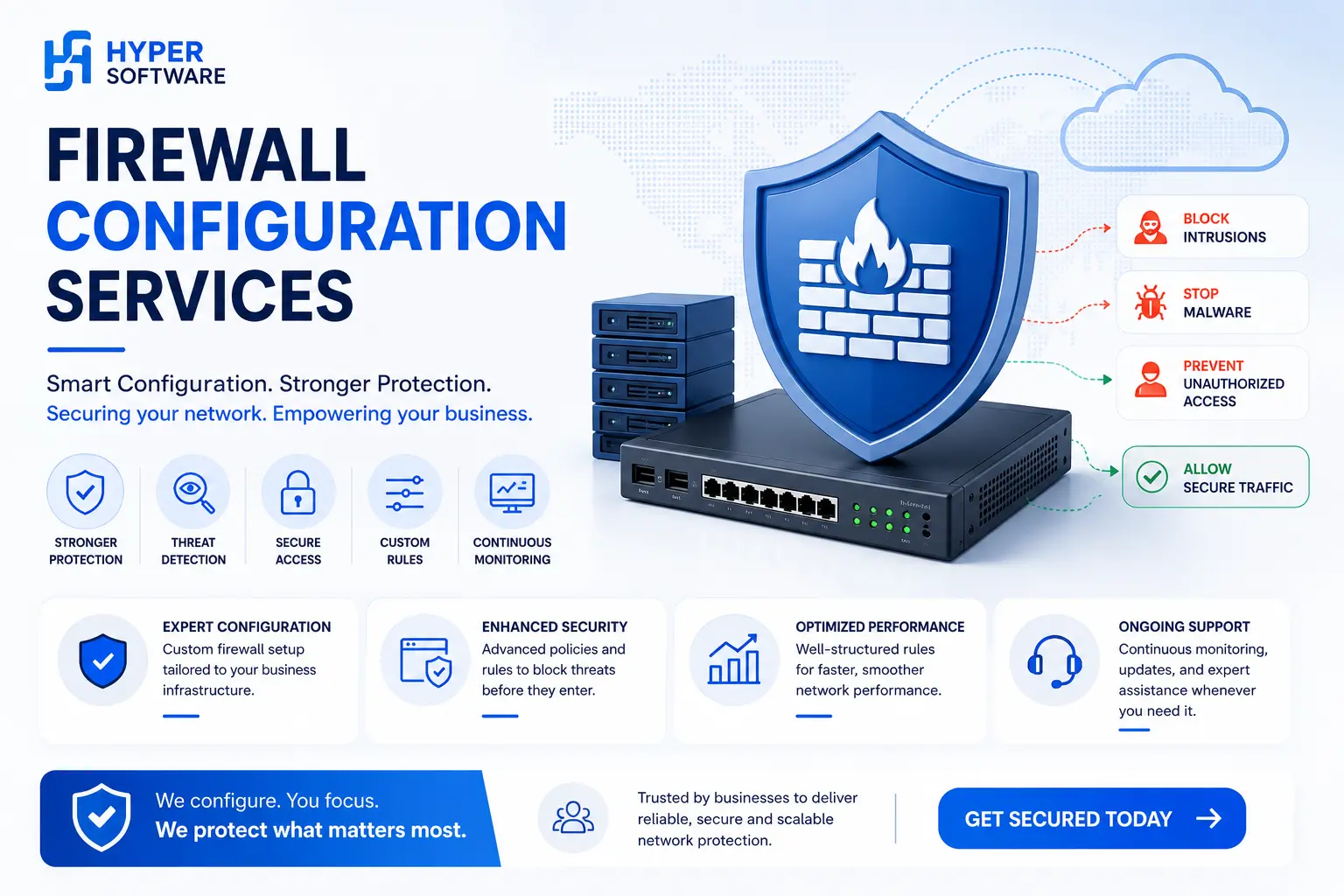
We've audited enough client networks to see the same mistakes come up again and again:
Firewall configuration pricing depends on your setup, not a flat number anyone can honestly quote without knowing your network. That said, here's what generally drives the cost:
As a rough starting point, small business setups typically run in the lower range, while multi-location or compliance-heavy setups cost more. We quote a fixed price after a short assessment call, not before — anyone who quotes you blind, without seeing your network, is guessing.
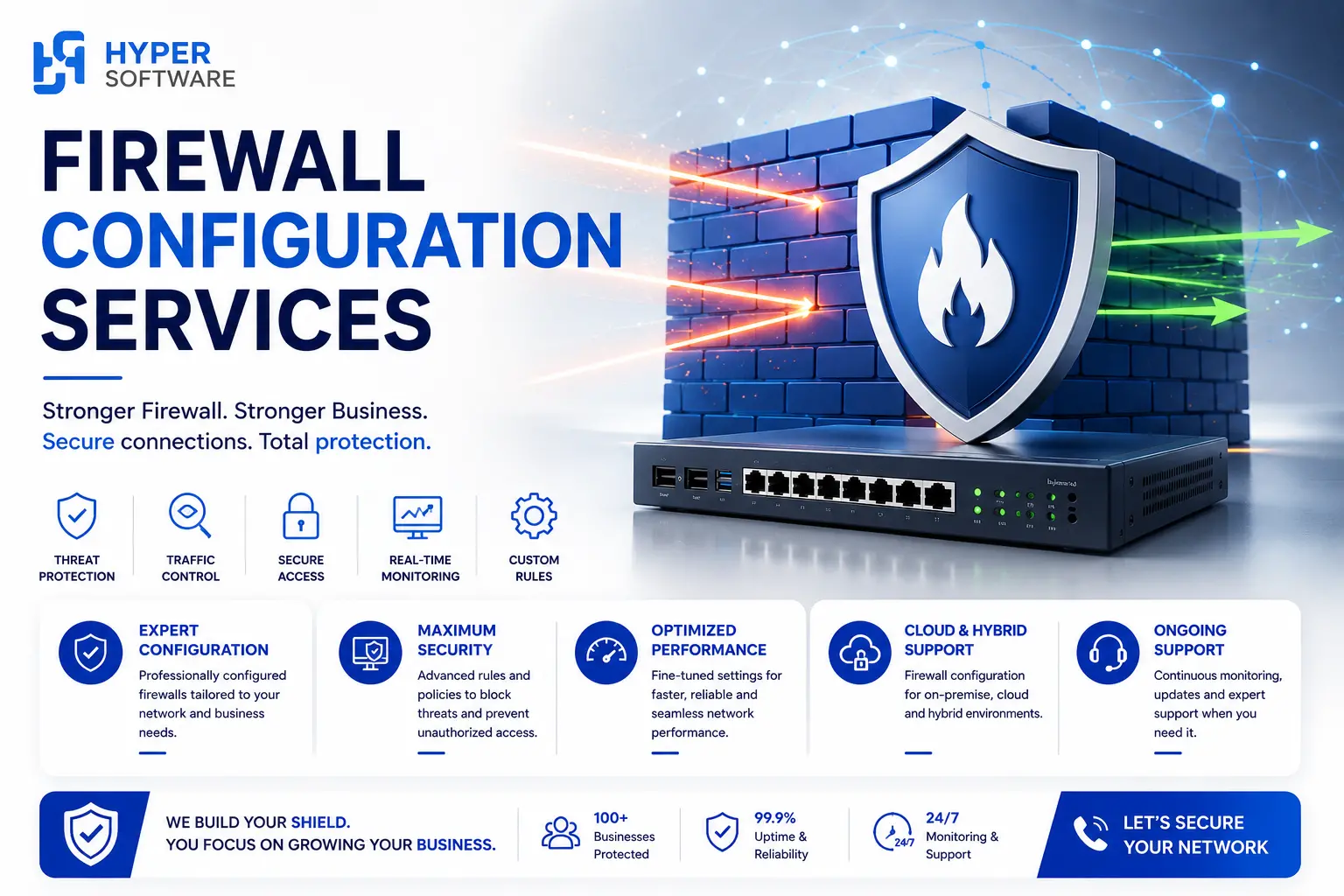
Most single-location firewall configurations are completed within 1 to 3 business days once we've done the assessment call. Multi-branch or compliance-heavy setups can take 1 to 2 weeks, mostly because of the extra documentation and testing involved, not the technical work itself. We schedule the actual cutover outside business hours wherever possible, so your team doesn't lose a working day to it
We work with clients across retail, eCommerce, healthcare, finance, education, and SaaS. Depending on your industry, that might mean:
If you're not sure which of these applies to you, that's a normal question to ask us on the first call. Most business owners aren't security monitoring specialists, and they shouldn't have to be.
Yes. We configure firewalls remotely for clients across India and internationally, and offer on-site support for businesses based in Jaipur and nearby.
We work across major vendors including FortiGate, SonicWall, Sophos, Palo Alto, pfSense, and cloud-native firewalls on AWS, Azure, and GCP.
It means the firewall blocks all traffic by default, and you only open the specific ports and connections your business actually needs. It's the safer starting point compared to allowing everything and blocking exceptions.
At least every six months, or sooner if your network changes significantly, such as adding new staff, systems, or remote locations.
No. Networks change, staff change, and new services get added. A firewall configured correctly a year ago can drift out of date without regular review.
It can leave ports open to unauthorized access, let ransomware or malware through, fail compliance checks like PCI DSS, and give you no logging to investigate an incident after it happens.
If the business handles customer data, takes online payments, or has remote staff connecting in, yes. The cost of a breach is almost always higher than the cost of getting the setup done properly.
Typically: rule design, zone setup, VPN configuration, logging setup, testing, and documentation. At Hyper Software, it also includes a written report explaining every rule.
Yes. Proper access control, logging, and rule documentation are core requirements under PCI DSS and similar standards, and are built into our configuration process.
Yes, as an optional add- on. Many clients choose an initial one-time configuration, then move to scheduled reviews once they see how quickly rules can drift without oversight.
A Jaipur-based logistics company came to us after a routine IT check flagged something odd: an "allow all" rule sitting on their firewall, wide open, left over from a vendor's remote- support session eight months earlier. Nobody had noticed. Nobody had closed it.
We ran a full audit, rebuilt their rule set from a default-deny baseline, segmented their finance systems away from general staff traffic, and turned on logging that had never been active. The whole process took four days, including testing. Six months later, during a routine review, we caught and blocked a scanning attempt from an unfamiliar IP within minutes, something that would have gone completely unnoticed under their old setup. That's the difference between having a firewall and having a firewall that's actually configured.
Hyper Software has been building technology for businesses since 2020, out of Jaipur, Rajasthan, and working with clients well beyond it. We're not a firewall-only shop that disappears once the invoice is paid — we already build websites, custom software, CRM and ERP systems, and automation tools for our clients, so we understand how your network actually gets used day to day, not just how it looks on paper.
It means setting the rules that control what traffic your firewall allows in and out, including ports, zones, and logging, rather than just installing the hardware and leaving it on default settings.
Most single-location setups take 1 to 3 business days once the assessment is done. Larger, multi-branch, or compliance-heavy
It depends on the number of devices, locations, firewall type, and whether it's a fresh setup or a cleanup of an existing one. We quote a fixed price after a short assessment call rather than guessing blind.
For a very small, single-device setup, yes. For any business with staff, customer data, or compliance needs, one missed rule can leave a real gap, so professional configuration is worth the cost.
The firewall is the hardware or software. Configuration is the set of rules that tells it what to actually do. A firewall with no configuration offers close to no real protection.
Have questions or need expert guidance? Our team is ready to help you with the right technology solutions for your business.