

The Complete Guide to Website Development for Beginners

In the current digital era, website building has become crucial for both individuals and businesses. Understanding fundamental concepts like domain names, web hosting, and website design is essential if you're a novice who wants to create a website. Hosting is where your website's data is kept, while a domain is the address of your website.
The two main parts of creating a website are the front end and the back end. HTML, CSS, and JavaScript are used in the front-end design and layout of the website. The back-end manages server-side and database operations using PHP, Python, and other computer languages.
Practice and cautious planning are essential for beginners. Start with a simple static website and work your way up to more complex features and dynamic webpages. By continuously studying, you can become a successful web developer.
Web Development Trends in 2026
To remain at the top of the industry, it is essential to monitor the latest trends, such as:
- Progressive Web Apps (PWA) – Blending web and mobile applications.
- Serverless Computing – Cloud services such as AWS Lambda.
- AI-Powered Development – Incorporating AI and machine learning into web applications.
- Headless CMS – Content management systems that are decoupled.
- Cybersecurity Focus – Best practices for securing web applications.
Web Development Technologies and Programming Languages
Developers use different technologies and programming languages to create websites. These tools transform a simple idea into a fully functional website.
1. HTML (Hypertext Markup Language)
HTML is the basic building block of any website. It builds the structure of a webpage. It tells the browser what a header is, what a paragraph is, where an image should go, and how links should work. HTML is only the basic framework of a webpage.
2. CSS (Cascading Style Sheets)
A website can have a polished and appealing appearance by using CSS. Colours, fonts, layout, spacing, mobile responsiveness, and animations are all under its control. If the structure is represented by HTML, the presentation and design are represented by CSS.
3. JavaScript (JS)
JavaScript gives a website dynamic features. JavaScript makes it easy to move a slider, validate a form after it is submitted, open a pop-up when a button is clicked, and change content without reloading. It adds interactivity to a static webpage.
4 Backend Technologies
For a website to function properly, back-end development is just as important as front-end development.
5 Server-Side Programming Languages
The backend uses languages like PHP, Python, Java, Ruby, and Node.js for data processing and logic. These languages handle user input and produce accurate results.
6 Database
Databases are used to manage and store website data. MySQL, PostgreSQL, and MongoDB are popular databases. These databases securely hold user information, orders, merchandise, and content.
Get Free Consultation Within Minutes
Popular Post

Android Training: Complete Guide to Learning Android App Developmentin 2026
Web Design and Development Course in Jaipur
What Is SEO? The Complete 2026 Guide to Search Engine Optimization
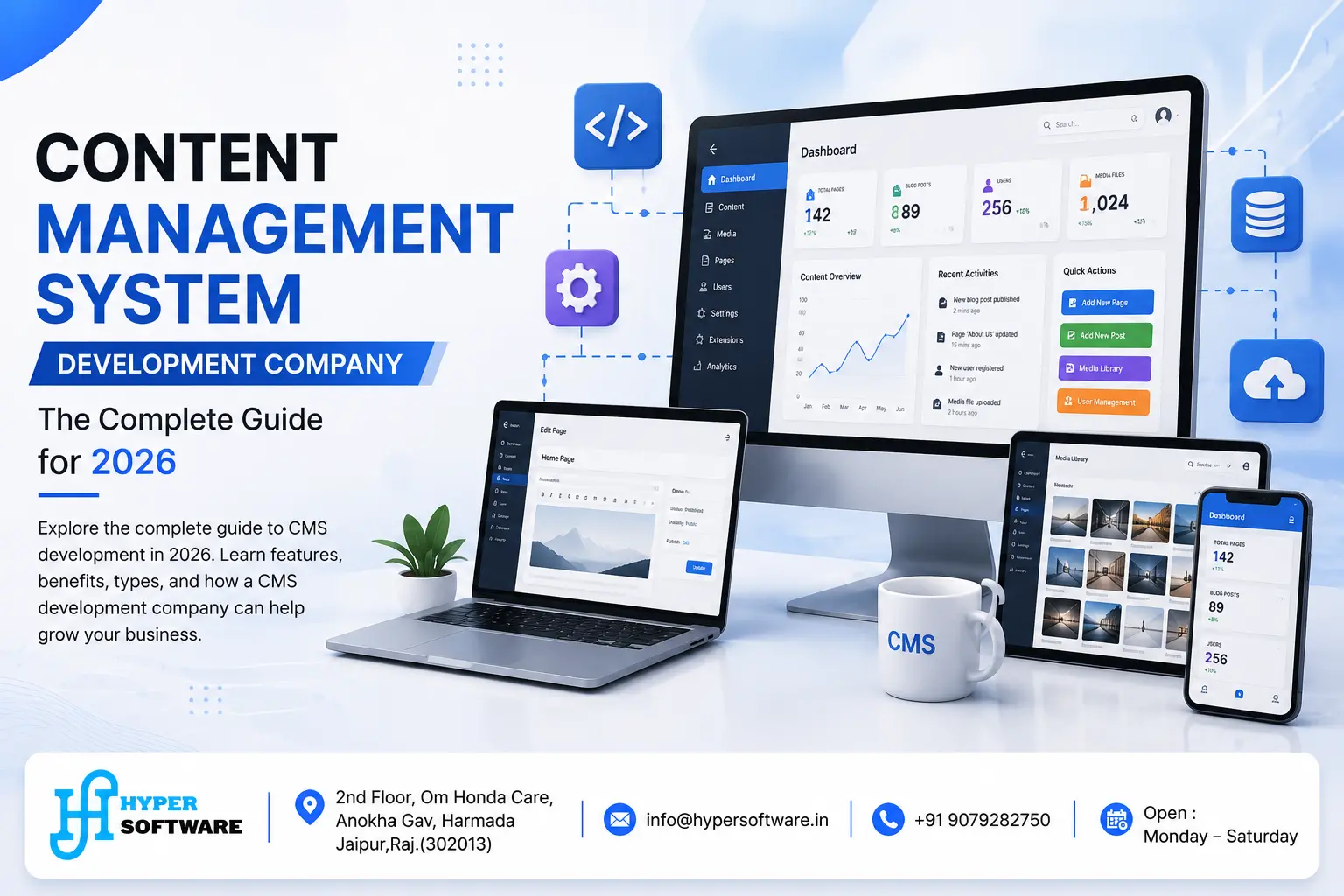
Content Management System Development Company: The Complete Guide for 2026

Domain Hosting: The Complete Guide to Choosing, Buying and Managing It (2026)