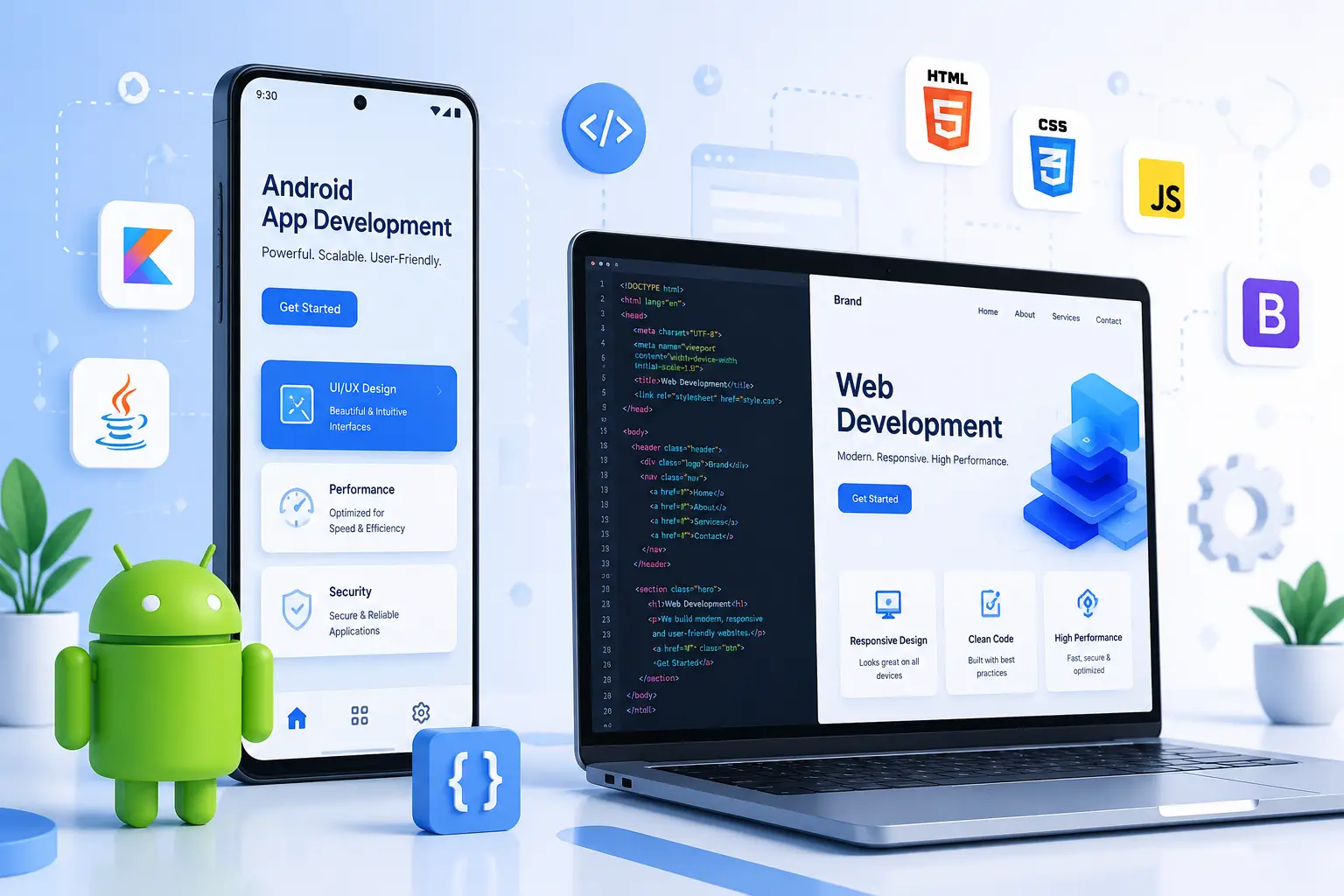
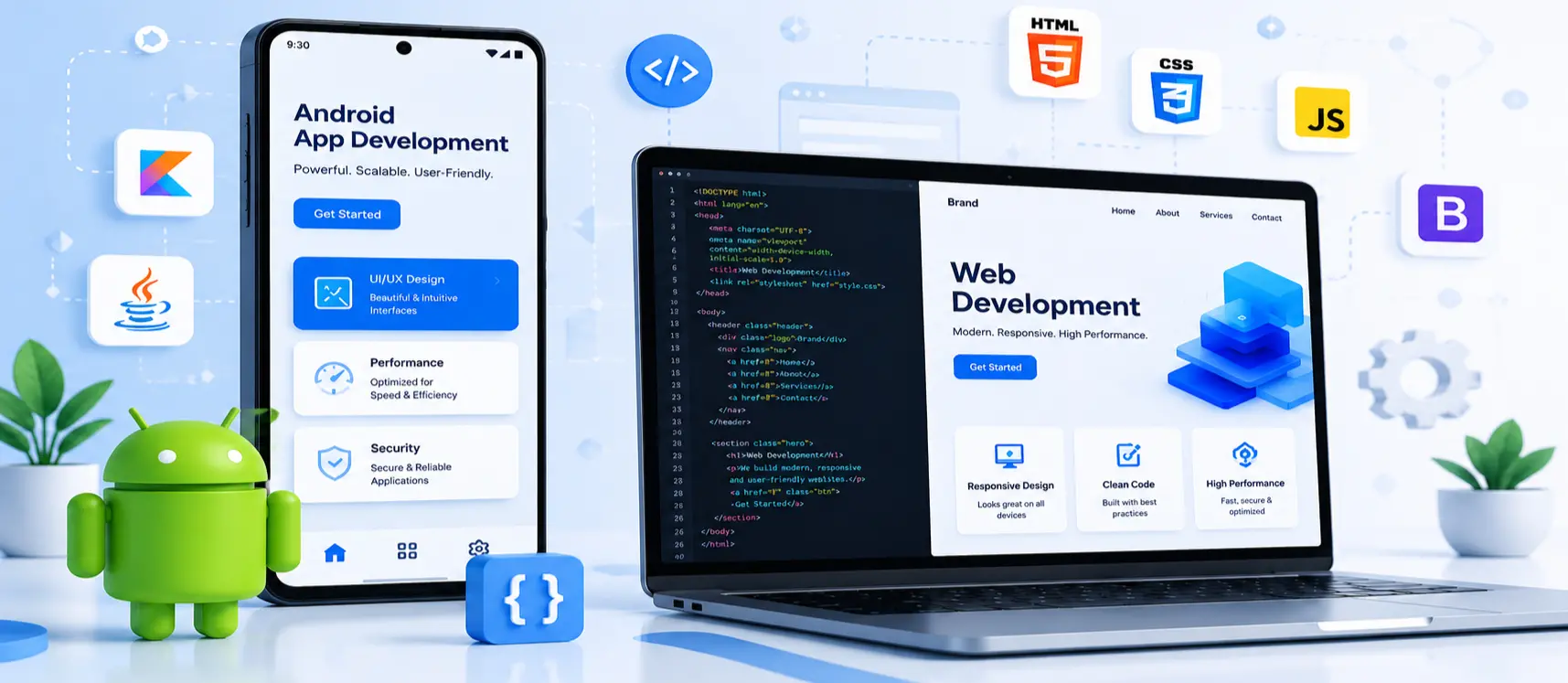
Why Your Business Needs a Connected Android App and Website
Android now runs on roughly 70% of smartphones worldwide, and India is one of its largest markets. If your customers are searching for you on their phone — and most of them are — an app-only or website-only presence leaves money on the table.
Here's what a properly connected Android app and website gets you:
- One source of truth. Orders, inventory, user accounts, and content update everywhere at once.
- Lower long-term cost. One backend team maintains both platforms instead of two separate ones.
- Better user experience. Customers can start a task on the website and finish it in the app, or the other way around.
- Faster feature rollouts. A new feature built once on the backend can be exposed on both the app and the site.
- Stronger SEO plus app visibility. Your website ranks on Google, and your app ranks on the Play Store — both feeding the same business.
OurAndroid App Web Development Services
We handle the full build, not just one piece of it.
Native Android App Development Built in Kotlin for maximum speed, smooth animations, and full access to Android hardware features like NFC, biometrics, and camera APIs. Best when performance and long-term scalability matter more than a tight launch budget.
Cross-Platform App Development (Flutter / React Native) One codebase that runs on both Android and iOS, cutting development cost by roughly 30–40% compared to building two native apps. A practical choice for most startups and small businesses that need to launch on both platforms without doubling the budget.
Connected Website Development Responsive, fast-loading websites built to share the same backend and APIs as yourAndroid app — not bolted on as an afterthought.
Backend & API Development Secure REST or GraphQL APIs that serve your app, your website, and any future platform (smart TV, wearable, admin panel) from one system.
UI/UX Design Wireframes and interfaces designed around Google's Material Design guidelines, so the app feels native to Android users while matching your brand.
Play Store Publishing & App Store Optimization (ASO) We handle the Google Play Console setup, developer account, listing copy, screenshots, and the review process — including revisions if Google asks for changes.
Post-Launch Maintenance OS compatibility updates, bug fixes, new features, and security patches after launch. Android ships major OS updates yearly, and apps that don't get maintained eventually break or get flagged in the Play Store.
OurAndroid App Web Development Process
- Discovery & Scoping. We sit down with you (call or in person if you're in Jaipur) and turn your idea into a written scope: features, platforms, timeline, and budget. No development starts until this is signed off, so there are no surprise costs later.
- Wireframes & UI/UX Design. We map out every screen before writing a line of code, so you can review the flow and request changes while it's still cheap to change.
- Backend & API Development. We build the database and APIs first — this is the shared foundation for both the app and the website.
- App & Website Development. OurAndroid and web teams build in parallel against the same APIs, so both platforms stay in sync from day one instead of being reconciled later.
- QA & Device Testing. Android runs on thousands of device models. We test across common Samsung, Xiaomi, Realme, and Vivo devices, not just a single flagship phone.
- Play Store Submission. We handle the listing, content rating, data safety form, and any resubmission Google requests.
- Launch & Support. We stay on after launch for bug fixes, monitoring, and the first round of user feedback.
A working MVP typically takes 8–12 weeks from signed scope to Play Store submission, depending on feature complexity.
Android App Development Cost in India (2026)
This is the question every client asks first, and the honest answer is: it depends on complexity. Below is a realistic 2026 market range — these figures are estimates for planning purposes and should be confirmed against Hyper Software's current rate card for your specific project.
| App Complexity |
What's Included |
Typical Cost Range (INR) |
Typical Timeline |
| Simple / MVP |
5–10 screens, basic UI, single backend, Play Store listing |
₹1,50,000 – ₹4,00,000 |
4–8 weeks |
| Moderate |
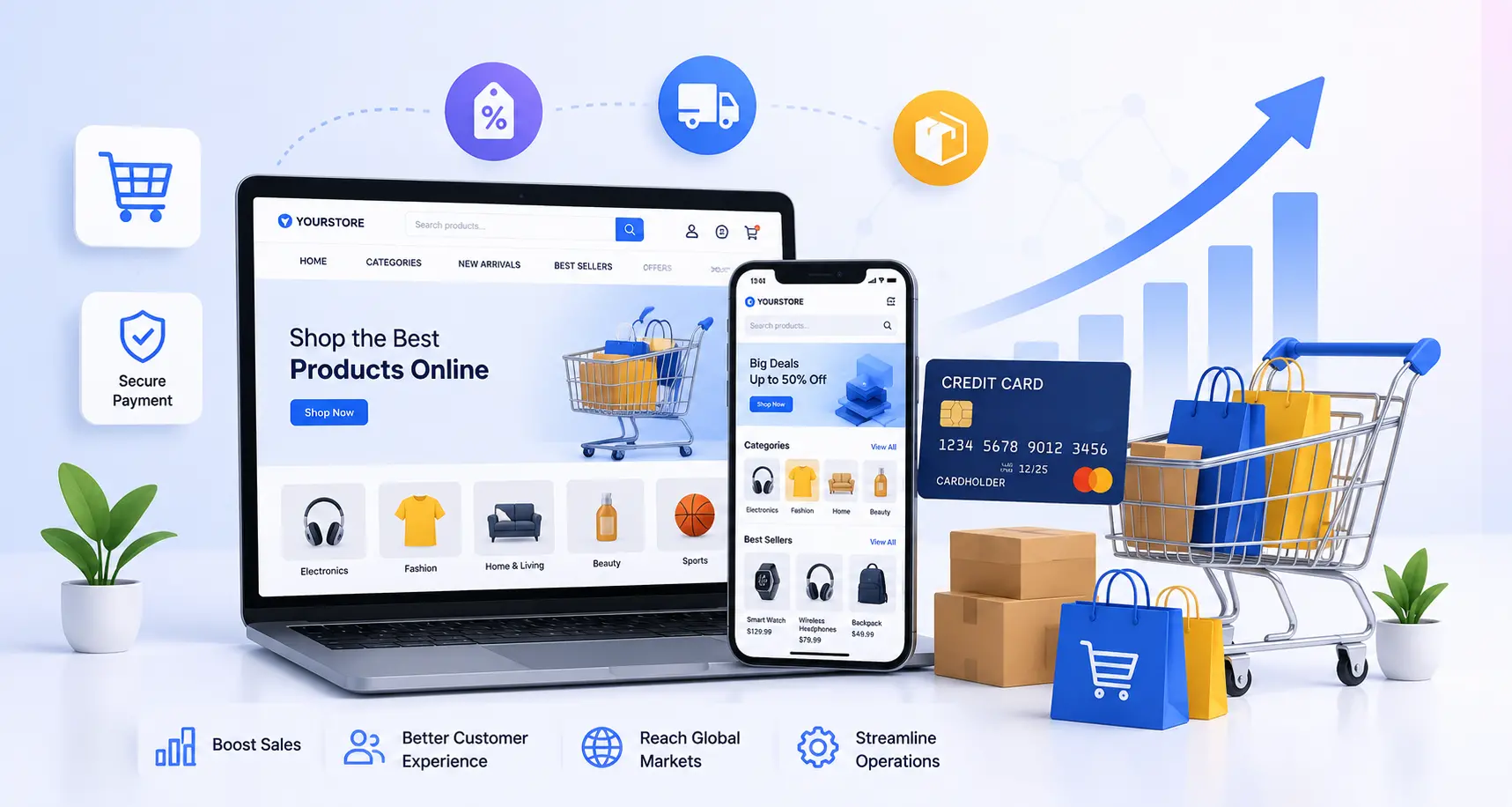
E-commerce, booking, or social features, payment integration, admin panel |
₹4,00,000 – ₹10,00,000 |
8–14 weeks |
| Complex / Enterprise |
Real-time tracking, AI features, third-party integrations, multi-language support |
₹10,00,000+ |
14+ weeks |
Common cost add-ons to plan for:
- Payment gateway integration (UPI, cards, wallets): ₹60,000 – ₹2,50,000 (market estimate)
- Annual maintenance: roughly 15–25% of the original build cost per year
- Cloud hosting and infrastructure: varies by user load — check current provider pricing
Cross-platform development (Flutter) is generally 30–40% cheaper than building separate native Android and iOS apps, because most of the code is shared between both.
DIY vs Hiring an Android App Web Development Agency
| Factor |
Doing It Yourself / No-Code Tools |
Hiring an Agency (Hyper Software) |
| Best for |
Very simple, single-feature apps |
Real businesses that need it to work correctly and scale |
| Upfront cost |
Lower or free |
Higher, but fixed and predictable |
| Time investment |
High — you're the project manager and the debugger |
Low — the team owns delivery |
| Security & data handling |
Often overlooked until something breaks |
Built in from the start |
| Play Store approval |
You handle rejections and resubmissions alone |
We manage the entire submission process |
| Long-term maintenance |
Falls entirely on you |
Ongoing support included |
| What usually goes wrong |
Apps that work in testing but crash on real devices; abandoned projects when the founder gets busy |
Rare, because the process includes device testing and a defined scope
|
If you're validating a very simple idea with almost no budget, a no-code tool can get you a rough prototype. The moment your app needs to handle real user data, payments, or scale past a handful of users, that approach runs out of road fast — and rebuilding from scratch later almost always costs more than building it properly the first time.
Native Android (Kotlin) vs Flutter vs React Native — Which Should You Choose?
| Factor |
Native Android (Kotlin) |
Flutter |
React Native |
| Performance |
Best — direct access to Android hardware |
Near-native, very close in practice |
Good, slightly behind Flutter for heavy animation |
| Cost (Android + iOS) |
Highest — two separate codebases needed |
30–40% cheaper — one shared codebase |
30–40% cheaper — one shared codebase |
| Best for |
Apps needing deep hardware access (NFC, Wear OS, biometrics) |
Startups needing both Android & iOS quickly with a consistent UI |
Teams with an existing JavaScript/React ecosystem |
| Developer Availability (India) |
High |
High and growing rapidly |
Highest — largest talent pool |
| Our Recommendation |
Best if you're building an Android-only app with advanced hardware integration |
Recommended for most cross-platform business apps due to speed, cost, and UI consistency |
Best if your team already has React/JavaScript expertise or an existing React web application |
How We Helped: A Real Client Example
A retail client in Jaipur came to us with a website that was doing fine, but customers kept asking for an app. Their earlier attempt — a freelancer-built app — had stalled for four months with no clear delivery date, and it used a completely separate database from their website.
We started by scrapping the disconnected backend and rebuilding one shared API layer for both the website and the newAndroid app. That meant product updates, stock levels, and order status stayed identical across both platforms instead of drifting out of sync. We built the Android app in Flutter to keep the door open for an iOS version later, added UPI payment integration, and ran it through device testing on the budget Android phones that made up most of their actual customer base — not just flagship devices.
The app went live on the Play Store nine weeks after the scope was signed off. Order volume through the app crossed website orders within the first two months, mainly because repeat customers found it faster to reorder from the app than to log into the website again.
Common Mistakes Businesses Make With Android App Web Development
- Building the app and website separately, with separate teams and separate databases. This is the single most expensive mistake we see — it usually costs more to merge two disconnected systems later than it would have cost to build them together from the start.
- Skipping device testing beyond one flagship phone. An app that runs perfectly on a Samsung flagship can lag or crash on a budget device, and in India, budget devices are most of your user base.
- Choosing the cheapest quote without asking what's excluded. Backend development, Play Store fees, and payment integration are commonly left out of low headline quotes, then added back in as "extras."
- No maintenance plan after launch. Android ships OS updates yearly. An app that isn't maintained eventually breaks or gets flagged during a Play Store policy review.
- Underestimating Play Store review time. Budget at least 1–7 days for review, longer if your app touches payments or personal data, since Google frequently asks for revisions on the first submission.
Why Choose Hyper Software forAndroid App Web Development
- Jaipur-based, globally delivered. Our team works from Rajasthan and serves clients across India, the US, UK, and UAE on the same working hours advantage that made India a preferred outsourcing destination in the first place.
- One team for app and website. You're not managing two vendors or two invoices — one team owns the whole system.
- Founded in 2020, with a track record across websites, custom software, mobile apps, CRM/ERP, and e-commerce for clients across industries.
- Fixed-scope pricing. You get a written scope and cost before development starts, not an open-ended hourly clock.
- Support that continues after launch. We don't disappear once the app hits the Play Store.
Have an idea you want to talk through? Call us at +91 9079282750 or visit hypersoftware.in for a free project estimate.